


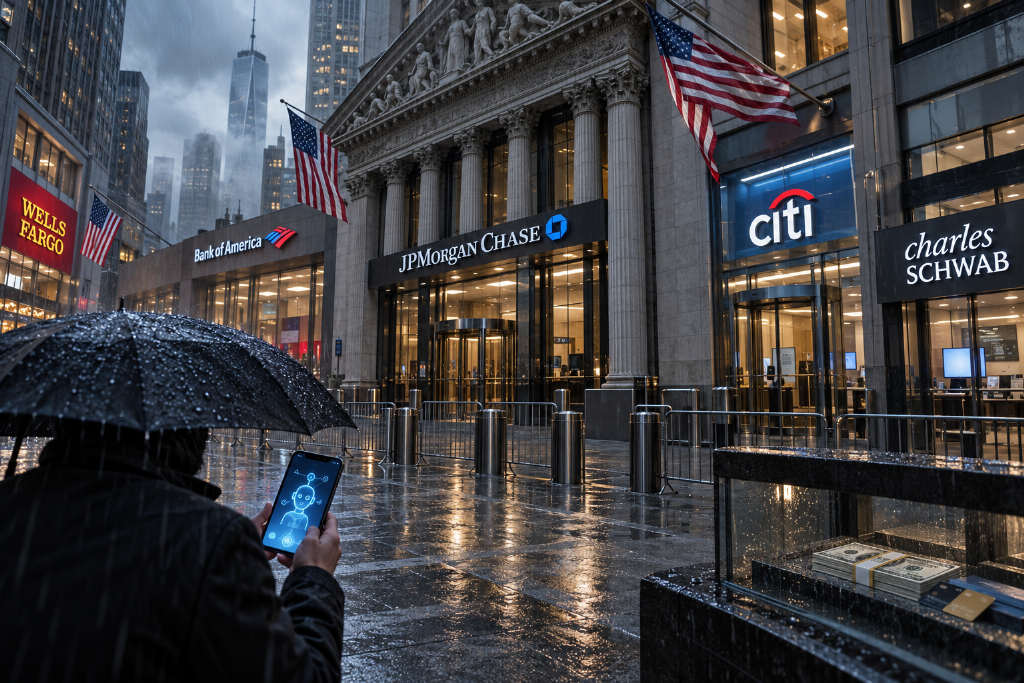
Jim Bianco, president of Bianco Research, said banks that block outside AI agents from customer accounts are protecting their own revenue more than their customers.
Speaking on Unchained’s Bits + Bips livestream on Oct. 26, Bianco framed the issue bluntly: 「Are you protecting me, or are you protecting your own profits?」
Banks tighten access for third-party AI agents
Bianco pointed to JPMorgan Chase as an example, saying the bank does not allow third-party AI agents to sign in to Chase accounts or act on customers’ behalf inside those accounts.
JPMorgan CEO Jamie Dimon explained the policy to analysts on Oct. 13. He warned about rogue agents and said JPMorgan was not going to allow just any outside agent to come inside the company because that would be too risky for clients and for JPMorgan.
A spokesperson told Fortune that 「protecting our customers is our top priority」 and added that the bank supports secure, customer-authorized data sharing through open banking providers.
The report said Citi, Bank of America and Wells Fargo have also taken steps to limit third-party agents. Charles Schwab CEO Rick Wurster has likewise said the brokerage is shutting out third-party agents that try to move funds in customer accounts.
Wells Fargo’s revised online access agreement takes effect on Nov. 24. Under that language, transactions initiated by an AI agent authorized by a customer are treated as the customer’s own transactions, and the customer remains responsible for unintended actions by that agent until the bank is told that access has been revoked.
Bianco says the business model depends on friction
Bianco argued that traditional finance is built around customer inertia. In his view, most customers do not want to log in every day and move idle cash into a money market fund, while an AI agent could do that automatically.
That matters because banks can invest deposits that pay customers nothing. 「Now that you’re able to do it, the banks are afraid they’re gonna lose that revenue stream,」 he said.
Bianco put the amount of money sitting in zero-yielding bank accounts at $4 trillion.
According to the Federal Deposit Insurance Corporation’s Quarterly Banking Profile, noninterest-bearing deposits in the domestic offices of U.S. banks totaled about $4.04 trillion at the end of June, roughly 21% of domestic deposits. That category includes business operating accounts, not just household savings.
FDIC BankFind data showed that JPMorgan Chase Bank held $628.8 billion of those deposits, equal to about 28% of its domestic deposits.
Bianco made the same argument about credit cards. He said issuers want cardholders to keep paying annual fees without fully using the value of their points, while some users have already turned to AI agents to maximize rewards.
Customers may still push for access
Bianco said he expects customers to demand this kind of access anyway, noting that people already trade privacy for convenience online.
「I think the public is gonna start demanding more and more of this,」 he said.
Ram Ahluwalia, founder and CEO of Lumida Wealth Management and a co-host of the show, agreed with Bianco on motive. 「They’re protecting themselves,」 he said on the stream, adding that the agents in question are acting as fiduciaries of the customer.
Ahluwalia also cautioned against overstating the risk of agent-driven deposit flight. Frictions still exist, he said, including the need to open a new bank account.