
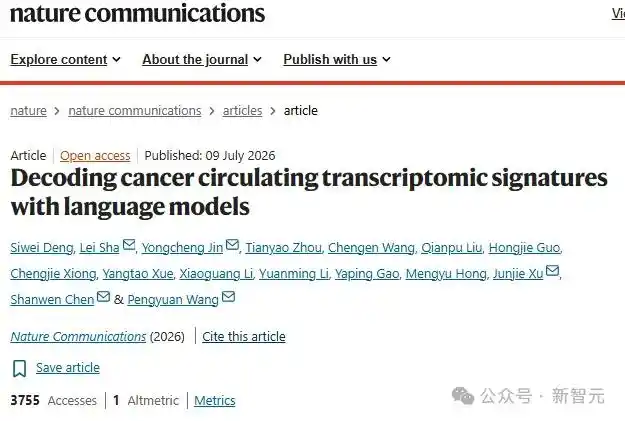
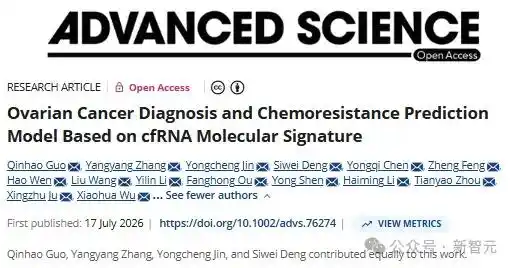
Jindu Biosciences has introduced GeneLLM, a life sciences-focused multi-omics foundation model that the company says recently appeared in two international journals, Nature Communications and Advanced Science. Founded by four Oxford-trained returnees, the startup is positioning the system as a major domestic step in China’s life science model stack, with a design built around learning directly from raw omics data instead of starting from human-curated annotations and labels.
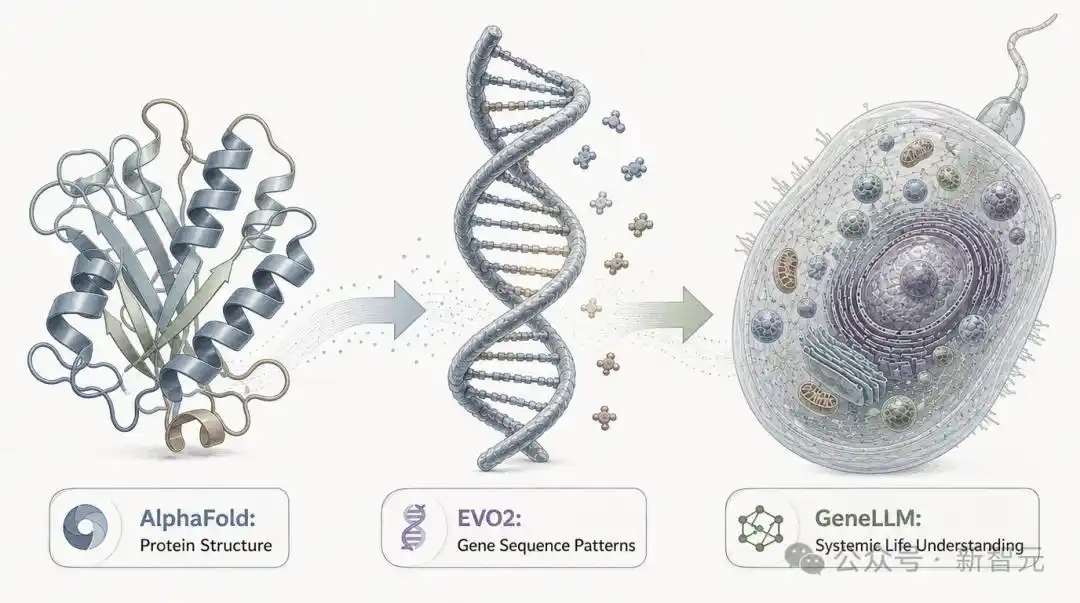
In the company’s framing, GeneLLM is the first multi-omics large model to pretrain directly on raw omics inputs. The article places it alongside Google’s AlphaFold and Stanford University’s EVO 2, arguing that GeneLLM aims not only to read biological structure or code, but to model biological systems at a broader level.
Predicting biological information the way language models predict tokens
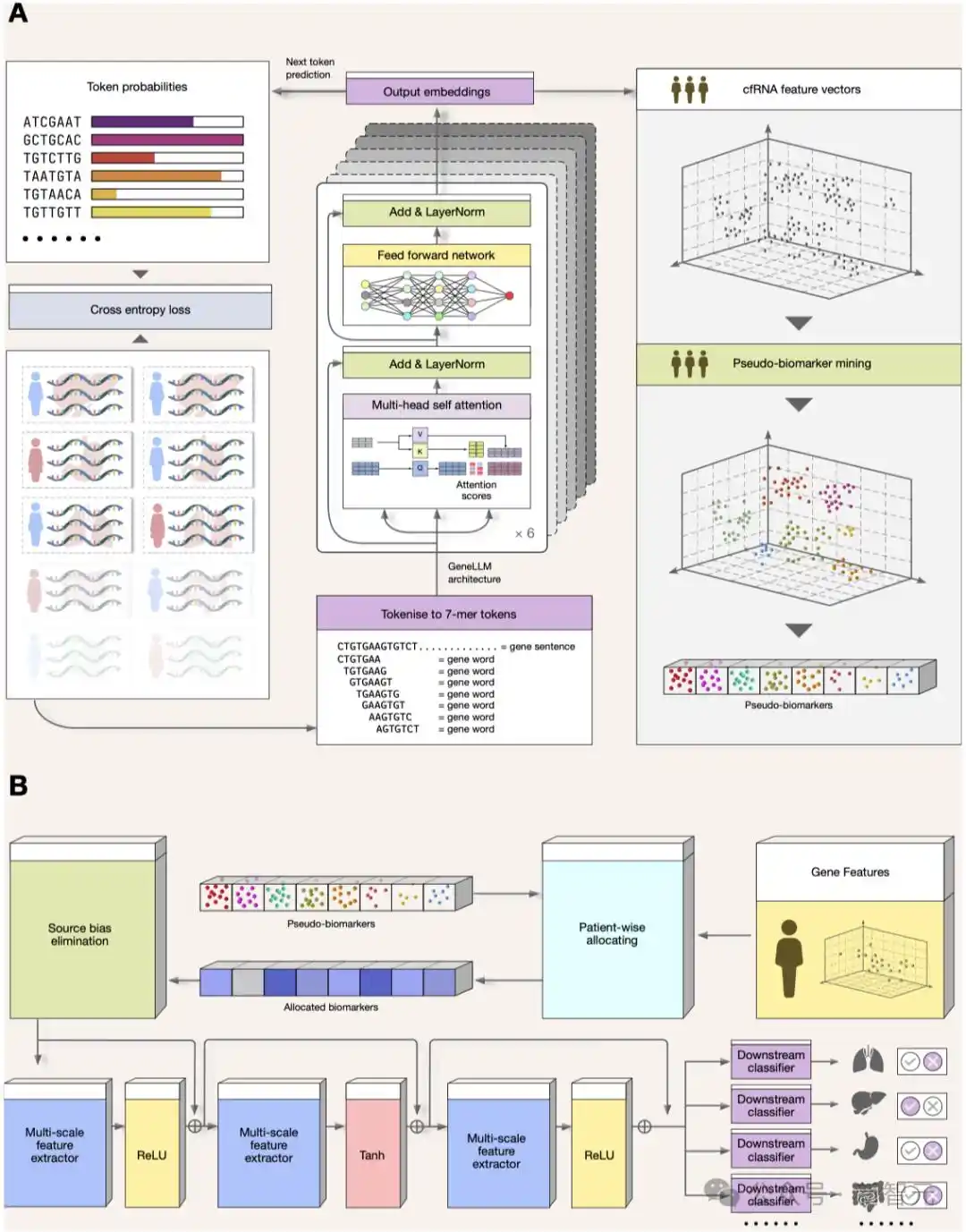
Large language models are built around next-token prediction. GeneLLM follows that general logic, but its prediction target is not text. It is biological information.
Within the model, the four RNA bases — adenine (A), uracil (U), guanine (G) and cytosine (C) — become the basic tokens of biological language. Traditional bioinformatics workflows often depend on gene annotation, sequence alignment and manually defined labels. The article says those methods can be accurate, yet they may also narrow the model’s field of view at the outset and leave unknown biological signals hidden in raw data untouched.
GeneLLM takes a different route. It learns directly from unprocessed sequencing data. Jindu says the training corpus spans raw multi-omics data, including transcriptomics, proteomics and metabolomics, allowing the model to discover disease-related patterns on its own.
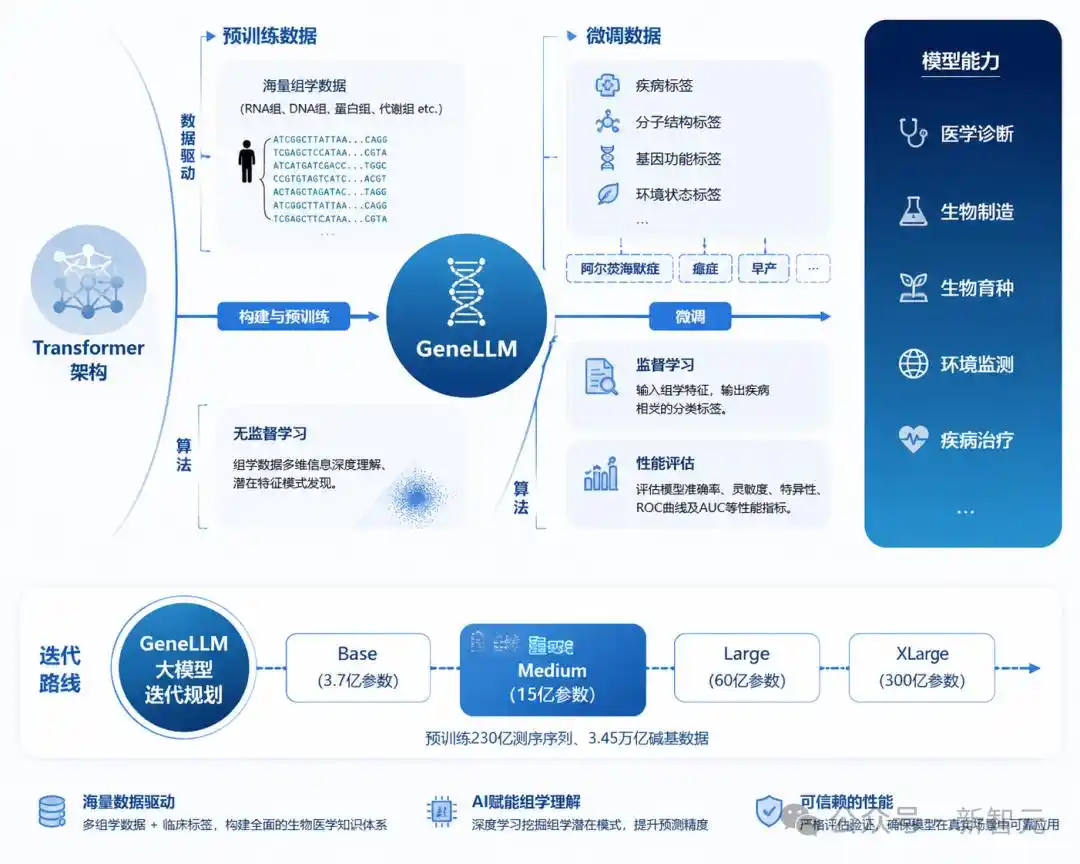
The company says GeneLLM has already completed pretraining at 1.5 billion parameters on 3.5 trillion base sequences. An XLarge version has reached 30 billion parameters in pretraining, with the company describing the expansion as part of a widening technical moat.
A two-stage training pipeline built on raw sequencing data
Jindu describes GeneLLM as a two-stage system:
- unsupervised pretraining and prototype mining
- patient-level disease tuning
The first technical problem was turning complex biological data into a language an AI system can parse. In natural language processing, BPE splits text into tokens. In GeneLLM, RNA sequencing fragments of roughly 150 base pairs are segmented into biological tokens with a sliding 7-mer window.
The model then uses a Transformer architecture to predict the next base directly, without gene annotation or manually assigned labels. Put simply, it does not begin with a human-made biological dictionary. It starts from raw biological signals.
During training, the company says the model processed roughly tens of trillions of RNA reads on a cluster of about 100 NVIDIA A100 GPUs. Jindu says generalization and other abilities began to emerge during that process.
Use cases run from drug discovery to agricultural biology
The article argues that disease recognition is only one application. Jindu says GeneLLM can be used in drug discovery, precision medicine, synthetic biology, environmental monitoring, microbiology and agricultural biology, as well as protein and molecular design. It describes the model as one of the few in the world already moving into practical deployment scenarios.
The comparison laid out in the piece is direct: AlphaFold helped AI read biological structure, EVO 2 pushed AI toward reading biological code, and GeneLLM is trying to understand biological systems.
Efficiency is another part of the pitch. The article says conventional approaches depend on 6 Gb deep sequencing, which raises cost and limits deployment. GeneLLM, by contrast, is said to maintain an AUC above 0.8 at 1 Gb ultra-shallow depth while cutting cost by 83%. The piece presents that result as a step toward making broadly accessible precision medicine more realistic.
From Jindu’s perspective, that points to a different research model: AI learns from life data itself, and life science shifts toward a more predictable, computable and scalable way of exploration.
Not just a model company: building the execution layer for laboratories
Jindu is not limiting the project to a foundation model. The company says GeneLLM serves as the cognitive base for a broader system that connects AI intelligence with the physical world. Through its Harness execution layer and a DBTL cycle — Design, Build, Test, Learn — it is trying to create a full AI-for-Science loop that spans biological understanding, hypothesis generation, automated experimental validation and continued optimization.
The article cites Liam Fedus, former OpenAI VP and former head of post-training, saying that current LLMs have exhausted the finite supply of text and code on the internet, and that major scientific progress from here will depend on experimental iteration. The implication in the article is clear: reading what humans have already written is not enough if AI is going to produce new science. It has to run experiments too.
That is where laboratory infrastructure becomes the bottleneck. Internet services come with APIs. Web information is natively digital. Lab devices, by contrast, come from different vendors, use different protocols and are expensive and complex to rebuild. Most labs are still designed for people: control panels, pipetting actions, sample states and on-the-spot decisions are generally not exposed as machine-readable signals.
So the challenge is not only model capability. It is infrastructure. Jindu’s answer is what it calls a physical Harness: a way to turn the lab into a system that can be compiled, scheduled, observed and traced.
BioFord Harness aims to make the lab programmable
To do that, the startup built BioFord Harness, which it describes as infrastructure linking AI to the physical laboratory. The goal is not to have a robot arm imitate human hands. The goal is to make the lab itself programmable and auditable.
According to the article, the physical Harness has to complete at least three tasks:
- compile scientific intent or an experimental DSL into instructions that different devices can execute;
- schedule multiple devices while managing resources, safety constraints and exceptions;
- feed experiment outputs, device logs and environmental parameters back into the next cycle of model training and experimental design.
The workflow is laid out as a loop: scientific question to AI understanding, experiment plan, device scheduling, execution, data return, model optimization, then the next round. Jindu says that is how a data flywheel for scientific experimentation begins.
BioFord Agent uses five agents to cover the research workflow
Between the physical layer of the lab and the cognitive layer of scientists, Jindu has also rolled out BioFord Agent, an embodied intelligent research platform. The company says it bridges the gap between reasoning and execution through physical AI. At the cognitive layer, the platform is organized around five cooperating agents and is presented as covering the full life sciences workflow while improving research efficiency by several multiples.
- literature retrieval agent
- experiment design agent
- science agent
- experiment scheduling agent
- data analysis agent
The literature retrieval agent is described as helping researchers search and read large volumes of papers, produce reviews and assist with hypothesis formation. The experiment design agent, according to the article, can compress a design cycle that used to take months down to one week.
The experiment scheduling agent relies on a Universal Instrument Abstraction Layer intended to break protocol barriers across heterogeneous equipment. The article names PCR machines, microplate readers, flow cytometers and automated pipetting workstations as examples that can be brought under unified control and scheduling.
The system includes a dynamic scheduling algorithm that can run batch scheduling automatically, avoid conflicts in real time and record experiment parameters throughout the process, creating a traceable audit trail. In the article’s view, that moves AI past the stage of offering suggestions and into direct laboratory operation.
Failed experiments become reusable data
The deeper value, the article argues, is that every experiment can become data the system can absorb, whether it succeeds or fails.
In a conventional lab, a failed experiment might end up as a short note saying the result did not meet expectations. The practical lesson stays in a person’s head, and when that person leaves, the lesson goes with them. Under the BioFord setup, Jindu says each failed run is stored as training data. The logic behind parameter choices, environmental conditions and proof that a path does not work are all retained as part of system memory.
Founder and CEO Jin Yongcheng put it this way: “During R&D, we gradually realized that AI for BioScience is not simply about piling up models and data. For people who actually run experiments, the problem that still has to be solved is the gap where computation finishes but no one knows how to execute it, or it gets executed and still turns out wrong.”
The article presents that capability as one of the hardest moats to replicate in the AI4S field.
Built by four Oxford-linked founders
The company’s founding story takes up a large part of the article. In 2022, after receiving a DPhil in bioengineering from the University of Oxford, Jin Yongcheng chose to return to China and start the company. His adviser was Hagan Bayley, a Fellow of the Royal Society and founder of Oxford Nanopore, the U.K.-listed third-generation sequencing company.
Three other Oxford-linked peers joined him: biology PhD Deng Siwei, computer school associate researcher Sha Lei, and Zhou Tianyao, who focused on product deployment. The article says Sha also holds a PhD in computer science from Peking University and is a senior schoolmate of Xiaomi large model head Luo Fuli.
Together, the team spans bioengineering, artificial intelligence, computational biology and business operations. The article says the four had previously worked on joint research that combined AI with transcriptomics for disease prediction and detection.
The company’s Chinese name, “Jindu,” is also explained in the article. “Jin” comes from Oxford, while “Du” carries the idea of ferrying people across, which the founders use to describe the endpoint they believe AI for Science should reach.
According to the article, Jindu’s BioFord Agent physical AI research platform has already been deployed at some well-known universities in China, where it has shortened research cycles from several months to one week.
Funding accelerated in 2025, with four rounds completed in one year
The article says Jindu faced a difficult early fundraising environment. AI startups were already drawing attention, but AI-plus-bioscience efforts were still rare. Jin said, “At one point, investors could not understand what we were doing.”
The team chose what the article calls the hardest route: entering through a foundational bioscience model, an area where only a handful of companies were operating worldwide. A turning point came in 2025. The article says the State Council released its opinions on deeply implementing the “AI Plus” action plan, and AI for Science was included.
Jindu then completed four financing rounds in one year. The timeline listed in the article is:
- Angel+ round: led by Sequoia China Seed Fund;
- Pre-A+ round: a ten-million-level lead investment from Create Capital;
- Pre-A+ round: a ten-million-level investment from Nanshan Strategic Emerging Industries Investment;
- Series A: nearly RMB 100 million led by GTJA Investment.
Teng Yuhang, executive managing partner at GTJA Investment, said: “Jindu Biosciences has turned foundational life science research into subscribable and scalable infrastructure built on ‘compute plus experimentation.’”
Jin said the ambition goes beyond software sales: “We are not satisfied with selling software. We want to build an intelligent operating system for life sciences. Just as Intel defined computing power in the PC era, we hope to define a new R&D paradigm for life sciences in the AI era.”
A lighter physical AI path in the AI-for-bioscience map
The article also places Jindu within a broader AI-for-bioscience landscape. One category is the digital AI scientist. It cites Stanford-incubated Biomni, later commercialized as Phylo, as having more than 150 specialized tools for literature review, hypothesis generation and bioinformatics analysis. It also names Eric Schmidt-backed FutureHouse, which is working on AI scientists that can independently generate hypotheses and write papers. Powerful as they may be, the article argues, they remain confined to the digital world.
The second category is the full-stack autonomous route. XtalPi is described as having deployed more than 300 workstations globally using an AI-plus-robotics approach. Lila Sciences, incubated by Flagship Pioneering, has raised $550 million and aims to hand experiment design, execution and redesign over to AI in pursuit of what it calls scientific superintelligence. The article’s assessment is blunt: those models are capital-intensive.
The third category is the end-to-end pipeline approach. Insilico Medicine is cited as pushing AI directly into its own innovative drug pipeline, with its first AI-designed drug already in Phase III clinical trials. But the article says such companies are closer to carmakers than road builders.
Jindu’s chosen lane is different. It is focused on physical Harness infrastructure, the last mile between models and real experimental systems. The article says it is not competing in base-model races, not building end-to-end pipelines and not stopping at a purely digital AI scientist. Instead, it is entering through the execution layer and trying to control orchestration across the broader scientific workflow.
That positioning, as laid out in the article, gives it different trade-offs. Compared with purely digital AI scientists, it can reach the physical world. Compared with heavy-asset autonomous science factories, it may be able to take over a customer’s existing lab. Compared with end-to-end AI drugmakers, it does not have to stake everything on one clinical pipeline. Its moat, the article argues, will not be parameter count, but the accumulated record of experiment trajectories, device interfaces, failure experience and cross-lab execution networks.
Jin summed up the company’s view this way: “The real dividing line in AI for Science is not whether a model sounds like a scientist when it answers. It is whether a laboratory can start behaving like a continuously learning system.” He also said that the thousands of signaling pathways and unknown reaction mechanisms inside biology are what make the field so compelling: “The richer biology is, the brighter the prospects for AI for Science.”
This article was originally published via the WeChat public account “Xinzhiyuan,” written by Xinzhiyuan and edited by Aeneas KingHZ.