
"Of all the signals, the last one is retail piling into meme-coin pools. That’s when you know the bull market is really here."
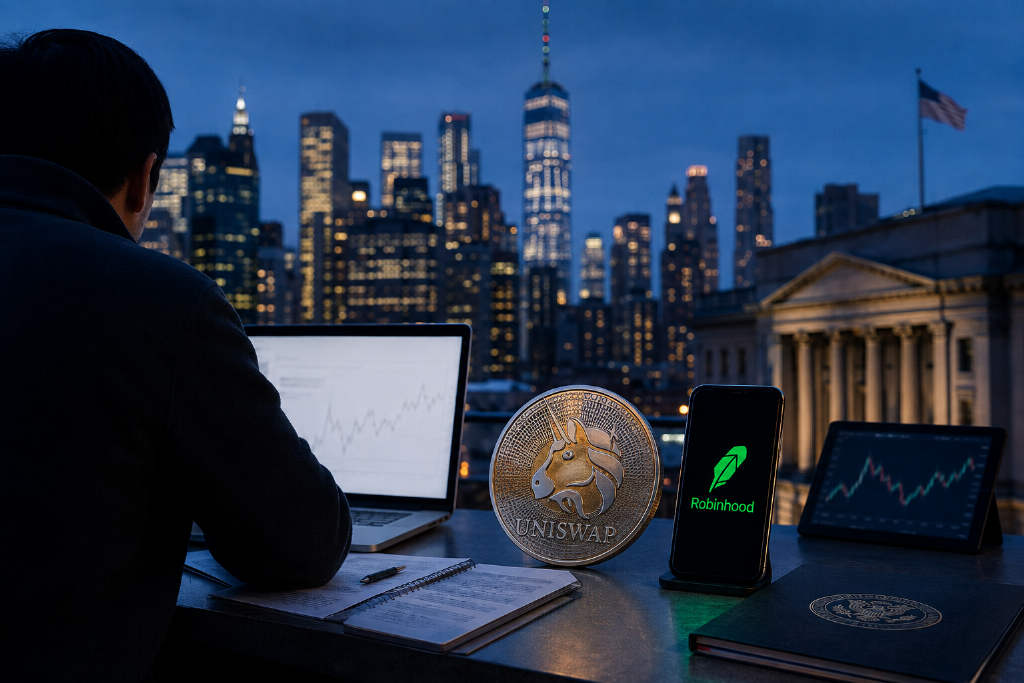
That line came from John, the Milk Road principal and Milk Road Pro portfolio manager, during the Sept. 4 episode of the Milk Road Show. In the interview, he explained why he bought altcoins for the first time in more than two months and why Uniswap’s UNI has become one of his highest-conviction positions.
The program also carried a conflict disclosure. John runs the paid Milk Road Pro portfolio, and the show repeatedly directed viewers to subscribe to see his holdings and trade history. Assets mentioned in the episode, including UNI, may be held by John personally or by related products. The show said the comments reflected his personal views and were not investment advice.
Why the market jumped so quickly
Guest host LG Doucet opened the conversation by noting that the episode was recorded on the afternoon of Sept. 3, after a morning in which Bitcoin broke out of its range and screens were filled with green candles. He asked what had changed.
John first joked that he had been right and everyone else had been wrong, then turned serious. He said the rally was the result of several developments stacking on top of one another. The earliest spark, in his telling, was a short squeeze after Trump mentioned the name of an exchange at the White House. Treasury Secretary Scott Bessent then announced a Treasury buyback plan, the market reacted positively, and a wave of short positions was liquidated. John said the price action on the day of recording looked like a replay of that setup.
Doucet then asked what was different about the latest buyback discussion. John said the earlier figure being discussed was $2 billion to $4 billion, but the current expectation was that around Sept. 9 the Treasury would start buying back $12 billion of long-dated debt while issuing short-term debt. In his view, that shortens the duration of U.S. government debt, injects liquidity into markets in practical terms, and signals that the Treasury is willing to weaken the dollar while supporting the bond market and broader risk assets. He described it as one of the factors that lit the fuse.
The second pillar of his argument was the Robinhood chain. John said demand and activity there had exploded because the ecosystem combines a launchpad with tokenized stocks, and those two pieces reinforce each other. He described trading volume, revenue, fees, and user growth as exceptionally strong. In his account, money that had previously been parked in AI themes and had gone quiet was being pulled back into crypto’s meme-coin pools, with even some Solana meme capital shifting over.
At the time of recording, John said Bitcoin was above $81,000 and still climbing, while Ether was back above $2,500. He cautioned that conditions could still change quickly. Even so, he said the macro setup looked favorable, the odds of a Federal Reserve rate hike appeared to be falling, and he still expected the Fed to stay put. He also said the Clarity Act could pass Congress within two weeks. Put together with the energy coming out of the Robinhood chain, he said, those elements formed a strong bullish case.
Why UNI became his third-largest position
Doucet then turned to Uniswap, a name John said he had been revisiting repeatedly. John disclosed that buying UNI a week earlier marked his first altcoin purchase in more than two months inside Milk Road Pro. The reason, he said, was that Uniswap had changed the economics around the token.
He argued that Uniswap’s earlier problem was not simply self-inflicted. Under the regulatory pressure associated with Gary Gensler’s approach and what he called "Operation Chokepoint 2.0," he said a direct buyback funded by protocol revenue could have led regulators to classify the token as a security. According to John, Uniswap found a workaround: instead of using protocol revenue directly, it takes a small cut from fees generated by liquidity providers, uses that money to buy UNI on the open market, and then burns the tokens.
For John, that matters because UNI had spent years being criticized as a governance token with no economic claim on the protocol’s value creation. He said Uniswap is now tying the token more closely to the chain, the business, and the platform’s activity, allowing holders to share in protocol value linked to business performance, revenue, and trading volume. In his words, "It used to be a useless governance token. Now token holders can finally participate in the value the protocol creates."
John said he was not among the earliest buyers. He entered after seeing UNI start to move, bought an initial amount, and added on a pullback. By the time of the interview, he said the position was up about 30%. On the chart, he said UNI had been in a prolonged decline, leaving relatively little technical resistance until around the $7 area. If this is in fact a confirmed digital-asset bull market, he said, Uniswap should do well in that environment, and he was comfortable holding the position.
Doucet said the portfolio dashboard showed UNI had become John’s third-largest holding, behind ETH, Bitcoin, and cash, with another five or six altcoins below it. John confirmed that and said he had been "buying like crazy" during the week, not only in UNI but in several other names as well.
He explained that his earlier plan had been to wait for Bitcoin to enter a technical bull market before returning to altcoins in force, because Bitcoin historically leads. What changed, he said, was a widening dispersion across the market: Bitcoin was still choppy while other pockets of crypto were already surging, particularly crypto lending protocols and DeFi names. He also said many altcoins appeared to have already bottomed, and he saw little reason to expect fresh lows. Even if Bitcoin pulled back, he said, he did not think UNI would suddenly drop below $4 again, so waiting longer no longer made sense to him.
Robinhood chain and the tokenized-equity trade
Doucet pushed back on one point, noting that the Robinhood chain generated only about $3 million to $4 million in fees last month, hardly a large figure for a company valued in the hundreds of billions. John said that looking only at one week or one month of fee revenue misses the larger point.
What matters, he said, is that the Robinhood chain serves as a proof of concept for the future of capital markets and tokenized equities. In his view, it shows there is real user demand for the model and that the structure can work in practice. He also said the move is forcing rivals to respond quickly, with Coinbase and Base reacting in real time and OKX also pursuing tokenization.
John’s bigger claim was that Robinhood has tied meme-coin speculation and tokenized equities together in one venue. That, he said, is pushing market makers to mint more tokenized versions of large-cap assets. As a result, trading pairs are no longer limited to SOL, ETH, or USDT. They now include names such as Nvidia, Tesla, Alphabet, and Meta. In his framing, meme speculation is no longer trapped inside crypto’s internal loop; it can feed value back into the real economy and public markets while expanding the opportunity set and the product set at the same time.
To explain why he sees that as structurally important, John pointed to Uniswap founder Hayden Adams. He said Adams had published his first blog post since 2019, titled "Correlation Pairs," laying out how automated market makers can compete for much larger markets. John’s takeaway was blunt: everything will trade against everything, and anything can be tokenized.
He offered an extreme illustration. If he owned a Rembrandt painting, he said, it should in theory be possible to swap it directly into Pepe or Nvidia using an automated market maker that handles liquidity formation and settlement in a way that remains secure, scalable, and decentralized. He also mentioned Jordi Visser, saying Visser included a clip from John’s interview with Tom Lee in a weekend video because the idea resonated with him. Once assets move on-chain and AI-driven agent finance is layered on top, John said, both speed and capital scale could accelerate exponentially. He described the overlap of tokenization, crypto assets, and agent finance as hard to overstate.
He tied that thesis back to Ethereum in unmistakable terms: "All of this settles back to Ethereum. ETH is money. It’s the root of global finance."
John then gave a more practical example for listeners trying to understand these new trading pairs. In the older Solana meme-coin model, a meme token would usually be paired with SOL, so the liquidity pool held SOL and the meme token together, and the token’s action was linked to SOL. In the newer setup he described, a meme token can be paired directly with a stock. He cited a token called Artificial Inu, which he said trades against Nvidia. A liquidity provider in that market would need to supply tokenized Nvidia alongside the token itself. He said that was a genuinely new native structure.
On Robinhood CEO Vlad Tenev, John was direct: "Vlad Tenev weaponized the enthusiasm of meme traders into something that can go toe to toe with Wall Street assets." He added that Milk Road’s newsletter had also covered another example in which Hims stock was paired with a meme token called boner coin. The real point, he said, is not one isolated pair but the proof that nearly any asset can be paired with nearly any other asset. Once product-market fit appears, the value proposition becomes obvious.
Other sectors he said were moving
John said meme activity was not the only reason he had started buying again. He also saw the market’s underlying base becoming stronger.
- Syrup (Maple Finance): He said the market was materially undervaluing it.
- Lyra: He said the token had already moved sharply and could still keep going.
- Perpetual futures platforms: He named Hype, Hyperliquid, and Lyra as projects that could see favorable near-term catalysts.
- Zcash: He said he did not own it, but added that the market had become extremely enthusiastic about it and that it was at or near $1,000 in his recollection.
He added that bullish action was showing up across the market and was hard to ignore. Still, he circled back to the same sign he kept stressing: meme-coin pools had come back to life. Retail liquidity, he said, had returned. He said no one really knows where that money came from, but it is clearly in the market. As one example, he pointed to Ponds reaching a $600 million market capitalization as evidence that liquidity is present.
Not a confirmed bull market yet
Despite the optimism in his positioning, John explicitly said the rally does not necessarily confirm a bull market. It could still be a bull trap.
Doucet noted that two weeks earlier, when Bitcoin had broken out of its range and pushed into the $70,000s, the market already felt ahead of schedule. By the morning of the recording, people were dealing with another round of FOMO, worried that they were underexposed and that the cash they had saved for a deeper pullback had been left on the sidelines for nothing.
John said the emotions were understandable, but that no one knows exactly what Bitcoin is about to do and trading on emotion is the wrong answer. His solution was practical: investors are not going to miss the entire market just because they did not catch the first move, and a bull market does not simply run away forever without offering entries. Build a plan that fits, place trailing buy orders for the assets you want, and wait for pullbacks. Even in a strong bull market, he said, Bitcoin can still retrace 30%, and other assets can swing even more.
He also said he is still holding substantial cash and is still thinking through how to deploy it. His caution rests on several risks he named directly:
- The Federal Reserve could still raise rates.
- The Clarity Act could fail to pass.
- September in U.S. midterm election years has historically been Bitcoin’s worst month.
At the same time, he said he views those as short-term shocks rather than a challenge to his long-term outlook, which he said has only grown stronger.
For people with no exposure at all, John suggested deciding on a target allocation and then buying 5%, 10%, or 15% first to take the edge off FOMO before averaging in gradually. He summed up his approach with a phrase he repeated during the show: "Buy in panic. Any price is a good deal."
Near the end of the episode, Doucet said part of the market’s FOMO comes from having stared at prices for eight months, waiting for a 10% correction that never came, only to chase a 20% rebound instead. John called that human nature. He said he buys on the way down, so he does not panic on the way up. Over those same eight months, he said, he had consistently argued that capital in AI could rotate back into crypto.
He closed the conversation with a line that had little to do with chart patterns and a lot to do with discipline: go outside, spend time with the people who love you, stop watching the charts for a while, and they will still be there when you come back.
Episode details
- Source program: Milk Road Show
- Guest: John (Milk Road principal / Milk Road Pro portfolio manager)
- Host: LG Doucet (guest host)
- Air date: Sept. 4, 2026
- Runtime: about 37 minutes
