
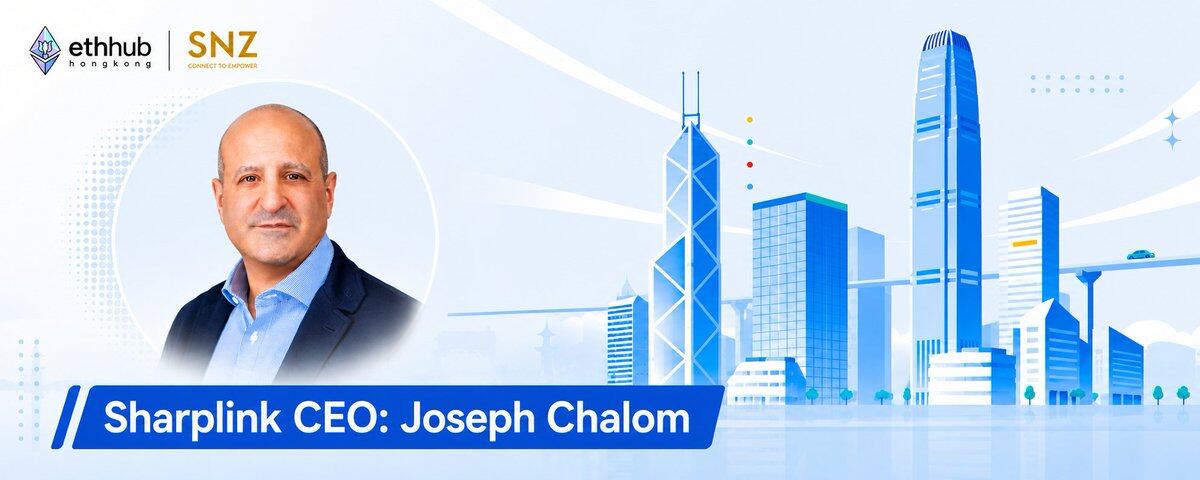
On June 8, 2026, Joseph Chalom, CEO of Sharplink and former head of digital assets at BlackRock, delivered a speech titled The Future Transformation of Financial Markets at a VIP event jointly hosted by Futu, SNZ, ETH HK Hub and Sharplink. Chalom previously led BlackRock’s Bitcoin and Ethereum ETF work, the BUIDL tokenized fund, and Circle/USDC reserve management. In his speech, he framed the coming shift in a different way: the Industrialization of Trust.
From BlackRock’s institutional infrastructure to Sharplink’s Ethereum treasury
Chalom began by outlining his institutional background. Before joining Sharplink, a listed company, he spent 20 years as a senior executive at BlackRock, the world’s largest asset manager. During the first 12 years of that period, he worked on the Aladdin platform, a technology system that now provides risk management services for around $50 trillion in assets held by buy-side institutions such as pension funds and asset managers.
From around 2018 to 2025, Chalom led a team that spent several years studying what role an asset manager could play in crypto, effectively examining how traditional finance could connect with the crypto industry. He said the initial answer was no, because the sector at that time had not reached the standards expected by BlackRock’s clients. Eventually, however, BlackRock launched its digital assets strategy and carried out several major initiatives.
He then turned to Sharplink. According to Chalom, Sharplink was the first company to build a digital asset treasury around a non-Bitcoin token and the first company centered on Ethereum. It currently holds the second-largest public ETH position, slightly above $2 billion. He noted that his friend Tom Lee holds a larger position at BitMine, and said the two sides are aligned in strengthening the ecosystem. Sharplink actively manages its treasury and has participated in DeFi from day one. By the end of this year, it plans to allocate roughly $325 million worth of ETH into DeFi protocols to support the ecosystem.

The breakdown of trust and the hidden cost of traditional finance
Chalom described the current internet environment as Web2.5. Web1, in his view, unified global information and connected people by making information searchable. The promise of Web3 is different: information should be verifiable and authentic, identity should be clear, and funds should move securely with economic guarantees. He argued that society has not yet reached that stage. In many societies, including the United States, people cannot fully trust the information presented to them. Social media uses information as a weapon, online identities are not automatically credible, and he said he would not trust any software company, including Anthropic, to guarantee that code is entirely free of vulnerabilities.
For Chalom, the coming repair mechanism combines AI and blockchain. AI can verify identity and facts, while blockchains can provide final settlement. He connected this point directly to financial services, where the lack of trust produces large costs. In the United States alone, he said the financial services industry spends more than $9.3 trillion every year on human-created trust, including contracts, insurance and counterparty risk management. He described this as wasted capital generated by a system in which counterparties do not fully trust one another.
The reason, he said, is settlement delay. Trades generally settle in one to three days. The United States is close to same-day settlement, Hong Kong takes two days, and much of Southeast Asia can take up to three days. A market participant must therefore trust that the counterparty will still exist and will deliver when settlement arrives. Chalom said this has produced more than one million separate and fragmented databases around the world. Each database must be maintained independently, and every day the system requires constant reconciliation of cash, stocks and positions. He added that much of the technology behind the U.S. trading system was built over the past 40 years.
He used market hours to illustrate the limits of the current structure. In a fragmented system, people can only trade between 9:30 a.m. and 4 p.m. If the U.S. president were to announce a war on a Friday evening and an investor wanted to sell stocks, that investor would have to wait until Monday morning. During that weekend, Chalom said, the only assets available for trading would be crypto assets, including tokenized equities, tokenized precious metals, tokenized assets and futures. He argued that the future will consist of 24x7 tokenized assets, programmable money, and assets that transfer and settle instantly on decentralized blockchains without a trust problem.
Ethereum as trustware, a proof layer and a settlement network
In capital markets, Chalom said Ethereum is leading this shift by becoming the settlement layer for financial transactions. He described it as trustware or a proof layer that can confirm that transactions and identities are real. In Web3, once a transaction is completed, it is irreversible, which makes the reliability of the underlying settlement system central to market design.
Chalom cited several metrics to support his view of Ethereum. He said Ethereum has more than one million validator nodes distributed across 84 countries and has had zero downtime over more than 10 years, making it one of the most battle-tested pieces of financial infrastructure. He also said that Ethereum and its Layer 2 networks secure more than 10 times the liquid assets of the closest competitor. Ethereum currently secures more than $300 billion in on-chain assets, while more than 65% of global stablecoins and tokenized assets are safely held and traded on Ethereum.
Drawing on his two decades in financial services, Chalom said most traditional finance professionals want to operate on trusted platforms that do not go down and are secure enough for institutional use. He acknowledged that other public chains are faster and cheaper, but said they can suffer downtime, lack economic security, and do not provide the liquidity profile required by the world’s largest institutions.
He then explained the role of ether, the native token of the Ethereum network. Ether can be staked to help secure the network. Chalom described it as both a store of value and an asset that can be staked to secure transactions, validate blocks and generate yield. He contrasted this with Bitcoin, which does not itself generate yield. He said people such as Michael Saylor must use leverage through MicroStrategy to obtain returns on Bitcoin. According to Chalom, staked ETH can generate close to 10% yield, and the more ETH is staked, the stronger the network’s economic security becomes. Sharplink has staked 100% of its ETH holdings to reinforce that security.
Chalom used a baseball analogy to describe where the industry stands. A U.S. baseball game has nine innings, and in his view crypto is around the second inning. Even though the crypto industry has existed for 16 or 17 years, he said it is on the eve of a step-function change. He cited Bill Gates’ well-known observation that people often overestimate what can happen in one year and severely underestimate what can happen in ten years. Chalom said the remainder of this decade will reflect that dynamic.
Stablecoins, tokenized assets and DeFi as the first three pillars
Chalom identified stablecoins as one of the central pillars of the next phase. He said the total supply of stablecoins is currently around $330 billion, with about 99.75% denominated in U.S. dollars. Europe has a small share, Hong Kong has just approved a related regulatory framework, and Korea is also moving in that direction. In the beginning, stablecoins mainly served as a bridge for dollar capital to enter crypto markets. That use case, he said, is changing.
Stablecoins, in Chalom’s view, will become a cross-border payment rail. Companies will use them to move funds among thousands of subsidiaries, and individuals will be able to send money across borders instantly and almost for free. He said salaries received within one or two years may be paid in stablecoins, offering efficiency, speed and near-zero fees.
The second pillar is tokenized assets. Chalom said asset tokenization began about eight years ago, yet the total market size is still only around $35 billion. He described this as surprising and said the world’s largest institutions are preparing to change the situation. This year has already brought four announcements that would have been difficult to imagine a few years ago. The New York Stock Exchange and Nasdaq, the world’s two major exchanges, are both moving toward 23-hour-a-day, seven-day-a-week trading so that tokenized assets can trade freely around the clock.
He also mentioned DTCC, describing it as the world’s largest securities settlement and clearing institution. DTCC processes roughly $15 quadrillion in transactions each year. Under regulatory permission, it is piloting DeFi-style models involving activities such as lending and swaps, largely based on Ethereum. Chalom said this will change how centralized trading venues work, how funds move, and how stablecoins, tokenized assets and tradable instruments are used.
Chalom argued that within the next few years the discussion will no longer be about crypto, and the industry may not even use the word crypto in the same way. Instead, he said, finance will undergo a digital transformation on a scale not seen since stocks moved from paper to electronic form in the 1970s. The third pillar is DeFi, decentralized protocols that already provide automated trading, lending and liquidity services on-chain. These services are open around the clock and can be accessed at any time. More than $200 billion in capital currently flows through DeFi protocols.
Agentic Finance and the idea of a CFO in every pocket
Chalom said the force that could permanently change the game is Agentic Finance. AI agents are already conducting transactions autonomously, executing payments, making investments and carrying out portfolio operations. What they require is programmable settlement: stablecoins plus smart contracts, allowing money to move automatically when conditions are met, without bank accounts, wire transfers or intermediaries.
He pointed to emerging standards, including X402, which defines a machine-readable payment protocol, and ERC-8004, which enables agents to conduct programmable and permission-controlled financial operations. These standards, in his framing, are part of the infrastructure needed for autonomous agents to transact with one another under rules and constraints.
Chalom asked how many people in the audience had a smart wallet and suggested the number was low. He said there are currently around 800 million such wallets globally. He then described a future in which every person with a securities account also has a digital twin wallet operated by regulated agents inside regulated companies. This AI agent would understand the user’s goals, risk tolerance and asset situation, and would help perform tasks that are difficult for retail investors to complete on their own today.
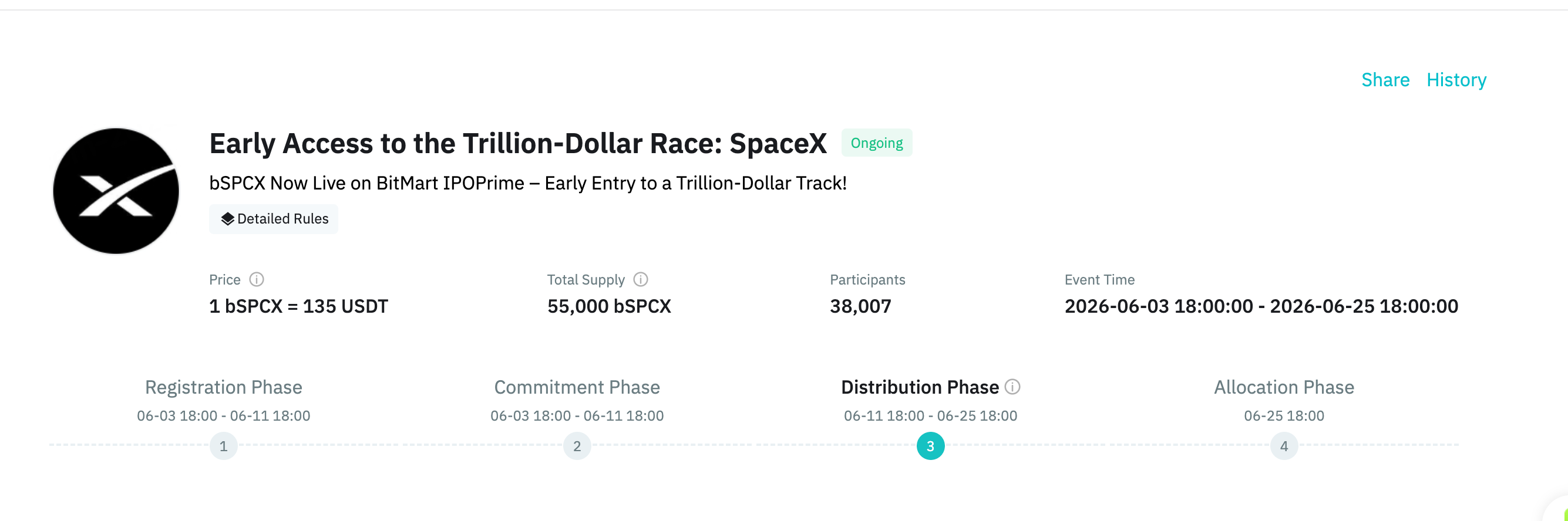
By the end of 2027, Chalom said, each person in the room will effectively have a CFO in their pocket. That agent would scan idle funds across accounts that are not earning the interest they should, then move the funds into higher-yielding accounts. If a user holds tokenized assets such as SpaceX or Tesla, the agent would operate in a manner similar to large institutions: placing those holdings on-chain, lending them out, returning the generated yield to the user, and then adjusting the portfolio allocation accordingly. The AI agent would become a reflection of the investor, designed to help produce better investment outcomes.
Chalom also cited an estimate from Boston Consulting Group that within roughly one year, the number of on-chain transactions could reach about 1,000 times the current level. These would be agent-to-agent transactions conducted under rules and guidelines, moving money and managing wealth in ways that are almost impossible today. He also referred the audience to the Canopy team, saying their work offers a sense of where this future is heading.
The event materials described Sharplink (NASDAQ: SBET) as a leading institutional-grade Ethereum treasury platform intended to provide public market investors with smarter and more efficient exposure to Ethereum. ETH HK Hub is Asia’s first physical Ethereum community center, supported by the Ethereum Foundation’s Ethereum Everywhere team and operated in partnership with SNZ and ETHTAO. SNZ is a research-driven investment firm active in Web3 and fintech since 2014, with a portfolio covering more than 200 companies across blockchain infrastructure, DeFi, payment systems and real-world applications. Futu is a leading integrated digital finance platform in Hong Kong. Its SFC-licensed virtual asset trading platform, PantherTrade, provides one-stop services for institutional investors and high-net-worth clients, allowing access to on-chain digital assets and traditional securities markets through a single account.