
$19.2B Market: The Hidden Bottleneck Behind AI GPU Growth
JPMorgan has published a first-principles analysis of the AI data center power delivery chain, concluding that the power semiconductor market for AI will surge from $2.7 billion in 2025 to $19.2 billion by 2028, a compound annual growth rate of 82%. The report emphasizes that while everyone focuses on GPU shipments, the power delivery infrastructure is the true bottleneck. Crypto miners, particularly those operating GPU-based or ASIC mining farms, should take note: rising demand for power semiconductors will drive up the cost and lead time for high-efficiency power supplies, directly impacting mining profitability.
Inefficient Traditional Architecture: 5 Conversion Stages, 85-88% Efficiency
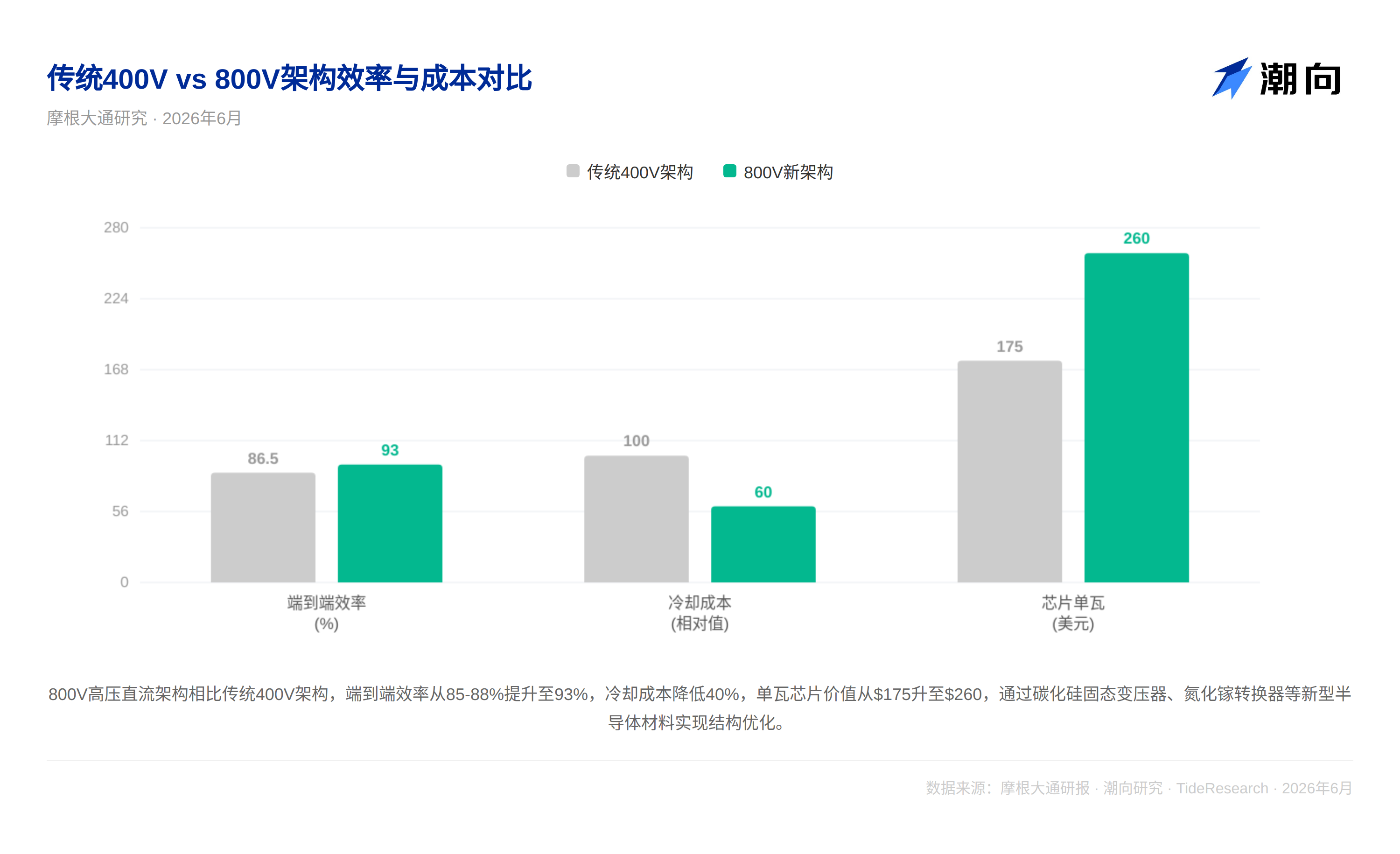
Current data center power delivery chains suffer from five conversion stages (grid transformer, UPS, PDU, server PSU, VRM), each losing 2-5%, resulting in only 85-88% end-to-end efficiency. For a 100kW rack, 15kW is wasted as heat requiring cooling. JPMorgan estimates 81 GW of new AI data center capacity by 2028 (63 GW new build, 18 GW replacement), with AI chips consuming about 54 GW. Miners using similar architecture face high electricity and cooling costs; the shift to 800V HVDC could cut copper losses by 75%.

800V High-Voltage DC Revolution: SiC and GaN Take Center Stage
The core technology shift is from legacy 400V AC to 800V HVDC architecture. Doubling voltage halves current, cutting copper losses to one-fourth. This introduces four new nodes: SiC solid-state transformers replacing copper-wound transformers, SiC solid-state circuit breakers for microsecond fault isolation, DC-native battery backup units with bidirectional DC-DC converters and BMS chips, and rack-level 800V-to-low-voltage DC-DC converters. Semiconductor content per watt jumps from $175 to $260. For crypto miners, this means future mining power supplies will likely incorporate GaN transistors, offering higher efficiency and smaller form factors but also higher procurement costs and potential supply constraints.

Timeline and Material Landscape: 2028 SiC/GaN Dominance
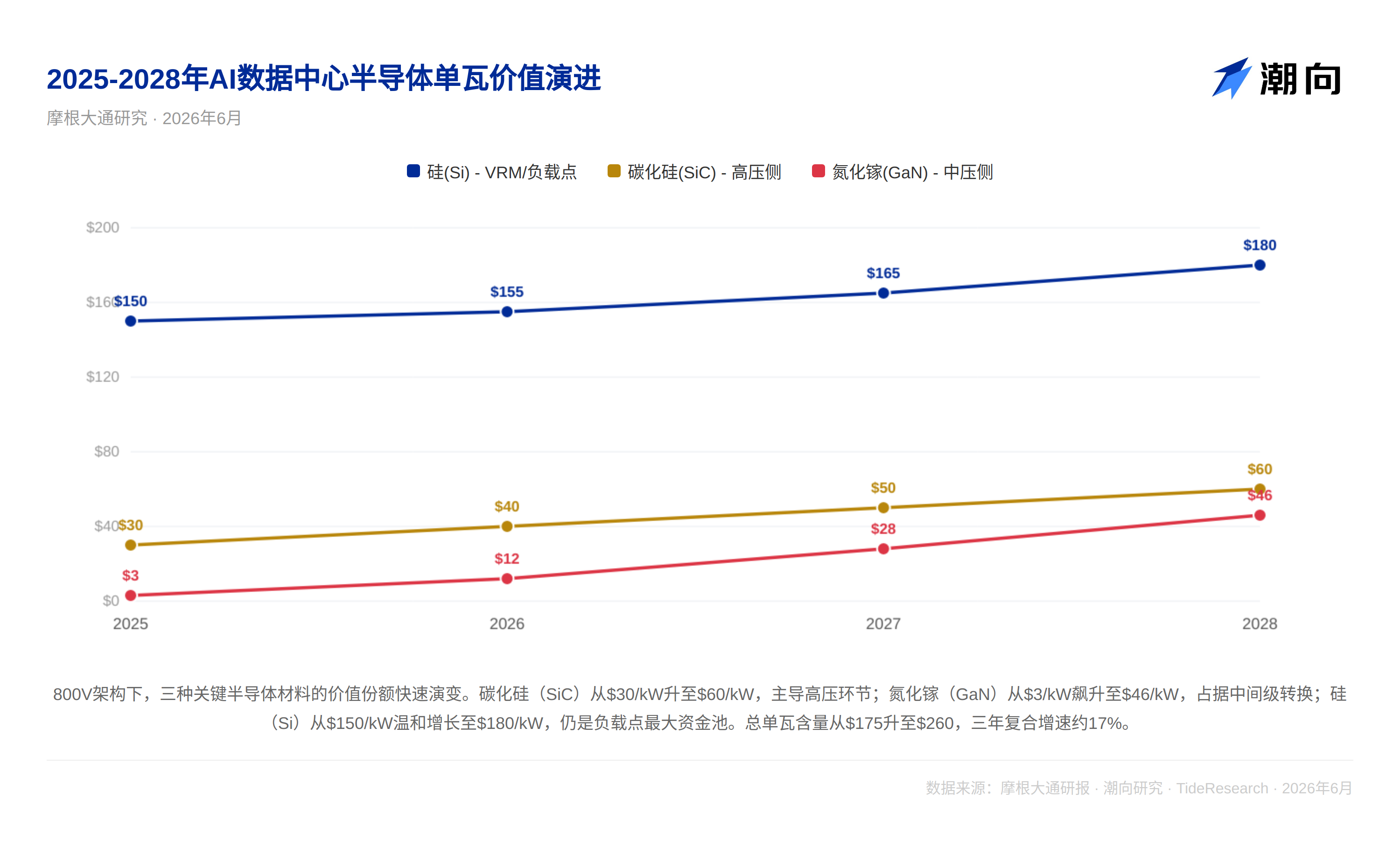
JPMorgan provides a clear timeline: 2026-2027 remains dominated by traditional 400V architecture, but sidecar power racks emerge; H2 2027 to 2028 sees NVIDIA's Kyber rack (600kW per rack) driving 800V native solutions into mass deployment; beyond 2028, solid-state transformers mature, merging sidecar and transformer into single SST units. Material-wise, SiC content per watt rises from $30 to $60 in high-voltage domains; GaN jumps from $3 to $46 in intermediate conversion; silicon grows modestly from $150 to $180, retaining the VRM/load-point pool. Miners relying on NVIDIA GPUs should monitor Kyber's supply chain, as it could influence GPU availability and pricing.

Key Players and Risks: NVIDIA Pricing Power and Grid Expansion Lag
The report covers 12 core vendors: Infineon (broadest), MPS (NVIDIA's VRM supplier), Renesas, TI, STMicroelectronics, Navitas (GaN leader), ADI, ON Semiconductor, Rohm, Innoscience, AOS, and Wolfspeed. JPMorgan flags two key risks: US grid expansion lead times (median 3-5 years) mismatched with data center build cycles (~2 years), making the 81 GW forecast subject to execution risk; and NVIDIA's dominant pricing power across the value chain – its supplier choice for Kyber racks will directly impact competitive dynamics. Crypto miners should factor in potential electricity price hikes due to grid congestion and watch for NVIDIA's power supply decisions that may affect GPU production lead times.