


Executive Summary
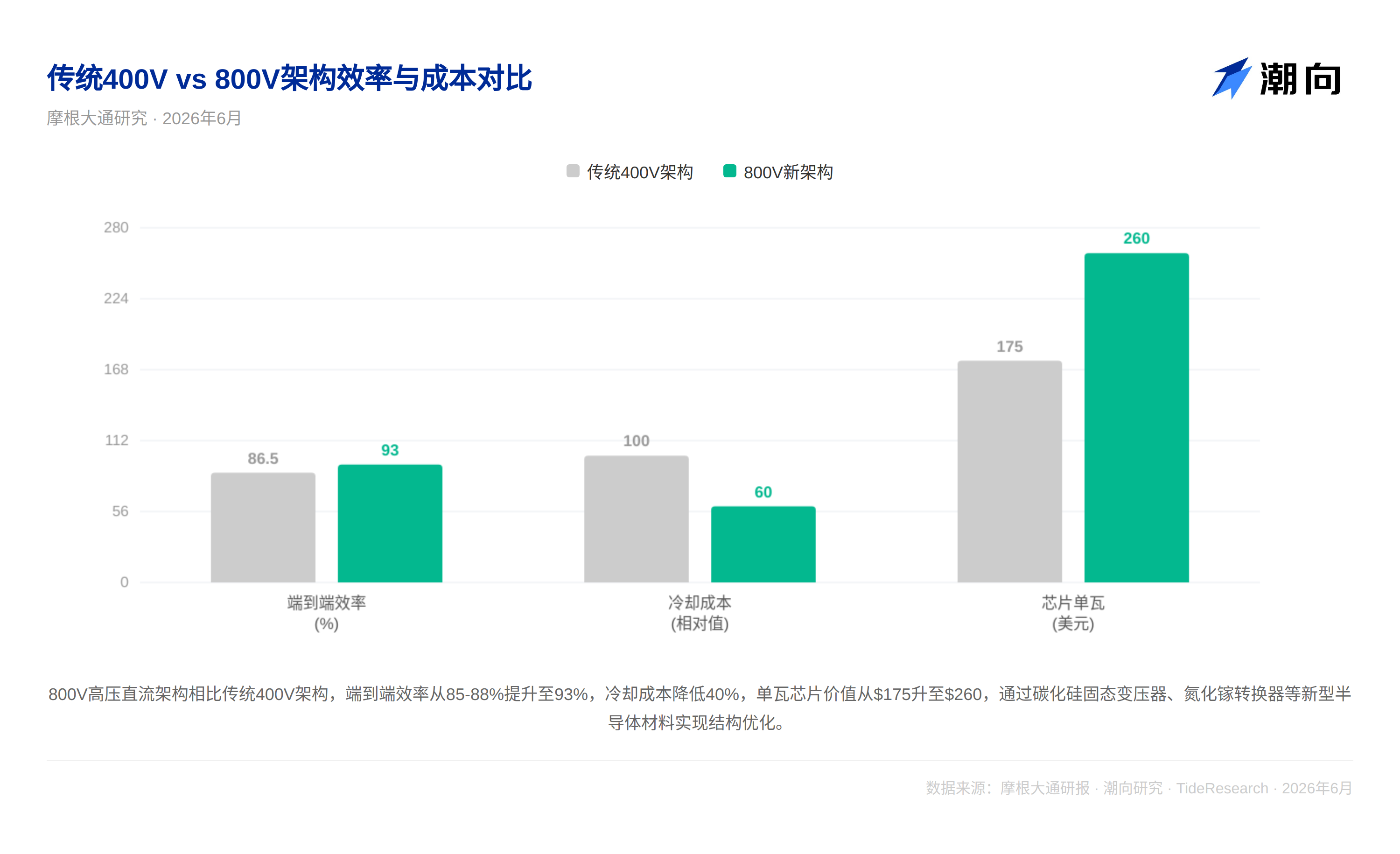
JPMorgan has conducted a first-principles analysis of the complete AI data center power supply chain, concluding that the AI power semiconductor market will grow from approximately $2.7 billion in 2025 to $19.2 billion in 2028—a compound annual growth rate (CAGR) of 82%. The larger inflection point is the 800V HVDC architecture revolution, which replaces traditional electromechanical equipment with silicon carbide (SiC) solid-state transformers and gallium nitride (GaN) converters, pushing semiconductor content per watt from $175 to $260. This reveals a value chain hidden beneath the GPU spotlight.
Inefficiency of Traditional Power Delivery
Everyone counts GPU shipments; few count electricity. Current data center power delivery is an inefficient multi-stage chain: utility power at 10-35kV AC is stepped down to 400-480V AC, enters an uninterruptible power supply (UPS), passes through a power distribution unit (PDU), then a server power supply converts AC to DC, and finally a voltage regulator module (VRM) steps down to the sub-volt level required by GPU cores. This five-stage conversion loses 2-5% at each step, resulting in end-to-end efficiency of only 85-88%. For a 100kW rack, 15kW is lost as waste heat, which must be removed by cooling systems.
Market Forecast: $19.2B Opportunity
Based on JPMorgan's internal AI server models, global AI data centers will add approximately 81 GW of new capacity by 2028, including roughly 63 GW of new builds and 18 GW of replacements. AI chip power consumption accounts for about 54 GW, with the final figure reached after including network equipment and PUE adjustments. The power semiconductor market supporting this 81 GW is estimated to rise from a current $175 per watt to $260 per watt, driving the total market to $19.2 billion.

Revolutionary Impact of 800V HVDC Architecture
The report's key technology insight is the shift from traditional AC architecture to 800V HVDC. The physics is simple: power equals voltage times current, and heat loss is proportional to the square of the current. By raising voltage from 400V to 800V, current halves and copper losses drop to one-quarter. But the real significance lies in the qualitative change in semiconductor content. In conventional architecture, most stages are electromechanical, with semiconductor density concentrated only in PSUs and VRMs. The 800V architecture introduces four new nodes: SiC solid-state transformers replacing copper-wound transformers; SiC solid-state circuit breakers for microsecond fault isolation; native DC battery backup units with bidirectional DC-DC converters and BMS chips; and rack-level 800V-to-low-voltage DC-DC conversion.

Deployment Timeline: 2026 to 2028
The report provides a clear timeline: 2026–2027 will remain dominated by traditional 400V architecture, but retrofits have already begun, with sidecar power shelves and power racks appearing. From the second half of 2027 through 2028, Nvidia's Kyber rack (600kW per rack) will drive large-scale deployment of native 800V solutions. After 2028, solid-state transformers mature, merging sidecar power shelves and transformers into a single SST device.

Semiconductor Material Share Evolution
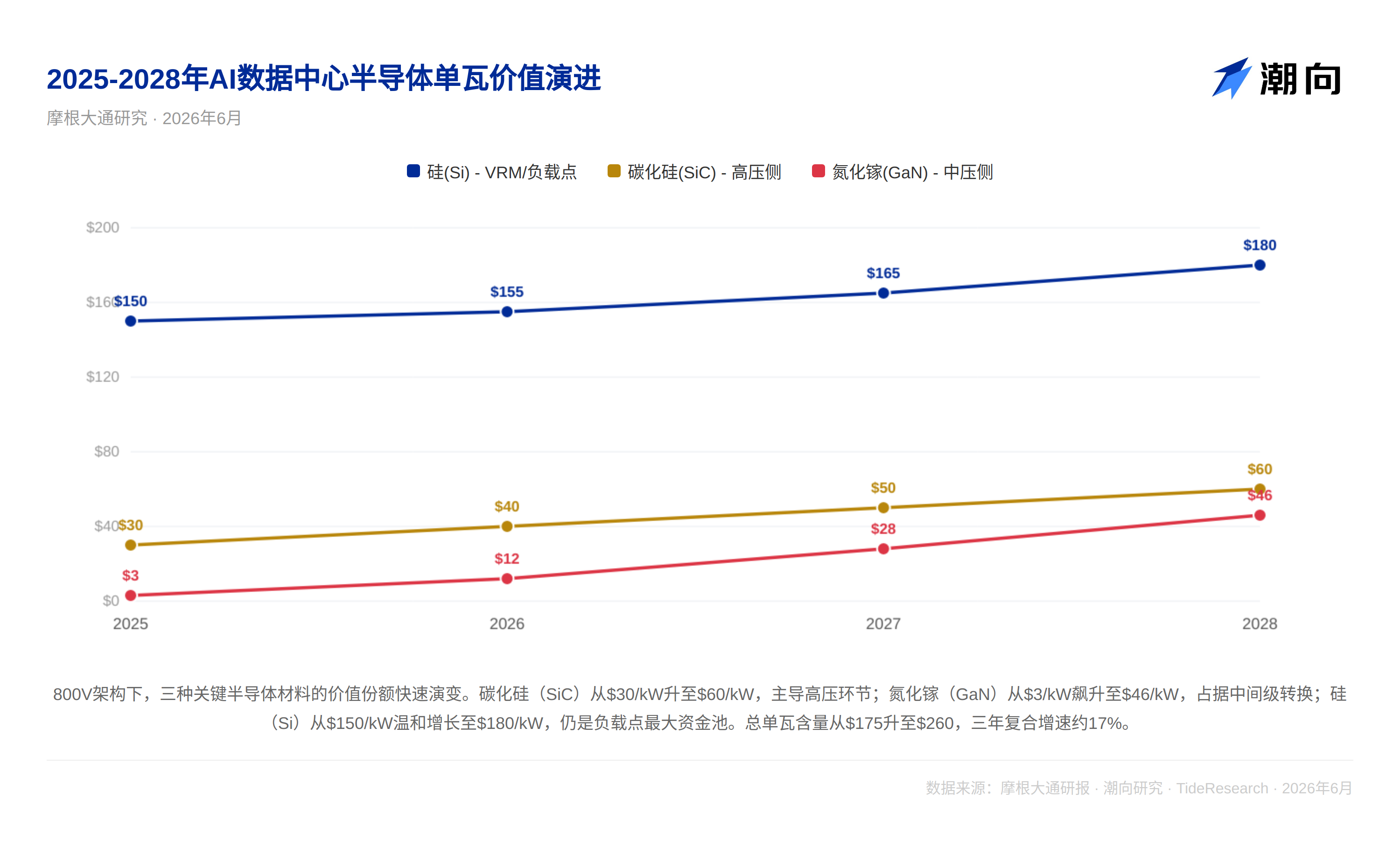
The report quantifies the share evolution for different semiconductor materials. SiC content per watt rises from $30 currently to a long-term $60, dominating the high-voltage grid-to-rack stage. GaN jumps from $3 to $46 per watt, winning in the intermediate 800V-to-low-voltage conversion stage. Silicon grows modestly from $150 to $180 per watt, still commanding the largest wallet share in VRM/point-of-load stages by virtue of cost effectiveness.

Key Player Landscape
The competitive landscape is taking shape. Infineon (strongest full-chain capability), MPS (VRM leader and key Nvidia supplier), and Renesas hold the largest shares in intermediate conversion and point-of-load stages, with Nvidia having selected several as suppliers. The report covers 12 core companies in detail: Infineon, MPS, Renesas, TI, STMicroelectronics, Navitas (GaN technology leader), ADI, ON Semiconductor, Rohm, Innoscience, AOS, and Wolfspeed.

Risks and Assumptions
The value of JPMorgan's report lies in its framework rather than a specific price target. $19.2 billion is not enormous in the overall AI infrastructure context, but the crucial point is: without enough power semiconductors, no amount of GPUs can run. The report has two under-explored assumptions. First, the delivery cycle for grid upgrades (median 3-5 years in the US) severely mismatches the two-year data center build cycle, creating execution risk that the 81 GW forecast for 2028 may face grid-side bottlenecks. Second, Nvidia holds pricing power across the entire value chain, and its choice of power suppliers for the Kyber rack will directly shape the competitive landscape. JPMorgan itself has investment banking relationships with covered companies such as Infineon and STMicroelectronics, which should be considered when evaluating specific stock recommendations.