
JPMorgan has sharply raised its global server shipment growth forecasts for 2026 through 2028, saying AI inference is now the main force holding up the server market as companies move models into practical use.
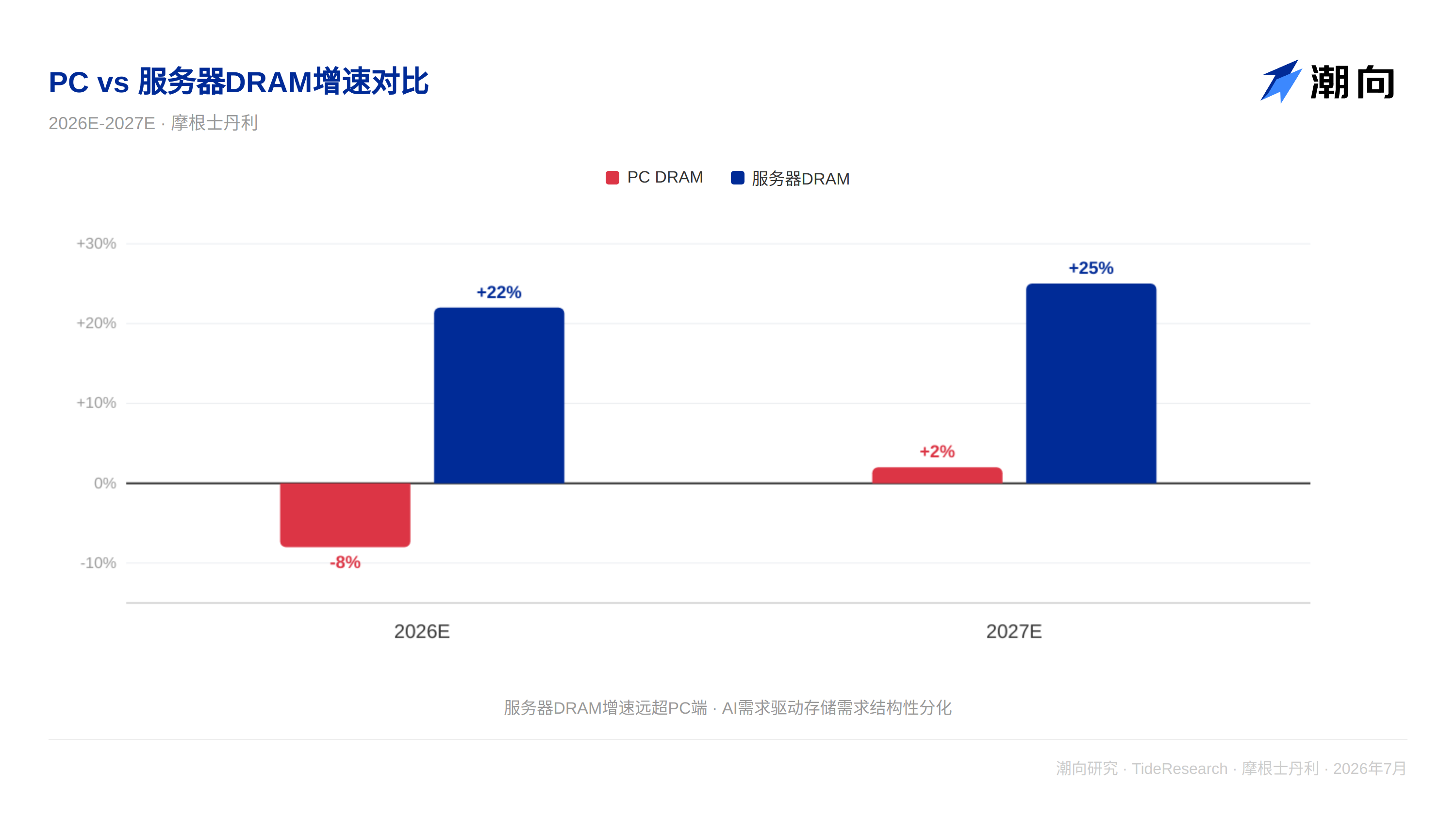
In the bank’s updated view, server shipment growth for 2026 was lifted from 15% to 22%, while the 2027 forecast was increased from 8% to 25%. PCs are moving in the opposite direction. JPMorgan expects PC shipments to fall 8% in 2026, versus 22% growth for servers. In 2027, it sees PCs up 2% and servers up 25%.
Servers rise as PCs face cost pressure and pulled-forward demand
JPMorgan described the split as structural. Servers are benefiting from sustained growth in AI inference demand. The bank estimates AI accelerator shipments will post a 50% compound annual growth rate from 2025 to 2028, while demand for AI server management-node CPUs will grow at a 74% annual compound rate.
By 2028, global server CPU shipments are projected to rise from 26 million units in 2025 to 68 million units, implying a three-year CAGR of 38%. Within that total, demand for Agentic AI server CPUs is expected to reach 53 million units and account for most of the incremental growth.
PCs, by contrast, are being squeezed by rising memory costs and demand that has already been pulled forward. JPMorgan said the bill of materials cost for high-end notebooks has climbed 30% over the past year, and memory’s share of BOM has jumped from single digits to 25%. Brands have raised prices to protect margins, but that has come at the expense of volume. The bank forecasts a 14% decline in consumer PC shipments in 2026 and a 4% drop in commercial PCs.
The report added that the PC market looked better than expected in the first half, but it did not read that as a sign of lasting strength. Instead, it linked the improvement to channel loading ahead of price increases and replacement demand tied to Windows 10, with second-half demand still seen as fragile.
Supply bottlenecks, not demand, are capping server growth
JPMorgan said the real constraint in servers is supply. Its channel checks showed server demand growing 35% to 40% year over year, yet shipment growth in 2026 can only reach 22% because bottlenecks remain across CPUs, substrates, memory, PCBs, passive components and power devices.
That supply tightness is also extending order visibility. According to the report, ODM order books now stretch into 2027. Orders that cannot be delivered this year are expected to roll into next year, which is one reason JPMorgan expects server shipment growth to accelerate again to 25% in 2027.
Among U.S.-listed names, the report said Dell Technologies (DELL) has accumulated a $51.3 billion AI server backlog. JPMorgan maintained an Overweight rating on Dell and raised its price target from $280 to $500. Hewlett Packard Enterprise (HPE) also received a higher price target, reflecting the bank’s confidence in AI and high-performance computing demand. Super Micro Computer (SMCI) was likewise cited as a beneficiary of continued growth in AI server demand.
Nvidia’s roadmap remains a swing factor
JPMorgan identified Nvidia’s roadmap as another major variable. It expects Vera Rubin to enter mass production on schedule in the third to fourth quarter of 2026, with full-year NVL72 shipments totaling 70,000 to 80,000 units. For 2027, the bank sees 85,000 to 95,000 units.
The next step, Vera Rubin Ultra, is expected to arrive in the second half of 2027 through 2028. But the report said the Kyber rack architecture is facing signal-performance challenges involving PCB and CCL materials, and that could delay the Feynman generation.
Value is shifting toward component suppliers
Changes in BOM structure are also shifting value across the supply chain. JPMorgan said GB300 and VR200 rack prices are 20% to 90% higher than GB200. Memory accounts for roughly 20% of VR200 BOM, compared with 10% during the GB200 cycle.
In the bank’s view, that creates a window for component makers through both volume and pricing gains, while PC brands face margin pressure from the same cost increases.
On the U.S. market side, JPMorgan highlighted Arista Networks (ANET) as a key beneficiary in data-center switching. Amphenol (APH) was cited for its exposure to high-speed connectors and denser rack interconnects. Corning (GLW), which has signed a multi-billion-dollar fiber supply agreement with Amazon, was described as a direct beneficiary of expanding data-center connectivity demand. Lumentum (LITE) was noted for exposure to optical communications and optical engines. Micron (MU) was identified as a direct beneficiary of rising memory costs and memory’s larger BOM share.
JPMorgan’s allocation call was straightforward: server components are preferred over ODMs, and PCs should be avoided as a whole.
How the report was framed in the TechFlowPost write-up
The TechFlowPost article said the most valuable part of the report was its distinction between the roles of inference and training in the current cycle. It argued that the market had previously focused on training compute, and is only now recognizing the persistence of inference demand.
The write-up also flagged two risks. One is that Agentic AI adoption could proceed more slowly than expected, which would leave the 53 million CPU demand forecast too high. The other is that signal issues in Nvidia’s Kyber architecture related to PCB and CCL materials could push CPO mass production to 2028. In that framing, the effect on the optical interconnect supply chain is a timing shift rather than an end state.
On PCs, the article said second-half supply-chain data may still come in below expectations, though the market has already priced in part of that weakness.
The piece stated that it was a整理 and interpretation by Chaoxiang Research of a JPMorgan research report dated July 15, 2026. It also said that the ratings, price targets, earnings forecasts and related judgments cited in the text were the views of the brokerage’s analysts, representing only the stance of their institution, not that of Chaoxiang Research, and did not constitute investment advice. The article closed with a warning that market decisions should be made independently and that the text should not be used as a basis for buying or selling any security.