The $19.2 Billion Blind Spot: GPU's Hidden Dependency
JP Morgan recently published a first-principles analysis of the AI data center power supply chain, challenging the industry’s singular focus on GPU shipments. The report reveals that the AI power semiconductor market is expected to grow from $2.7 billion in 2025 to $19.2 billion in 2028, representing a compound annual growth rate of 82%. This explosive growth is driven by an estimated 81 GW of new AI data center capacity by 2028, comprising 63 GW of new builds and 18 GW of replacements. AI chip power consumption accounts for approximately 54 GW, with network equipment and PUE overhead bringing the total to 81 GW. The semiconductor content per watt is forecast to rise from $175 today to $260 by 2028, directly fueling the market expansion.
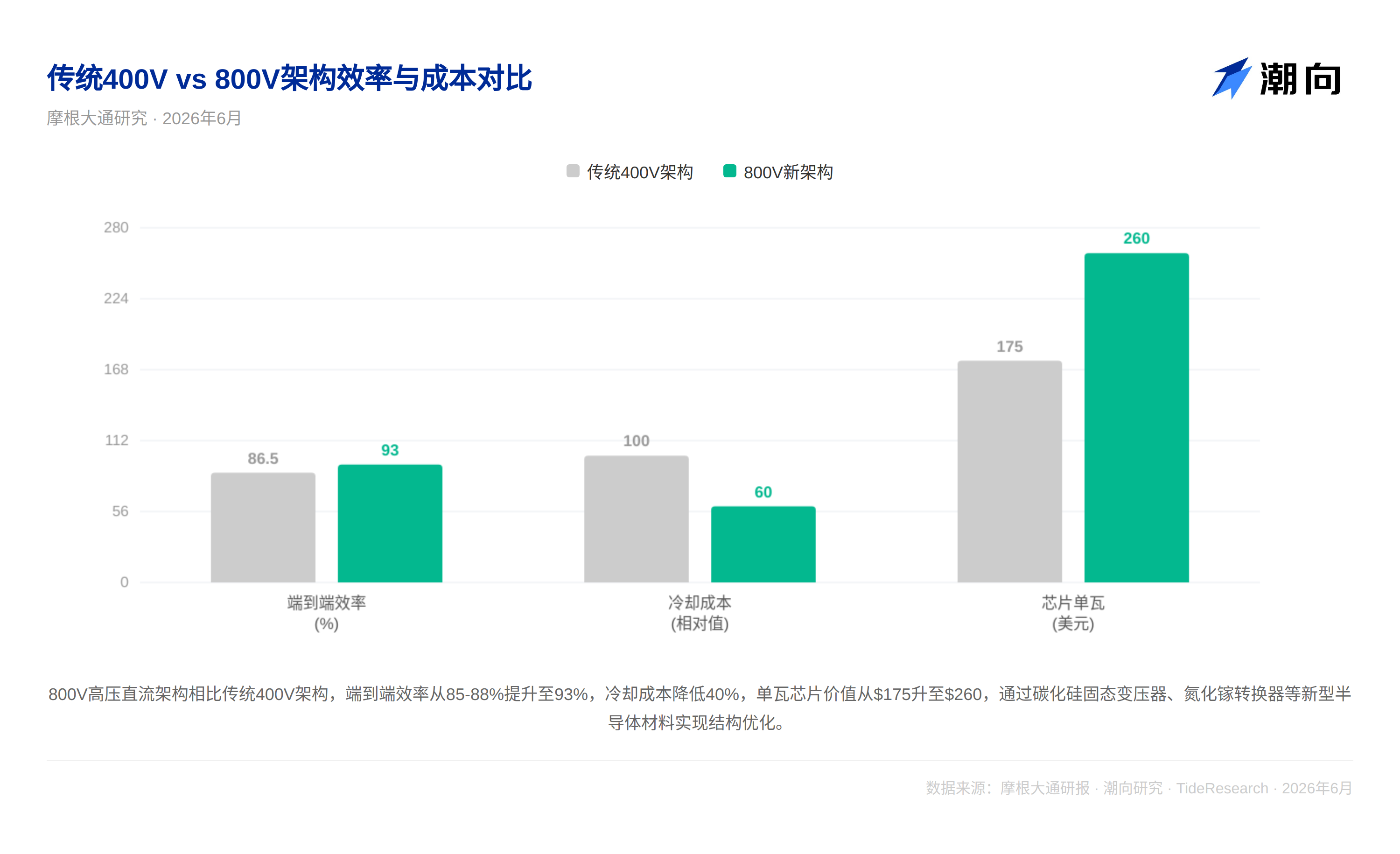
The current power delivery chain is highly inefficient: grid-level 10-35 kV AC power undergoes five conversion stages (transformer → UPS → PDU → server PSU → VRM), each losing 2-5% efficiency, resulting in end-to-end efficiency of only 85-88%. For a 100 kW rack, about 15 kW is wasted as heat requiring cooling. The report’s core technical insight is the impending transition to 800V high-voltage DC (HVDC) architecture, replacing traditional 400V AC. The physics is straightforward: doubling voltage halves current, reducing copper losses by a factor of four. More importantly, the architecture shift triggers a material change in semiconductor content: electromechanical components are replaced by silicon carbide (SiC) solid-state transformers, SiC solid-state circuit breakers, native DC battery backup units (with bidirectional DC-DC converters and BMS chips), and rack-level 800V-to-low-voltage DC-DC converters.

Timeline-wise, 2026-2027 will still see predominantly 400V AC architecture, but retrofit begins with side-car power shelves and power distribution racks. In the second half of 2027 through 2028, NVIDIA’s Kyber rack (600 kW per rack) will drive large-scale deployment of native 800V solutions. After 2028, solid-state transformers mature, merging side-car and transformer into a single SST device.

Semiconductor Material Share Shift: SiC Doubles, GaN Explodes
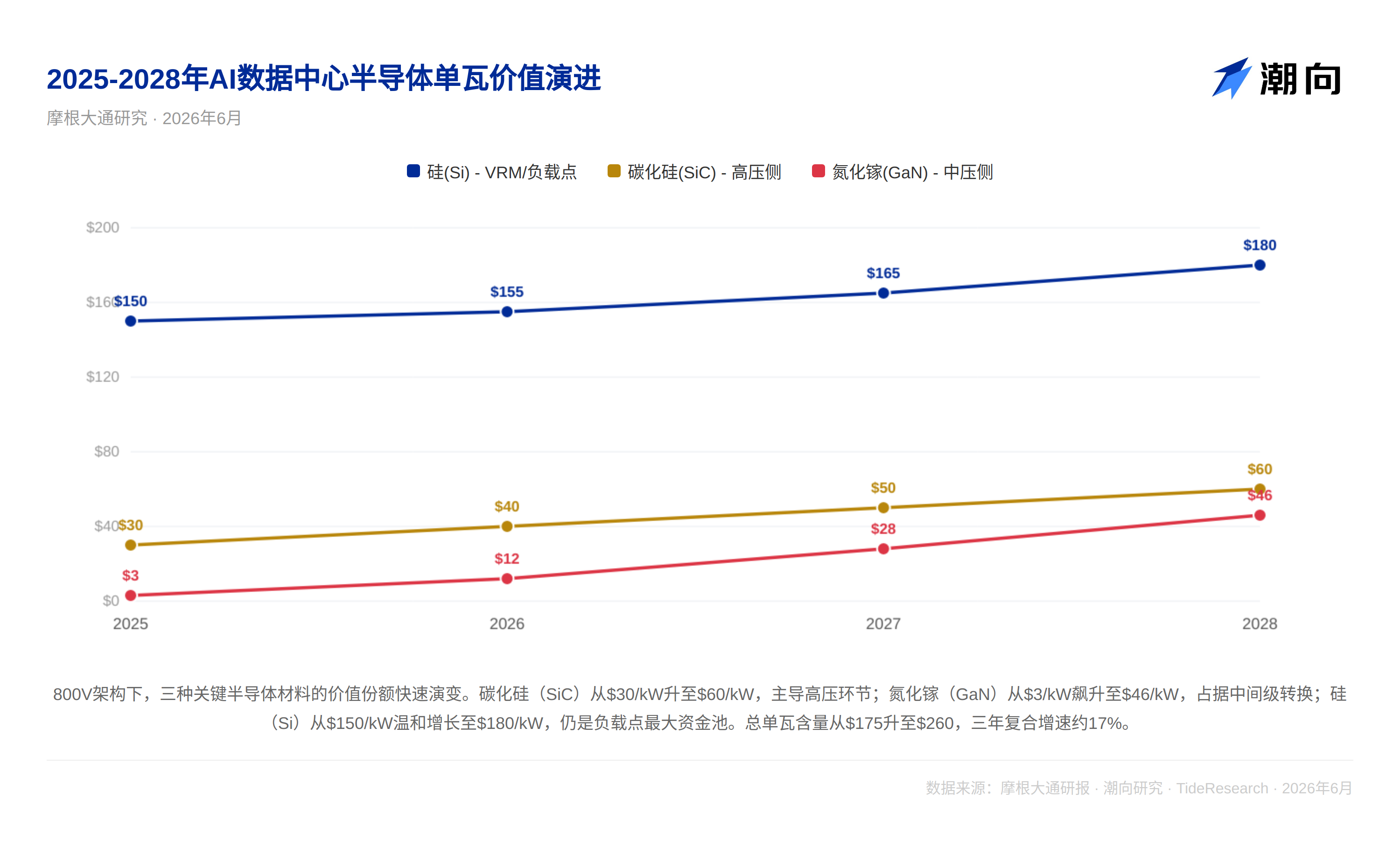
The report quantifies the changing semiconductor material landscape: SiC content per watt rises from $30 to $60 long-term, dominating high-voltage sections from grid to rack; gallium nitride (GaN) jumps from $3 to $46, winning in intermediate 800V-to-low-voltage conversion; silicon sees modest growth from $150 to $180, retaining the largest pool (VRM/load point) thanks to cost-performance. Key players are clearly mapped: Infineon (strongest full-chain presence), MPS (VRM leader, core NVIDIA supplier), and Renesas hold the largest shares in intermediate conversion and load point; NVIDIA has already selected several as suppliers. The report covers 12 core companies: Infineon, MPS, Renesas, TI, STMicroelectronics, Navitas (GaN leader), ADI, ON Semiconductor, Rohm, Innoscience, AOS, and Wolfspeed.

Risk and Investment Caveats: Grid Bottleneck and NVIDIA Pricing Power
The report highlights two significant assumptions that may face execution risk. First, the median US grid upgrade delivery cycle is 3-5 years, severely mismatched with the two-year data center construction timeline; the 81 GW forecast for 2028 may face grid-side bottlenecks. Second, NVIDIA holds strong pricing power across the value chain; its supplier selection for the Kyber rack will directly reshape competitive dynamics. Additionally, JP Morgan has investment banking relationships with several covered companies (Infineon, STMicroelectronics), which readers should consider when evaluating stock recommendations. While the $19.2 billion figure is relatively small within the broader AI infrastructure landscape, the critical point remains: without sufficient power semiconductors, no amount of GPUs can operate.