

JPMorgan said in a recent report that Bitcoin’s core structural risk is not Strategy’s planned coin sales, but a longer-term shift by traditional financial institutions toward building their own infrastructure outside public blockchains. Citing the report, The Block said the bank’s analysts view Strategy’s selling as a source of cyclical pressure, while the bigger threat would come if tokenization and settlement activity moves at scale to closed, permissioned chains. In that scenario, activity across the broader crypto ecosystem could slow, liquidity could decline, and Bitcoin prices could come under pressure.
Why institutions prefer permissioned networks
JPMorgan’s analysts said institutional investors generally favor permissioned blockchains because those systems can offer privacy protections, support know-your-customer (KYC) and anti-money-laundering (AML) controls, and provide stronger certainty on governance and regulation. The report said that trend poses a direct challenge to open public chains such as Ethereum.
The report also noted that the Bank for International Settlements, or BIS, has warned against using public blockchains for critical financial infrastructure and has instead promoted a permissioned unified ledger that would combine tokenized central bank money and bank deposits.
Tokenized deposits and CBDCs seen as alternatives
On the application side, banks are building dedicated blockchain systems of their own, and tokenized deposits are one example. The report warned that if non-transferable deposits become widely adopted, institutional demand for stablecoins could fall sharply.
It also said SWIFT’s blockchain project and central bank digital currency efforts such as the digital euro would strengthen regulated alternatives, narrowing the room available for stablecoins and open blockchain networks.
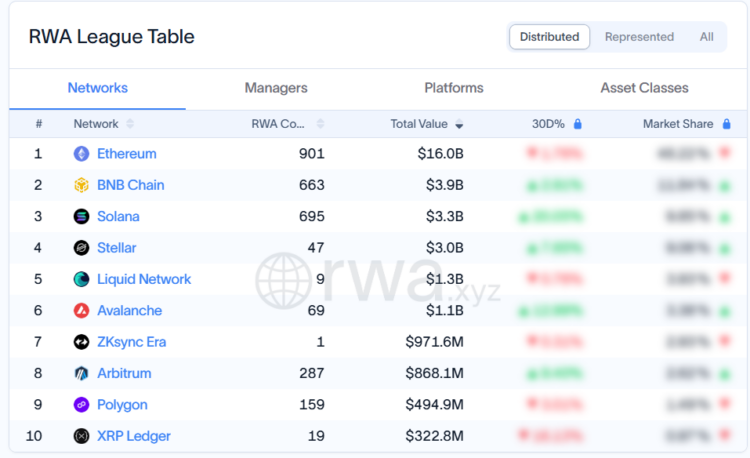
Data from RWA.xyz shows the market for tokenized real-world assets, measured by onchain asset value, currently stands at $33 billion. A significant share of that market is on Ethereum. Even so, JPMorgan’s analysts said Ethereum’s current share should be seen as an early experiment. As institutional use expands, they expect issuance of onchain assets to shift toward private infrastructure that better meets confidentiality requirements.
The report says legislation may not help public chains
JPMorgan also said that even if the United States passes the Clarity Act this year, the result may still not favor public blockchains. According to the report, if the law encourages banks to issue tokenized deposits, it could reinforce the position of traditional financial institutions and end up limiting the development of public-chain networks.
At the same time, the analysts said that outlook could be overturned under several conditions: if public and private chains settle into a hybrid model, if regulatory improvements drive wider stablecoin adoption, or if Bitcoin continues to function primarily as digital gold and a hedge asset.
An opposing view from Blocktrend
The article also cited a different view from Taiwan-based crypto media outlet Blocktrend, which argued that the end goal of putting assets onchain is interoperability rather than confinement within closed systems.
In an article titled “JPMorgan spent seven years learning it should use Ethereum,” Blocktrend author Hsu Ming-En said JPMorgan had long defended a closed architecture and launched JPM Coin on a private-chain framework in 2019. By 2026, he wrote, cumulative transaction volume had exceeded $3 trillion.
Hsu said the limitation of that closed network was that it only allowed transfers between internal clients and could not connect to external tokenized funds. Because of that constraint, he wrote that JPMorgan moved its deposit token in mid-2025 to Base, the Ethereum Layer 2 network developed by Coinbase.
In his view, that decision showed that openness is the key factor in determining the value of putting assets onchain. Under that reading, when financial institutions face demand for interoperability, client needs may eventually push them to connect with public blockchain networks.