


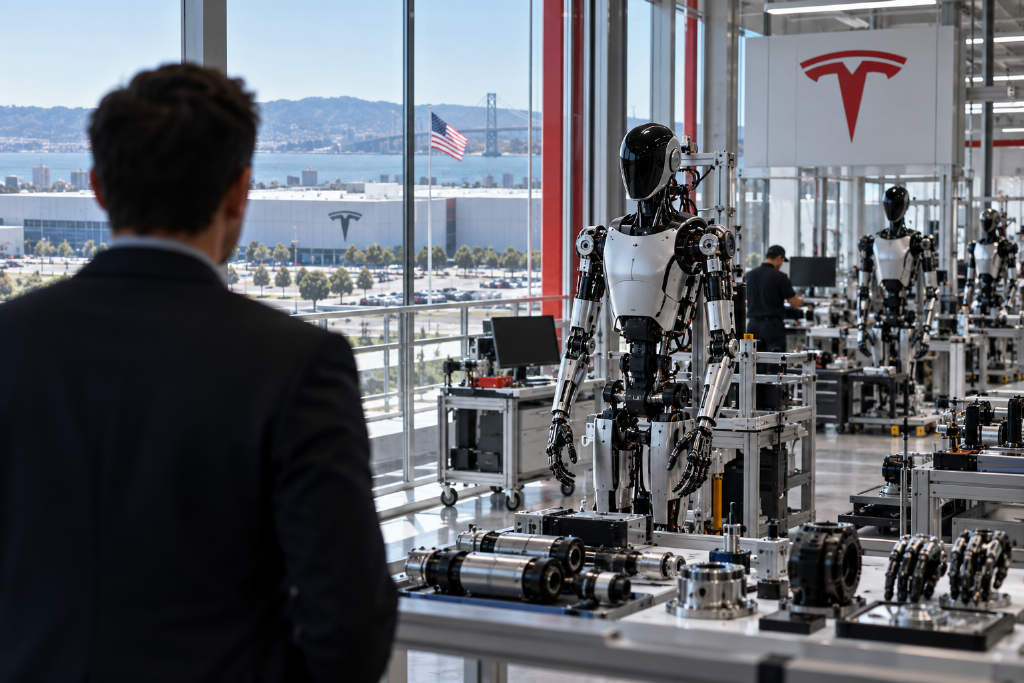
Tesla has begun producing Optimus in Fremont, but JPMorgan said the company’s volume outlook points to a slower ramp than some investors had expected. In a report dated Oct. 22, 2026, the bank said Elon Musk confirmed on Tesla’s third-quarter earnings call that Optimus production is underway and that shipments to other companies could begin as early as the end of next year. Before external sales start, however, Tesla is guiding to internal production of only 10,000 to 20,000 units over a 12-month period.

JPMorgan said that figure sits below the market’s most optimistic expectations and suggests a more measured production path.
Production has started, but scaling will take time
According to the report, Musk described manufacturing as an S-curve and said that "10,000 things" have to go right at the same time. The slowest component or process step sets the pace for the entire ramp.
JPMorgan said that means production may have started in Fremont, but scaling to meaningful volume will not happen quickly. Musk did not give a precise date for external commercial shipments, saying only that they could come in about a year. The bank said the target for external commercial deliveries is the end of 2027, while consumer applications are likely to come later because reliability, safety, and cost-effectiveness still need to be proven.
The report also said Tesla is deliberately reducing its reliance on China’s supply chain, a move that adds complexity to the ramp.
The hand remains the main hardware bottleneck
JPMorgan said the robot hand is still the key hardware constraint for Optimus. Design, durability, and tactile sensing need improvement, and the bank described those issues as critical hurdles for both industrial and consumer use cases.
Musk explicitly identified the hand as the main hardware bottleneck. JPMorgan added that human-like dexterity, reliability, and long-duration operation remain difficult to achieve. By contrast, the Optimus engineering lead appeared more confident in the body system, while details on reducers, vision, and battery technology were limited in this update.
Musk also said Tesla plans to show a video within the next one to two months of Optimus performing non-scripted tasks. JPMorgan said that should offer a clearer look at progress in generalized behavior.
AI5 integration is planned for April 2027
The report said Tesla plans to integrate the AI5 chip into Optimus in April 2027. JPMorgan estimated AI5 will provide about 10 times the compute of the current AI4, which could support more complex and more generalizable behavior.
Even so, several steps remain between the roadmap and deployment, including hardware integration, software stack migration, and validation in real tasks. JPMorgan also noted that Tesla did not provide specific updates on the vision system, cameras, or battery technology. The focus of this round of disclosures was the hand, onboard intelligence, and the compute roadmap.
Internal deployment comes first
JPMorgan said Tesla is building an Optimus Academy, where robots can self-play and generate training data. Early deployments will take place inside Tesla factories, where the robots will handle dangerous or repetitive work.
In the bank’s view, that approach allows Tesla to gather proprietary real-world data, test reliability, and iterate on hardware and software before selling to outside customers. Musk also said humanoid robots still have a long way to go before reaching industrial-grade automation.
China checks point to stronger demand for components
JPMorgan said its field work at the China International Industry Fair supported the same conclusion. The clearest demand is coming from suppliers of sensors, 3D vision, data collection equipment, reducers, and dexterous hands. Full humanoid robot manufacturers have not yet become the center of demand.
Leader Drive management said physical AI now contributes more than 35% of its business and that the company plans to expand capacity over multiple years. Orbbec said robot-related orders have risen sharply, especially for data collection hardware and 3D vision modules.
JPMorgan said demand is still concentrated in research, pilot programs, and data collection rather than large-scale end deployment. The bank wrote that there is still a wide gap between humanoid robot demos and industrial-grade automation, with bottlenecks in perception consistency, operational reliability, and the ability to deliver repeatable return on investment in real workflows.
JPMorgan prefers component suppliers over robot OEMs
The bank said it has become more selective on China’s humanoid robot supply chain. Recent gains in Chinese robot OEMs, led by Unitree and UBTech, were described by JPMorgan as sentiment-driven.
As the market absorbs Tesla’s more gradual production outlook, JPMorgan said it is cautious on robot OEMs over the next one to three months and sees a risk of disappointment, especially for Unitree, Estun, and UBTech.
By contrast, the bank remains constructive on component suppliers. It said Hengli Hydraulic and Sanhua Intelligent Controls are confirmed suppliers in Tesla’s robot supply chain. Their share prices, according to the report, do not yet reflect much of the optimistic Tesla robot narrative, and after the pullback since the first half of 2025, their price-to-earnings valuations are near or below historical mid-cycle averages. JPMorgan also said both companies have solid underlying businesses.
Leader Drive was listed as a top component pick because its moat, scalability, and contribution from physical AI are more concrete. Orbbec ranked next, with JPMorgan citing strong positioning in 3D vision and data collection tools, while also warning that near-term earnings risk should be watched.
JPMorgan preference ranking
- Hengli Hydraulic = Sanhua Intelligent Controls (both Overweight)
- Leader Drive (Overweight)
- Orbbec (Overweight)
- Inovance Technology (Neutral)
- UBTech (Neutral)
- Estun = Unitree (both Underweight)
Key risks remain tied to ramp and execution
JPMorgan listed several risks: a slower-than-expected production ramp at Tesla, unresolved hand-related bottlenecks, delays in AI5 integration, later-than-expected external commercial shipments, and added complexity from localizing the supply chain away from China.
Overall, the bank maintained Overweight ratings on Hengli Hydraulic, Sanhua Intelligent Controls, Leader Drive, and Orbbec; Neutral on Inovance Technology and UBTech; and Underweight on Estun and Unitree. Its central call was that Tesla’s lower-than-expected Optimus production guidance requires the market to reset expectations for robot OEMs, while the more immediate supply-chain opportunity is shifting toward components.
This article is a summary and interpretation of a third-party brokerage report from JPMorgan dated Oct. 22, 2026, combined with public market information. The ratings, target prices, earnings forecasts, and related judgments cited in the report are the views of the brokerage analysts and represent the position of their institution, not TechFlowPost, and do not constitute investment advice.
Market risk exists, and investment decisions should be made independently. This article should not be used as the basis for buying or selling any security.
