
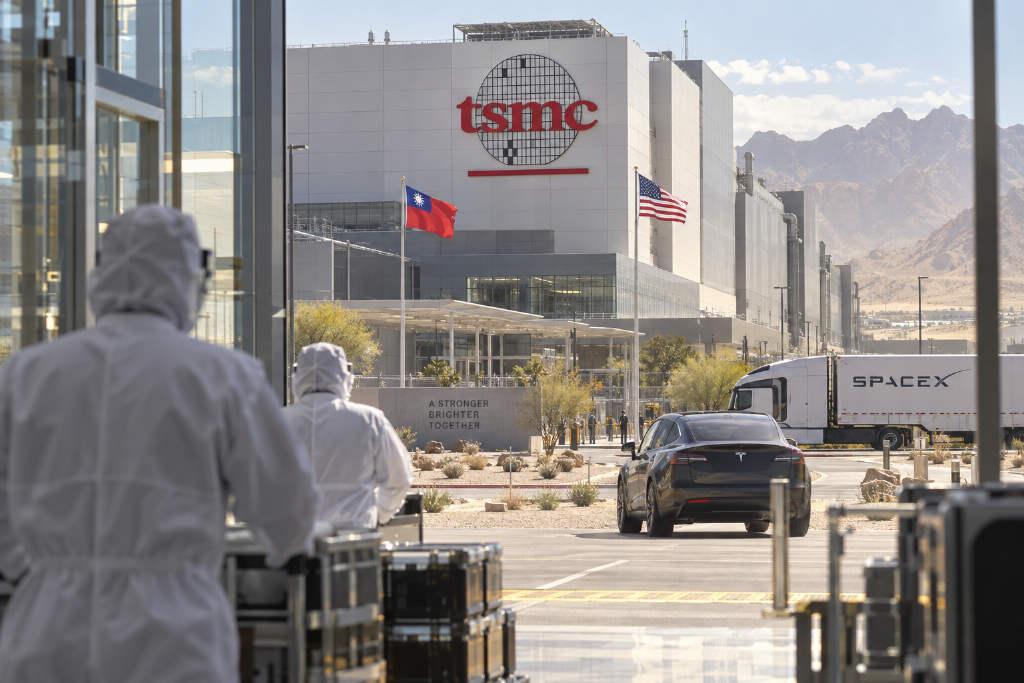
JPMorgan said in an Oct. 5 research note on Taiwan Semiconductor Manufacturing Co. that if a reported U.S. semiconductor capacity partnership with Elon Musk’s companies moves forward, TSMC would still be expected to retain control over process technology and overall execution.
The bank was commenting on Musk’s weekend remarks that Tesla and SpaceX are in talks with TSMC over U.S. semiconductor capacity. JPMorgan said such a deal, if it materializes, could also weaken the narrative that customers may build their own fabs to compete directly with TSMC, which it said would support the company’s valuation.
JPMorgan kept its Overweight rating on TSMC and maintained a NT$3,300 price target. It also said GUC (3443) could benefit if Tesla shifts a larger portion of its business back to TSMC.
Two structures outlined in the note
According to the report, Musk said over the weekend that Tesla and SpaceX were discussing U.S. capacity with TSMC. JPMorgan noted that this came shortly after reports the previous week that TSMC was considering a second U.S. fab cluster in Texas.
Based on its supply-chain checks, JPMorgan said early discussions pointed to two possible structures: a pure-play foundry relationship, or a joint-venture arrangement similar to JSMC and ESMC that would provide Tesla and SpaceX with dedicated capacity access.
On timing, the bank said it expects the fab to begin mass production in 2030 and beyond. It added that the first three phases of TSMC’s U.S. expansion would still likely remain focused on Arizona. The note also said U.S. fab capacity has long been a key constraint on broader foundry cooperation between Tesla and TSMC, and that any change on this front could expand TSMC’s foundry opportunity.
JPMorgan says TSMC would keep technology and operating control
JPMorgan said TSMC would still control process technology, ownership of the technology and fab operations, and that it is unlikely to agree to any technology-sharing arrangement. The bank said this would be consistent with how TSMC works with other customers.
The note drew a contrast with Intel’s TeraFab agreement with Tesla on the 14A process. As for a co-investment structure, JPMorgan said that remains possible, but in theory TSMC should hold a majority stake. In other words, even if Tesla and SpaceX invest, the bank does not expect them to receive special treatment beyond dedicated capacity.
Compute demand seen as the main driver
On the rationale behind the talks, JPMorgan said strong demand for compute is the main driver. The report said SpaceX has already been able to sell compute at $20 to $30 per watt, which it said points to attractive returns on invested capital in compute sales and creates urgency to build new capacity.
JPMorgan also said there are signs that some competing process nodes are moving more slowly toward volume production. It cited the possibility that Tesla AI6 may reconnect with TSMC, and that new ASIC projects may also use TSMC processes rather than Intel. The bank said more information is still needed to confirm those points, but added that the direction of travel would strengthen TSMC’s competitive position.
At the same time, JPMorgan said TSMC now appears more willing to accelerate capacity expansion because compute demand is strong and the company does not want to remain a major bottleneck for customers over the long term.
NT$3,300 target maintained; GUC named as a possible winner
On valuation, JPMorgan said a potential partnership with Tesla would weaken the competitive narrative and help support TSMC’s price-to-earnings multiple. The bank based its NT$3,300 target on 20 times estimated EPS over the next 12 months, implying about 28% upside from the current price.
In the supply chain, JPMorgan said GUC could benefit if Tesla shifts more business back to TSMC. GUC is currently Tesla’s design partner for AI5, though it had previously faced the possibility of losing share in AI6.
Independent analyst Alex says the deal may be hard to close
Chain News reported yesterday that independent semiconductor analyst Alex believes TSMC is unlikely to accept the terms Musk wants, making the proposed cooperation difficult to complete.
- TSMC has historically kept majority ownership in its overseas joint ventures, which differs from Musk’s reported concept.
- Musk previously announced a 14A partnership with Intel, and the risk of leakage involving TSMC’s advanced process know-how may outweigh the benefit of taking the order.
- Advanced process technology in Taiwan is subject to strict controls and review.