
This article was originally published by Bit.Fan. For more cryptocurrency news and market insights, visit www.bit.fan.
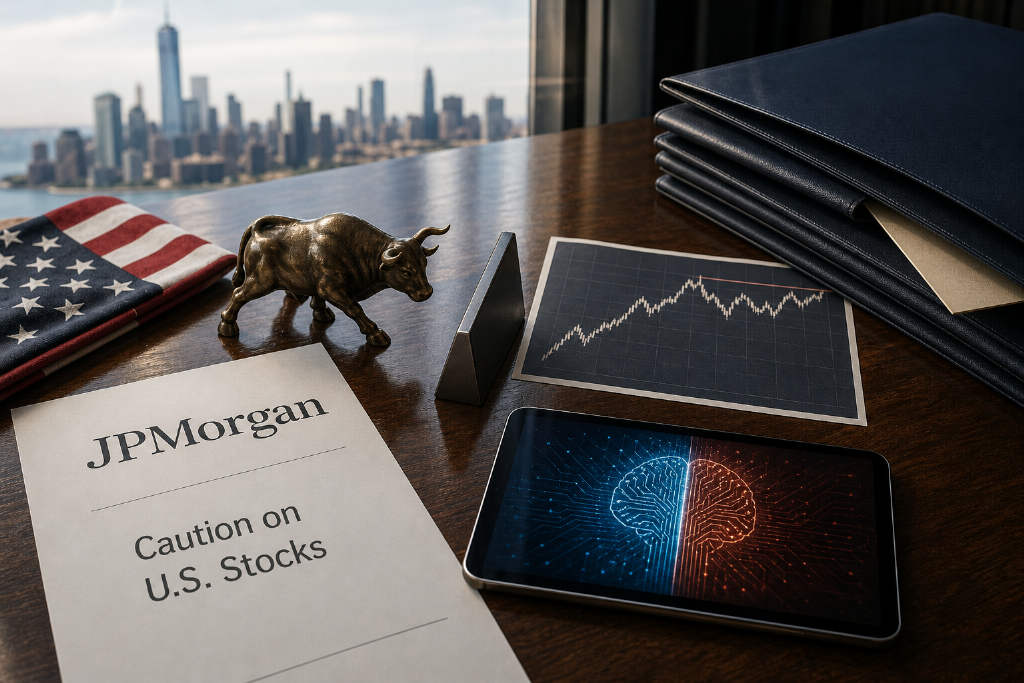
JPMorgan Warns on U.S. Stocks as AI Splits Grow, Sees a September De-Risking Window
N
News EditorJPMorgan said U.S. stocks are still in a bullish trend and near record highs, but internal rotation, rising technical resistance and seasonal weakness from August through October are adding risk. The bank said investors may want to trim equity exposure modestly rather than move into aggressive defensive positioning. Technical strategist Jason Hunter said the S&P 500 has not printed a clear top signal, though market internals are shifting. JPMorgan also pointed to AI as a key source of risk, citing the gap between AI hardware names and large cloud companies, recent weakness in Nvidia, Micron and Broadcom, and policy pushback tied to data center power demand. Even so, the bank raised its year-end S&P 500 target to 8,000. In the near term, Nvidia's earnings, remarks by Fed Chair Waller at Jackson Hole and PCE inflation data are expected to help shape September's market direction.
JPMorgan said U.S. stocks are still in a bullish trend and close to record highs, but market internals are showing more stress. The bank pointed to sector divergence, stronger technical resistance and the seasonal weakness that often runs from August through October. Its view is that investors can consider trimming stock exposure, but do not need to rush into aggressive risk-off moves.
Technical strategist Jason Hunter said the S&P 500 has not given a clear top signal yet, but the structure beneath the index is changing. JPMorgan recommended continuing a trend-following stop-loss approach and said it may consider reducing equity exposure further before early September if the current setup persists.
The bank also leaned on historical data. Bank of America data show that since 1928, the S&P 500 has averaged a return of about -0.02% during the August-to-October stretch. Goldman Sachs data show that since 1974, in midterm election years, the index's median return from early August to Election Day has been 0%.
AI is the main risk JPMorgan is watching. The bank said the split between AI hardware names and large cloud companies bears some resemblance to the period before the peak in telecom capex during the 2000 internet bubble. Recent weakness in Nvidia, Micron and Broadcom has added to concern.
Investors are now waiting for Nvidia's earnings to judge whether AI infrastructure spending can still support rich valuations. JPMorgan also flagged policy resistance tied to the power demand of data centers as a new risk for the AI trade.
Even with those warnings, JPMorgan still sees a strong long-term case for U.S. stocks and raised its year-end target for the S&P 500 to 8,000. In the near term, Nvidia's earnings, remarks by Fed Chair Waller at Jackson Hole and PCE inflation data are set to be the key inputs for September's market move.
200
Disclaimer:
The market information, project data, and third-party content displayed on this platform are for industry information sharing only and do not constitute any form of investment advice or return commitment.
Cryptocurrency trading carries high risks. Users should fully assess their risk tolerance and make independent decisions. All profits, losses, and legal responsibilities are borne by the users themselves.