

JPMorgan said the deleveraging overhang in U.S. equities has not cleared. In a report published on July 15, the bank’s global markets strategy team said the investor deleveraging process that started in June is still unfolding across three areas: leveraged equity ETFs, the options market, and margin accounts. The bank said all three still have room to deleverage, a setup it expects to weigh on stock performance over the coming months.
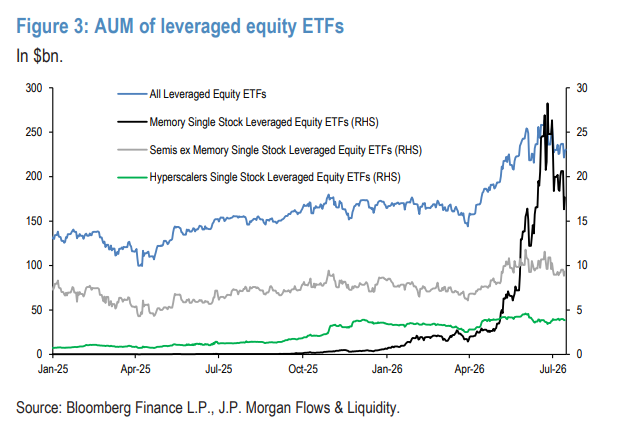
JPMorgan estimates it will take about three months of choppy trading for the ratio of leveraged equity ETF assets to underlying market capitalization to return to pre-April levels.
Leveraged ETFs are still working through their built-in reset
JPMorgan described the leveraged equity ETF problem as a mathematical trap created by volatile markets. The report used a simple example: if the underlying index falls 10% one day and then rebounds 11.1% the next day to get back to flat, a 3x leveraged ETF would lose 30% on day one and gain 33.3% on day two, yet still end with a 7% net loss.
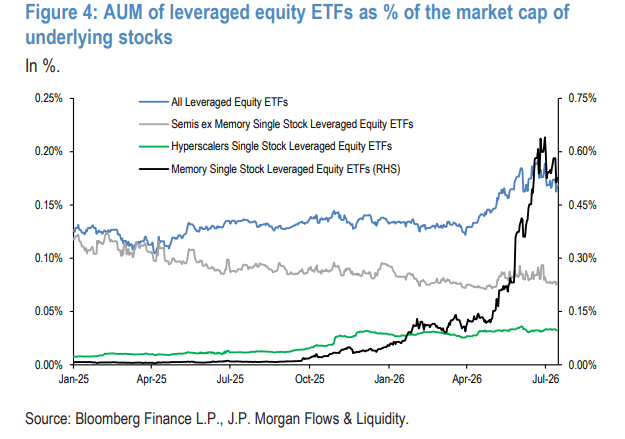
That dynamic means a range-bound market can erode leveraged ETF assets on its own. The bank called it a built-in self-correcting mechanism.
Its data shows that since the peak, assets in leveraged memory-chip equity ETFs have dropped 34%, while leveraged equity ETFs as a whole are down 13%. Even so, the decline in the ratio of ETF assets to the market capitalization of the underlying stocks has been much smaller.
JPMorgan said the asset-to-market-cap ratio for leveraged memory-chip equity ETFs stands at three times the average level for all equity ETFs, which helps explain why volatility in memory-chip stocks has been much higher than in the broader market. The bank added that even for the broader leveraged equity index ETF complex, the ratio remains high relative to its own history, pointing to a market-wide issue rather than one confined to a single sector.
The team said it would likely take another three months of range-bound trading for that ratio to fall back to where it was before April. It also noted that fresh inflows into leveraged ETFs in July have lengthened the time needed for the deleveraging process to run its course.
Options and margin remain the main retail pressure points
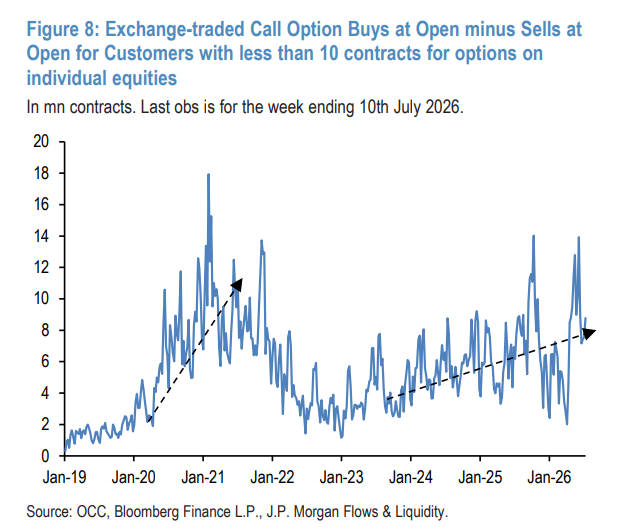
In options, JPMorgan tracks a retail call-buying indicator based on OCC data covering clients with positions of fewer than 10 contracts. That gauge reached nearly 14 million contracts on June 5, matching the historical highs seen in October 2025 and November 2021.
According to the report, previous peaks in that indicator were followed by months of adjustment in technology stocks, with bottoms often lining up with a drop to between 2 million and 4 million contracts. The gauge has already moved down sharply from its peak, but JPMorgan said tech stocks could remain under pressure if it ultimately falls to that 2 million-to-4 million “capitulation” zone.
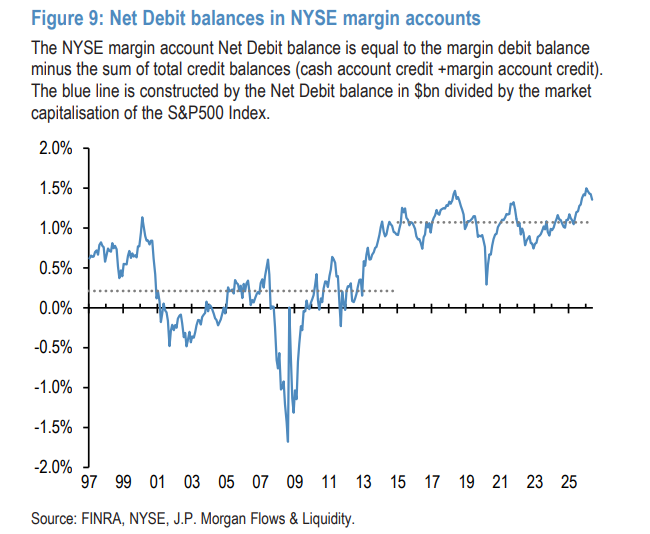
On margin, the bank uses NYSE Net Debit Balance as a proxy for U.S. retail investor leverage. It said the current reading remains at historically extreme levels, comparable to the peaks seen in late 2021 and mid-2018. Both of those episodes were followed by several months of stock market adjustment.
JPMorgan said margin accounts have shown some recent signs of pulling back, but “a substantial deleveraging is still needed before they stop being a significant headwind for equities.”
By contrast, leverage in risk-parity funds has largely normalized and is no longer a major source of resistance for the market.
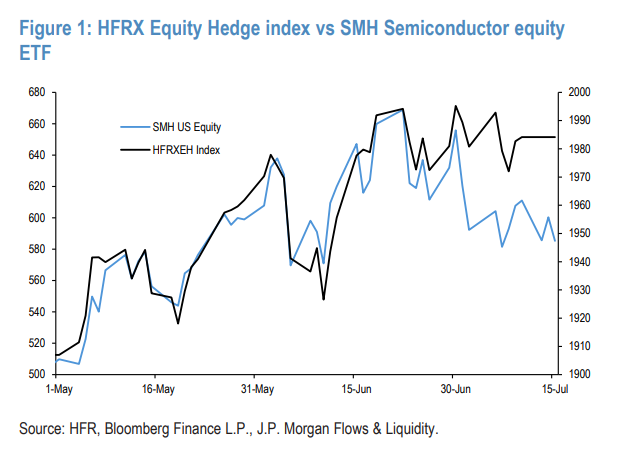
Hedge funds may already be cutting semiconductor exposure
The report also flagged a shift in hedge fund positioning. In June, even as the S&P 500 and Nasdaq declined, equity long/short funds and equity sector TMT funds posted positive returns of 1.2% and 3.7%, respectively.
JPMorgan tied that performance to strength in semiconductors. The SMH semiconductor ETF rose 9.5% in June, while U.S. mega-cap cloud computing stocks fell 14.5% over the same period.
By July, though, the signal had changed. JPMorgan said the correlation between daily reported equity long/short fund performance and semiconductor stocks had fallen noticeably. Its high-frequency leverage proxy also showed leverage coming down in July after reaching the highest level since 2017 in June.
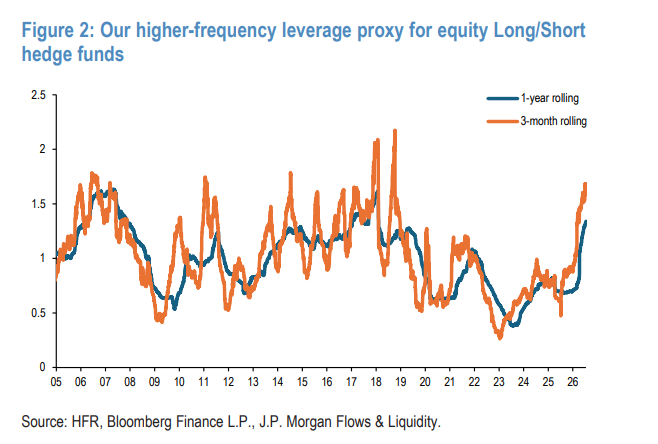
Based on those signals, the bank said equity long/short hedge funds may have reduced semiconductor exposure during July.
Second-half supply and demand still points positive
JPMorgan said deleveraging is a near-term drag, but the longer-term equity supply-demand setup still looks supportive once that pressure fades.
The bank laid out its flow expectations across investor groups.
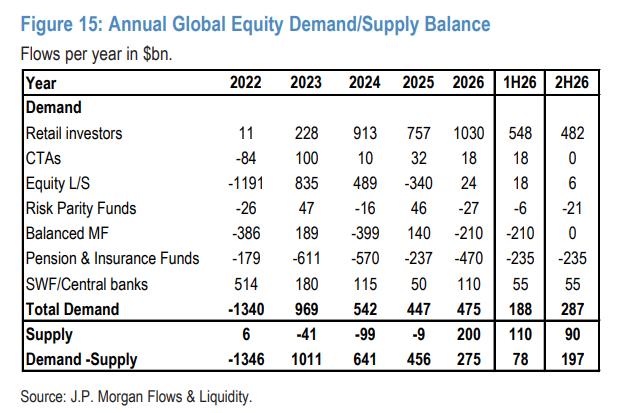
Demand side
- Retail investors remain the largest support. Year-to-date inflows have reached about $550 billion, full-year inflows could exceed $1 trillion, and JPMorgan expects roughly $482 billion more in the second half.
- Sovereign wealth funds and central banks are expected to contribute about $110 billion of equity demand for the full year, with about half of that in the second half.
- Equity long/short hedge funds, which manage about $1.4 trillion, have bought about $20 billion net year to date, but JPMorgan sees almost no room for further position increases in the second half.
- CTA trend-following funds have a momentum signal z-score of about 1.0, and are expected to generate close to zero net buying in the second half.
Supply side pressure
- Pension funds and insurers continue to reduce equity exposure structurally. JPMorgan expects net selling of about $470 billion for full-year 2026, including about $235 billion in the second half.
- Balanced mutual funds have already sold about $210 billion net year to date, with most of that concentrated in June.
Putting those pieces together, JPMorgan estimates total net equity demand for 2026 at about $475 billion, with net supply of about $200 billion, including three AI-related IPOs. That leaves net demand of about $275 billion for the year, including about $197 billion in the second half.
The bank said this positive supply-demand balance does not conflict with the near-term deleveraging story. In its words, deleveraging could dominate the market over the coming months and produce large price swings, while the equity supply-demand balance acts more as a longer-run background force that may offer support after the deleveraging pressure recedes.