

JZL Capital said in its weekly report covering July 27 to Aug. 2 that four themes shaped markets over the period: the Federal Reserve held rates steady but internal divisions widened sharply, lower energy prices drove a cooler PCE print while core services inflation remained sticky, Chinese and U.S. equities showed deeper structural dispersion, and Bitcoin stayed under pressure as oil remained elevated and U.S. spot ETF flows turned negative again.
Fed holds, but the vote points to a hawkish pause
The July Federal Open Market Committee left the federal funds rate unchanged at 3.50% to 3.75% in a 9-3 vote. Three members explicitly favored a 25 basis point increase, which the report described as a hawkish pause rather than a broadly shared neutral stance.
On growth, the Fed said the U.S. economy is showing “impressive resilience,” with positive trends and solid expansion even after recent shocks. It also singled out business investment as a standout feature, saying the rise in high-tech capital spending has been remarkable.
On inflation, the committee said price pressures remain elevated relative to its 2% goal and stressed that it is not relying on any single data point “as cover or as an excuse.” It added that if inflation stays elevated through the forecast period, interest rates could still be part of the solution. JZL wrote that while the policy rate was left unchanged, markets have already pushed up nominal and real Treasury yields in response to inflation and growth data, which means financial conditions have tightened in practice.
On employment, the Fed said job gains have kept pace with workforce growth and the unemployment rate has changed little. Policymakers, in its words, are doing fairly well on the full-employment side, but “considerably less well on prices.”
PCE cools, but the move came mostly from energy
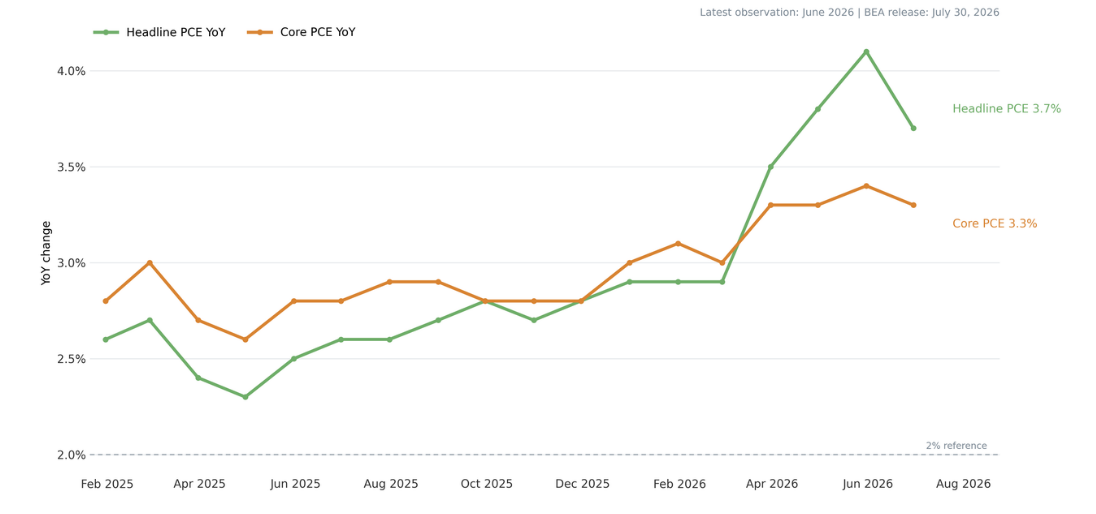
U.S. June PCE inflation fell to 3.7% year over year from 4.1% in May, while core PCE eased to 3.3% from 3.4%. JZL said the bigger drop in headline PCE than in core PCE shows that the disinflation impulse came mainly from energy, not from a broad-based improvement in underlying inflation.
On a monthly basis, lower energy prices pushed PCE down 0.1% in June. The report said that helps near-term inflation expectations, but services prices are still making a positive contribution, which means core inflation has not broadly weakened.
Long-end Treasury yields keep climbing
In rates, the 2-year Treasury yield fell 8 basis points, while the 10-year and 30-year yields rose 10 basis points and 15 basis points. JZL said that mix points to some cooling in near-term hike expectations, but rising long-term inflation concerns, fiscal supply pressure and term premium.
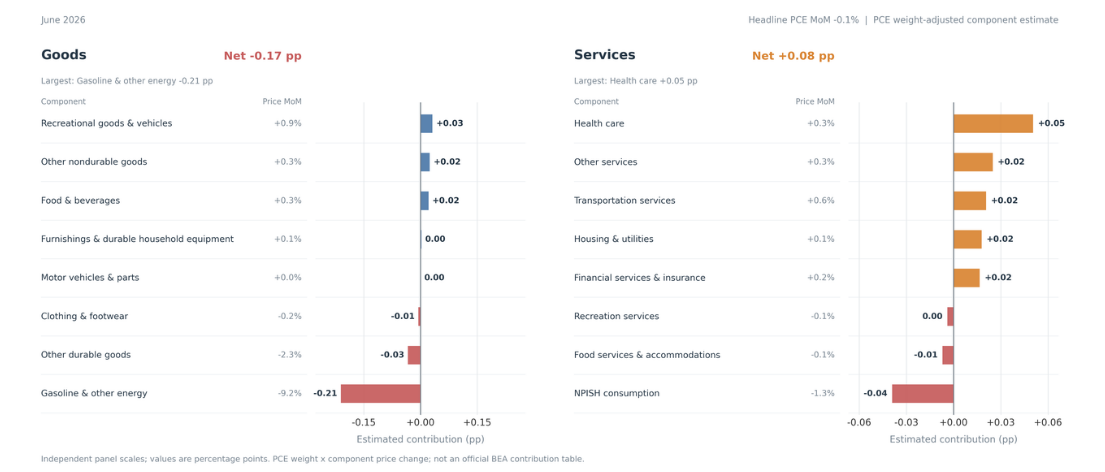
The MOVE index climbed to 83.02, signaling more uncertainty around the rate path and adding pressure to expensive growth stocks.
Low VIX closes contrast with large intraday swings
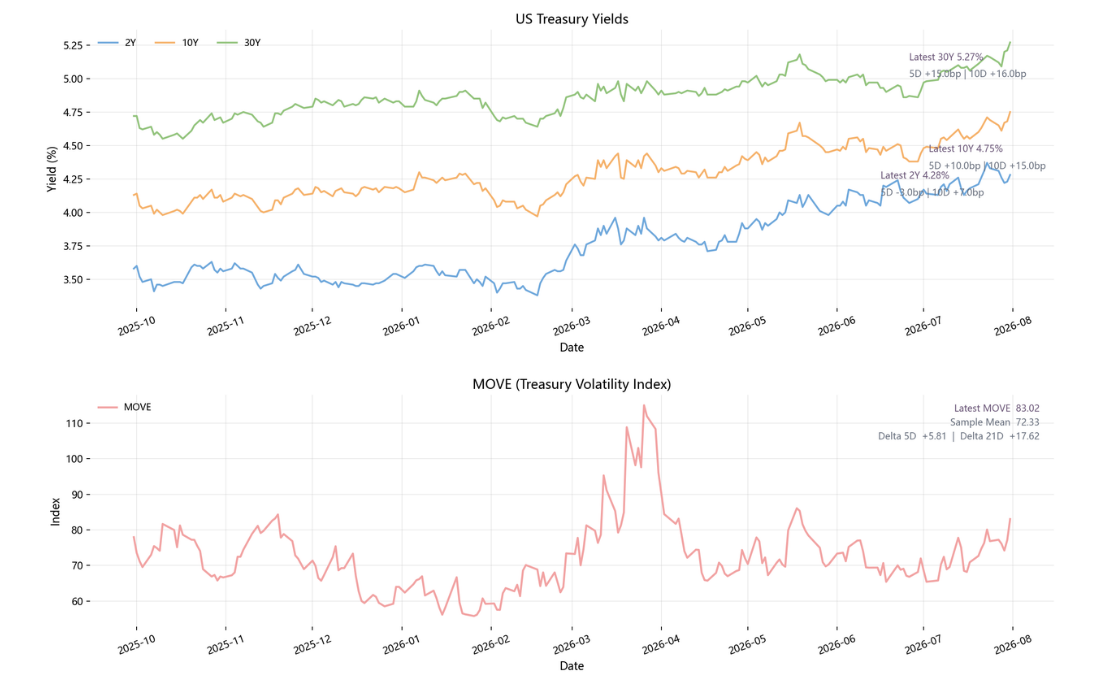
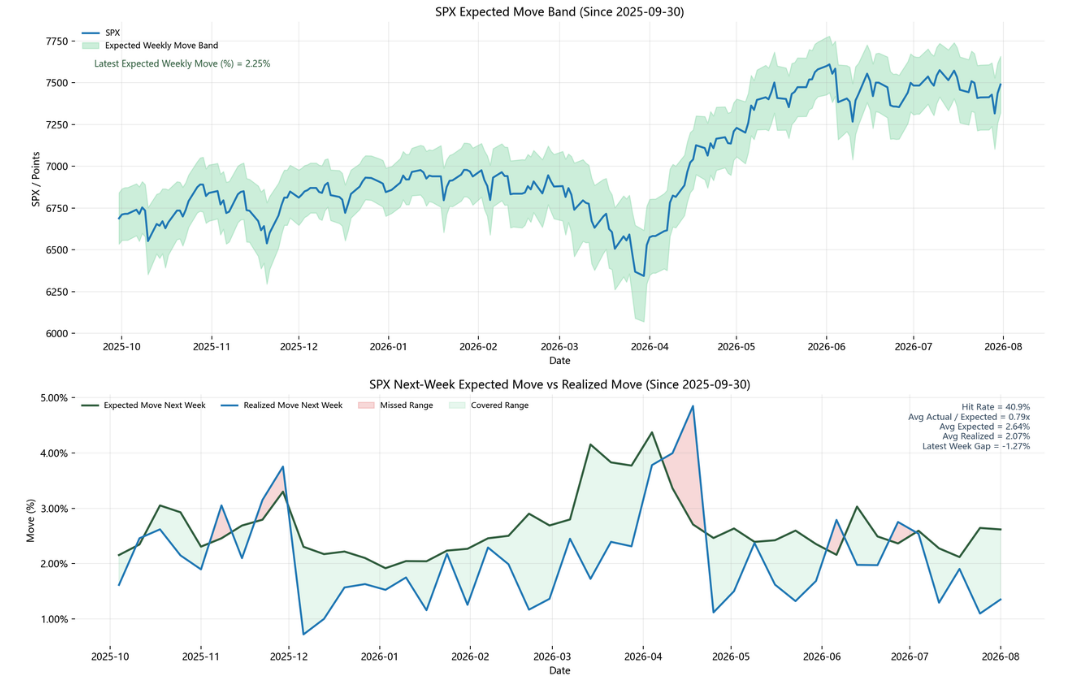
The VIX closed at 15.99, below the sample average of 18.63 and in the 23.8th percentile of its 252-day rolling range. According to the report, that leaves U.S. equities with relatively low risk pricing at the close.
At the same time, the week’s single-day high-low amplitude reached 17.1%, creating a gap between low closing volatility and larger intraday movement. Expected weekly volatility was about 2.25%, while realized volatility came in 1.27 percentage points lower. JZL said options markets still embed a rich long-run risk premium. If macro events remain calm, volatility could decline, but subdued realized volatility can also crowd positioning and magnify any surprise shock.
Markets now treat a September hike as the base case
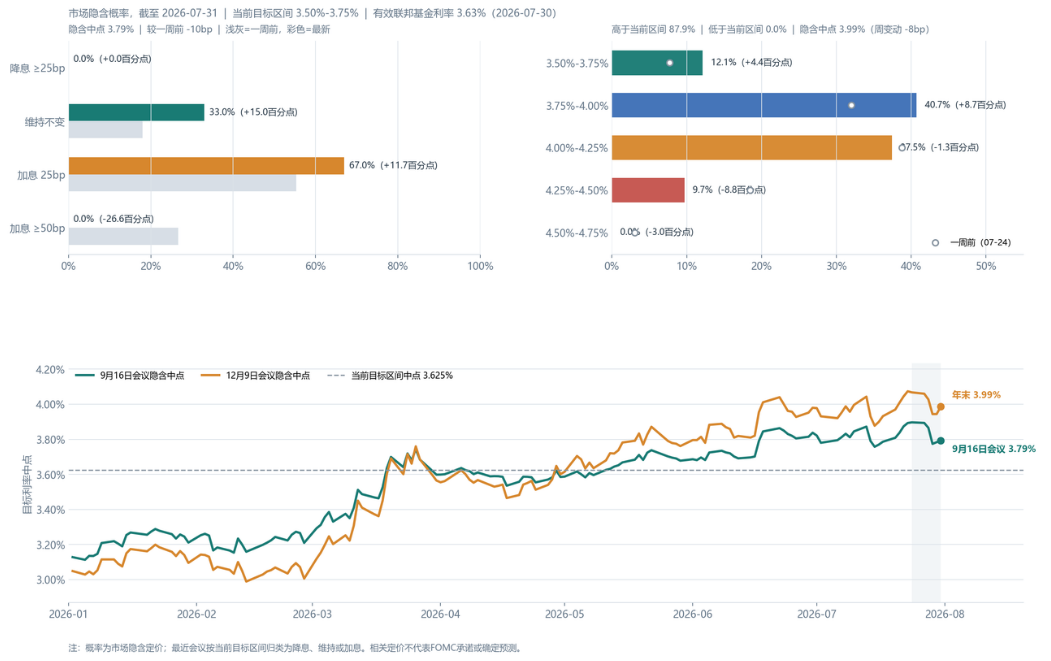
JZL said market pricing for a 25 basis point rate increase in September rose to 67%, making it the base case. The probability that year-end rates finish above the current range climbed to 87.9%.
China equities diverge as Beijing stocks rebound and STAR Market pulls back
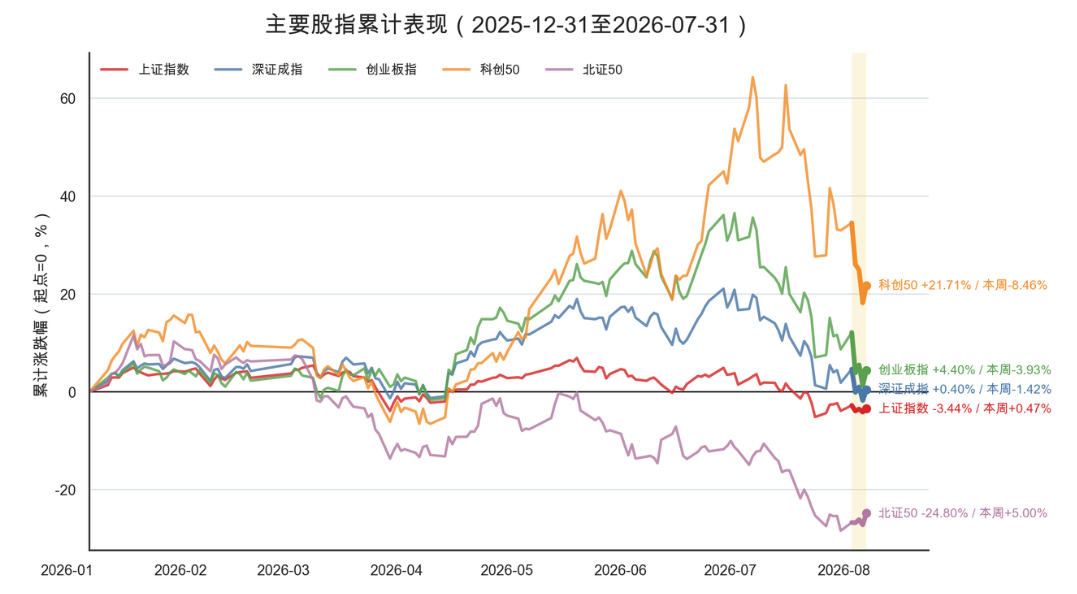
In China, the report said A-shares remained highly split. The Beijing Stock Exchange 50 Index rose 5.00% for the week, while the STAR 50 Index fell 8.46%. Trading turnover across Shanghai and Shenzhen reached RMB 2.07662 trillion on July 27, up roughly RMB 145.4 billion from July 24, before easing to RMB 2.02578 trillion on July 28.
Changxin Technology listed on July 27. Its first-day turnover hit RMB 141.19 billion, and its five-day cumulative turnover reached RMB 325.47 billion. The stock closed its first session at RMB 49.00, up 465.82% from its RMB 8.66 IPO price. JZL said that created both a high-valuation anchor and significant trading capacity for memory-related assets. The risk, it added, is that tighter controls on leveraged products in South Korea and renewed volatility in overseas memory names could compress semiconductor valuations across markets.
July PMI data showed broad cooling in demand
China’s National Bureau of Statistics released July PMI data and January-to-June industrial profit data for above-scale enterprises on July 31. JZL said the combined message was that earnings improvement remains concentrated in a limited number of industries, while new demand cooled sharply in July.
At the aggregate level, manufacturing PMI fell to 49.2 from 50.3 in June. The production index slipped to 49.9 from 51.4, and new orders dropped to 48.5 from 51.2. The non-manufacturing business activity index declined to 49.0 from 50.2, while the composite PMI output index fell to 49.3 from 50.6. Manufacturing PMI for large, medium and small firms came in at 49.5, 49.7 and 47.4, all below 50.
On the order side, manufacturing new orders fell 2.7 percentage points to 48.5. The import index slid from 49.6 to 47.5, and purchasing volume dropped from 51.4 to 49.4. New export orders declined only 0.5 percentage points to 49.6, leaving domestic-demand-related components weaker than export-related ones. In non-manufacturing, new orders fell from 48.0 to 44.4, with construction dropping from 46.3 to 40.1 and services falling from 48.4 to 45.2. The employment sub-index edged up to 49.0 but stayed in contraction territory.
The report said high temperatures and flooding disrupted construction activity in July, with some local housing and urban-rural development departments requiring staggered outdoor work schedules and temporary shutdowns. Construction business activity fell to 47.0. Even so, PMI is seasonally adjusted, and the scale of this year’s decline stood out. Manufacturing PMI fell 1.1 percentage points month on month in July, versus declines of just 0.1 and 0.4 percentage points in July 2024 and July 2025.
JZL said the more important signal was that new orders fell more than production, while imports, purchasing volume, and new orders in both construction and services weakened together. Input prices for raw materials were still at 53.2, but output prices were only 47.8, leaving a 5.4-point gap. In its view, slower demand and squeezed profit margins led firms to cut procurement and production schedules, which became the main drag on manufacturing.
The report also warned that industrial profit growth is sensitive to base effects, commodity prices and industry concentration. If electronics orders, metal prices or export orders weaken, earnings expectations for today’s high-growth sectors could be revised down quickly.
Reports point to small-batch production of domestic immersion DUV tools
JZL cited a July 27 report by The Information and a July 28 Reuters follow-up citing anonymous sources that said Shanghai Aishengna Electronic Technology Group, integrating teams from Yuliangsheng and Shanghai Micro Electronics, is leading small-batch manufacturing of domestic immersion deep ultraviolet lithography equipment. The report said output is planned at about five units in 2026 and about 20 in 2027, with Semiconductor Manufacturing International Corp., Hua Hong and CXMT named as potential validation customers.
Five units would equal 3.8% of ASML’s 131 immersion shipments in 2025, according to the note. After the reports, ASML fell about 10% over two days and lost more than 60 billion euros in market value. ASML has said China is expected to account for about 20% of total revenue in 2026.
Technically, immersion DUV uses a 193-nanometer argon fluoride laser. Patterns are projected through a mask and lens system onto the wafer, while ultrapure water is inserted between the final lens and the wafer, lifting numerical aperture from about 0.93 in dry systems to as high as 1.35. Under the Rayleigh formula, a higher numerical aperture reduces critical dimension and improves resolution.
On generational differences, ASML’s public figures put immersion DUV resolution at 38 nanometers, versus 13 nanometers for 0.33NA EUV and 8 nanometers for High-NA EUV. On the same k1 basis, JZL said the theoretical optical resolving power of the two EUV systems is about 3.5 times and 5.8 times that of DUV. It added that mature 193-angstrom processes combined with quadruple patterning have precedent at the 7-nanometer node, but that approach requires more masks, deposition, etching and metrology, raising overlay risk, cycle time and cost.
The first beneficiaries, in JZL’s view, would be domestic tool makers and suppliers tied to ArF light sources, projection optics, wafer stages, immersion control and metrology. More extensive patterning would also lift demand for etch, deposition, cleaning, polishing and photoresist-related materials. The report named NAURA, AMEC, Piotech, ACM Research Shanghai, Hwatsing, Kingsemi and Scotech as names to watch. It also said equipment supply security would improve for SMIC, Hua Hong and CXMT.
On the downside, the first pressure point would be ASML’s China immersion DUV machine business, parts and service operations. JZL said the near-term impact is limited because roughly five tools in 2026 still amount to only 3.8% of ASML’s 2025 immersion shipments. Over a longer horizon, it said greater competition in mature-node manufacturing and DRAM could affect UMC, GlobalFoundries, Samsung, SK Hynix and Micron.
U.S. tech investors shift focus to earnings and cash flow
In the U.S. equity market, JZL said the recovery in technology stocks was led by the three cloud giants. Microsoft, Amazon and Alphabet added about $1.5 trillion in combined market value over the week.
Microsoft rose 21.75% after earnings beat expectations, Azure grew 43%, and AI commercialization accelerated. Amazon climbed 15.3% on Friday as profit topped forecasts and AWS growth improved. JZL said that does not mean the market has turned against AI capital spending. Instead, earnings season is leading investors to reprice platforms that have cloud scale, customer demand and a visible ability to commercialize AI.
The pricing framework is changing, though. The question is no longer simply whether a company is spending on AI, but whether that spending can translate into revenue, profit and free cash flow. JZL pointed to Meta, whose quarterly capital spending and lease payments totaled about $31 billion while free cash flow was only $784 million. Apple beat expectations, but its weaker revenue guidance tied to shortages in AI-related components sent the stock down 7.4% on Friday. In the report’s view, heavy spending alone no longer earns a valuation premium. Markets are drawing a line between capex with commercial proof and capex that pressures cash flow before returns are visible.
Memory fundamentals remain solid, the report said. SK Hynix and Samsung both posted record results, and Samsung said server memory demand should keep widening the supply-demand gap. JZL said the HBM and DRAM story has not been disproved. But stocks had already priced in a lot of strength: on July 28, Samsung and SK Hynix fell 13.4% and 14.7%, reflecting concern around AI infrastructure financing, valuations and Chinese memory competition rather than a sudden drop in orders.
There were signs of flow support. On July 29, DRAM ETF inflows totaled $21.6 million. On July 30, SMH and SOXX saw net inflows of $907 million and $371 million. Even so, Micron reversed from an intraday gain of 6.4% on Friday to close down 5.9%, showing that money has not yet formed a stable trend-following bid.
Technically, SOXX opened Friday at 527.10 and rose as high as 532.67, briefly breaking above the upper edge of its downward channel before retreating to close at 504.89, up only 0.07%. JZL said the long upper shadow shows trapped holders and profit-taking are still active after Thursday’s rebound, so it is too early to call a trend reversal. It said the market now needs to see whether SOXX can reclaim and hold the roughly 520 to 525 area on a daily closing basis for one to two sessions, whether DRAM can keep outperforming SOXX and SMH while maintaining inflows, and whether Micron can repair Friday’s reversal. Only if those conditions line up would semiconductors be seen as moving from a falling channel into a new uptrend.
The report added that rates still constrain valuations, but they were not the main driver this week. Even with the Fed keeping rates unchanged at 3.50% to 3.75%, three officials voted for a hike. In that backdrop, investors are still giving valuation premiums to tech companies whose cloud revenue, earnings delivery and cash flow can cover capital spending.
Gold stays range-bound while oil remains elevated
In commodities, gold last traded at 4098.60, up 0.80% on the week but still down 1.78% over the past 30 days. JZL said the metal looks more like a bottoming range than a confirmed trend reversal. Geopolitical risk and uncertainty over Fed policy are supporting demand for safety, but higher long-end Treasury yields and rate-hike expectations are capping upside.
Oil was at $91.04, down 1.55% on the week but still up 13.97% over 30 days. The report said a pause in some military actions between the U.S. and Iran allowed some risk premium to fade, but uncertainty remains around transport through the Strait of Hormuz and regional supply. Oil above $90 would keep inflation expectations and long-end yields under upward pressure.
BTC fell about 3.5% and failed to break $67,000
In crypto, JZL said BTC fell from $65,400 to around $63,114 during the week, down roughly 3.5%. It reached a weekly high of $65,745 early on, failed to break $67,000 at any point afterward, and later touched a weekend low of $62,275.
The report said the market first reduced risk ahead of the FOMC meeting. BTC then briefly recovered toward $65,000 after the meeting, but renewed ETF outflows, a shift in the Strategy capital-management narrative and continuing policy uncertainty pushed the asset back toward the $62,000 to $63,000 support area.
JZL noted that the Fed kept the policy rate unchanged at 3.50% to 3.75% in July, but the 9-3 vote and three dissenters calling for a 25 basis point hike made the meeting a pause rather than a dovish signal. The statement continued to stress elevated inflation under energy-supply shocks, and Warsh did not offer a clear next-step guide.
Against that backdrop, U.S. equities rallied on Microsoft and Amazon earnings. The S&P 500, Dow Jones Industrial Average and Nasdaq each gained 1.0%, 1.0% and 1.6% for the week. BTC, by contrast, fell 3.5%. JZL said that gap shows the main problem for crypto has shifted from macro risk to weak spot demand and internal industry selling pressure.
Strategy is no longer a one-way marginal buyer of BTC
JZL said the most important change in Strategy’s second-quarter report was not the $8.22 billion net loss on paper, but the company’s move away from a one-way “raise capital to buy BTC” flywheel after STRC lost its peg. The firm is now operating with two-way capital management.
As of July 26, Strategy had realized about $218 million of BTC, lifted its dollar reserves to $3.75 billion, and launched an STRC repurchase plan of up to $1 billion. Management set Sept. 8 as a reference point for pushing STRC back toward its $100 par value.
JZL said that setup may help restore STRC credit and reduce chain-reaction risk within the Strategy structure in the short term. For BTC, though, it means Strategy is no longer simply a buyer that never sells. Future BTC sales tied to dividends, buybacks or debt management could become a fresh source of overhead supply. The report said investors now need to watch both whether STRC re-pegs and whether Strategy returns to net buying.
Short-term BTC line in the sand shifts down to $64,000
In its market view, JZL revisited last week’s call. At the time, it said BTC would likely stay in a $63,100 to $67,000 range if it failed to hold above $67,000, with a break below $64,000 leading to a retest of $63,100 and, if that failed, a look toward $61,800 to $62,000. It also expected a range-bound reaction if the Fed held rates but kept warning about inflation risk.
What followed, the report said, was broadly in line with that path. BTC topped out at only $65,745, then broke below $64,000 and $63,100 before falling to $62,275. JZL said the lower end of its prior range was too high and that it underestimated the weekend selling pressure created by the combination of ETF outflows and the changing Strategy narrative.
The report now places the short-term line between strength and weakness at $64,000. If BTC can hold the $62,200 to $62,300 area and reclaim $64,000, JZL said it can still be treated as moving within a $62,200 to $65,700 range. If $62,200 breaks, it would first watch $61,800 and then $60,000. The report added that procedural progress on CLARITY next week could spark an event-driven rebound, but without a concurrent turn to sustained ETF inflows, policy headlines alone are unlikely to change the current weak structure.
Sentiment is weak, but not a full washout
On technical indicators, the Alternative.me Fear and Greed Index stayed at 34 and hit a midweek low of 25, or Extreme Fear. At the same time, the average 8-hour funding rate for Binance BTC perpetuals was about 0.0063%, equivalent to roughly 6.9% annualized, which is still mildly positive.
JZL said falling prices with funding still positive suggest sentiment is weak, but not yet at the point of a full, one-directional panic washout. If BTC breaks below $62,200 while funding remains positive, leveraged longs continuing to pay could raise the risk of a second deleveraging wave.
In core liquidity, the report used Binance spot volume as its CEX benchmark. Seven-day volume there came to about $42.25 billion, down 3.9% from the prior week. Across the DEX market, seven-day volume totaled about $46.68 billion, up 8.5% week on week. Since the two sets do not cover the same scope, JZL did not compare the absolute numbers directly. Instead, it tracked DEX divided by Binance plus DEX. That ratio rose from 49.5% to 52.5%, showing trading activity is shifting on-chain, but not indicating fresh money entering the market.
A 30-day funding-rate heat map for major tokens showed BTC’s average annualized funding around +6.9%, while most other samples stayed in a 0% to +6.3% range. Compared with the first half of the month, market activity looked softer, but the report said there was still no broad, deeply negative funding event across tokens. In its view, this is not yet a market-wide panic flush, and U.S. equity-linked tokens remain the main pocket of funding volatility.
U.S. spot BTC ETFs posted $61.5 million of net outflows
On ETF holdings, JZL said U.S. spot BTC ETFs saw about $61.5 million in net outflows for the week. Activity was muted ahead of the FOMC. The daily flow breakdown was a net outflow of $11.6 million on July 27, a net outflow of $49.7 million on July 28, a net inflow of $32.1 million on July 29, a net inflow of $233.1 million on July 30, and a net outflow of $265.4 million on July 31.
The overall weekly number was not extreme, JZL said, but the July 31 outflow fully erased the prior day’s large inflow. That, in its view, shows institutional buying still lacks continuity. The report said BTC reclaiming $64,000 to $65,000 would look more credible only if ETFs return to three to five consecutive trading days of net inflows.
JZL ended with a standard risk warning, saying markets carry risk and the report does not constitute investment advice.