
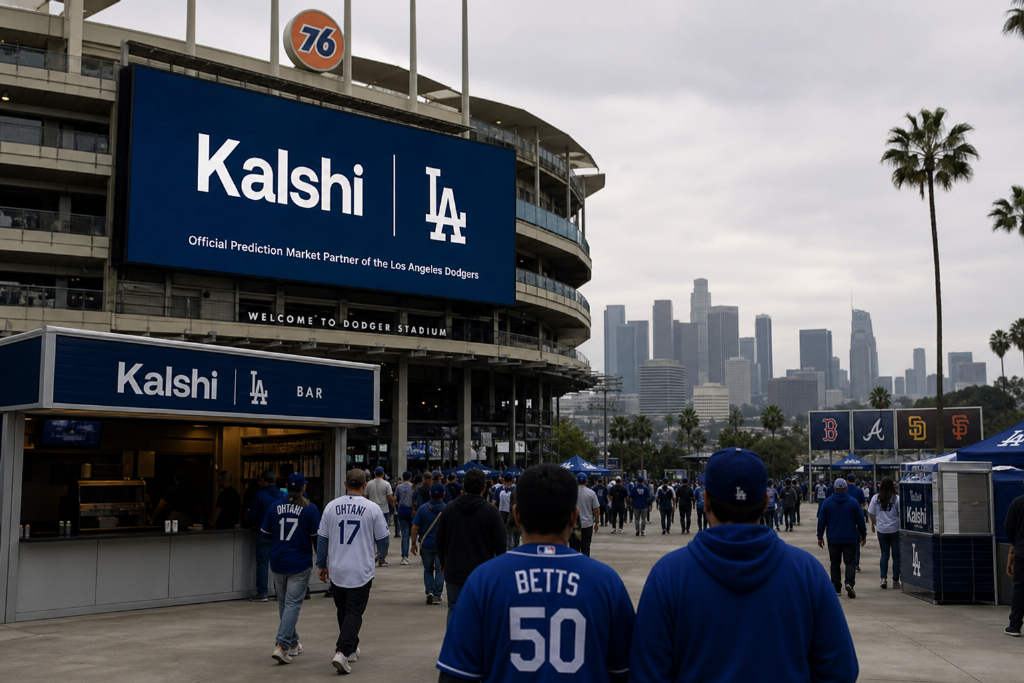
Prediction market platform Kalshi is making a major push into U.S. professional sports, announcing brand partnerships with five Major League Baseball teams: the Los Angeles Dodgers, Boston Red Sox, Atlanta Braves, San Diego Padres and San Francisco Giants.
The agreements go beyond online advertising. Kalshi said its branding will appear on stadium signage, social media, digital platforms, radio and live fan events, bringing prediction markets directly into the ballpark environment and everyday fan engagement.
The Dodgers offer one of the clearest examples. Dodger Stadium is set to carry Kalshi LED ads, and the partnership also covers naming rights for an in-stadium bar, along with fan events and exclusive offers at Centerfield Plaza.
Kalshi says baseball contract activity has surged
Kalshi is clearly targeting rising demand tied to sports trading. The company said baseball-related trading volume on the platform increased 36-fold over the past year. It also said baseball-related contract volume in 2026 has already approached 13 billion contracts, compared with about 355 million over the same period last year.
The line between prediction markets and sports betting is getting harder to separate
Kalshi describes itself as a federally regulated event contracts exchange, where users trade contracts based on whether a specific event happens rather than placing traditional wagers based on sportsbook odds.
Still, once the contract is tied to outcomes such as which team wins or how a game ends, the practical experience for many fans starts to look much closer to sports betting.
That is what makes Kalshi’s MLB partnerships particularly sensitive. On one side, professional sports leagues gain a new sponsorship category and another channel for fan engagement from a fast-growing prediction market business. On the other, baseball has long carried a deep institutional sensitivity to gambling.
The Ippei Mizuhara case remains a sharp point of comparison
The article points to the case of Shohei Ohtani’s former interpreter, Ippei Mizuhara, as a reminder of the risks associated with sports gambling.
According to the U.S. Department of Justice, Mizuhara began placing sports bets through an illegal bookmaker in September 2021, then quickly accumulated large losses and debt. To repay those debts, he used his role handling language and banking matters for Ohtani to alter contact information tied to Ohtani’s bank account and impersonate Ohtani in order to authorize wire transfers.
He ultimately transferred nearly $17 million out of Ohtani’s account without authorization. Case records cited in the article said his betting wins totaled more than $142 million, while losses reached about $183 million, leaving a net loss of nearly $41 million. His wagers covered international soccer, the NBA, the NFL and college football. Prosecutors said there was no evidence that he bet on baseball.
Mizuhara later admitted to bank fraud and filing a false tax return. In 2025, he was sentenced to 57 months in federal prison and ordered to pay $16,975,010 in restitution to Ohtani, plus about $1.15 million to the Internal Revenue Service.
Investigations by the Justice Department and MLB both concluded that Ohtani was a victim, and found no evidence that he participated in or knew about Mizuhara’s illegal gambling activity.
A sharp contrast for the Dodgers and MLB
The article frames Kalshi’s partnership with the Dodgers and other MLB clubs as a striking contrast. Two years ago, the Dodgers were caught in a global media storm because of Mizuhara’s illegal sports gambling case. Now the same club is entering a formal commercial relationship with a platform offering sports event contracts.
The two situations are not legally or structurally the same. Mizuhara used an illegal bookmaker, while Kalshi presents itself as a federally regulated event contracts exchange in the United States.
For MLB, the question to watch may no longer be whether sports can touch gambling at all. The issue is where the line should be drawn between sports betting, financial trading and prediction markets.