
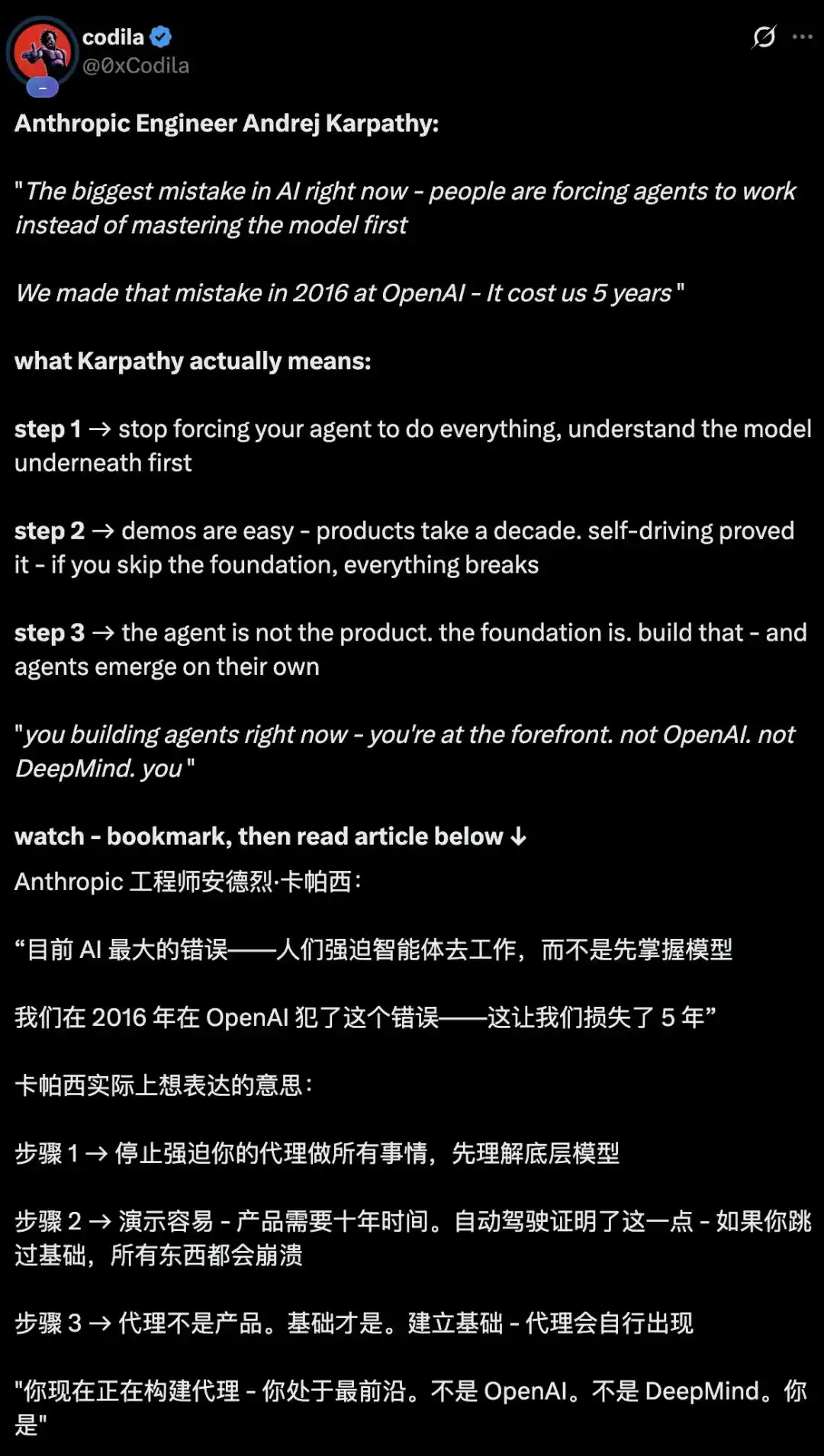
Andrej Karpathy said in a recent talk for agent developers that one of the biggest mistakes in AI today is trying to force agents to do useful work too early while failing to first understand and improve the foundation models underneath them. The remarks were later widely circulated on X and quickly became a focal point in the ongoing debate over the pace and direction of agent development.

Karpathy revisits the failed World of Bits effort
To explain his view, Karpathy pointed back to 2016, when he was involved at OpenAI in a project called World of Bits alongside Tianlin Shi, Jim Fan, and others. The goal was strikingly similar to what many agent startups are still pitching now: train an agent to operate a computer with a keyboard and mouse, navigate websites, and complete practical tasks such as booking flights or ordering food. The work eventually produced the paper “World of Bits: An Open-Domain Platform for Web-Based Agents,” presented at ICML 2017.
Karpathy was blunt in his retrospective assessment: the project did not truly succeed in the way the team had hoped. According to him, the core issue was not a lack of ambition, but a lack of technical readiness. At that time, reinforcement learning was the main tool available, and it was simply not enough to support capable open-domain web agents in messy real-world environments. Looking back, he said the better move would have been to stop focusing on agents and instead work on language models and other foundational capabilities first.
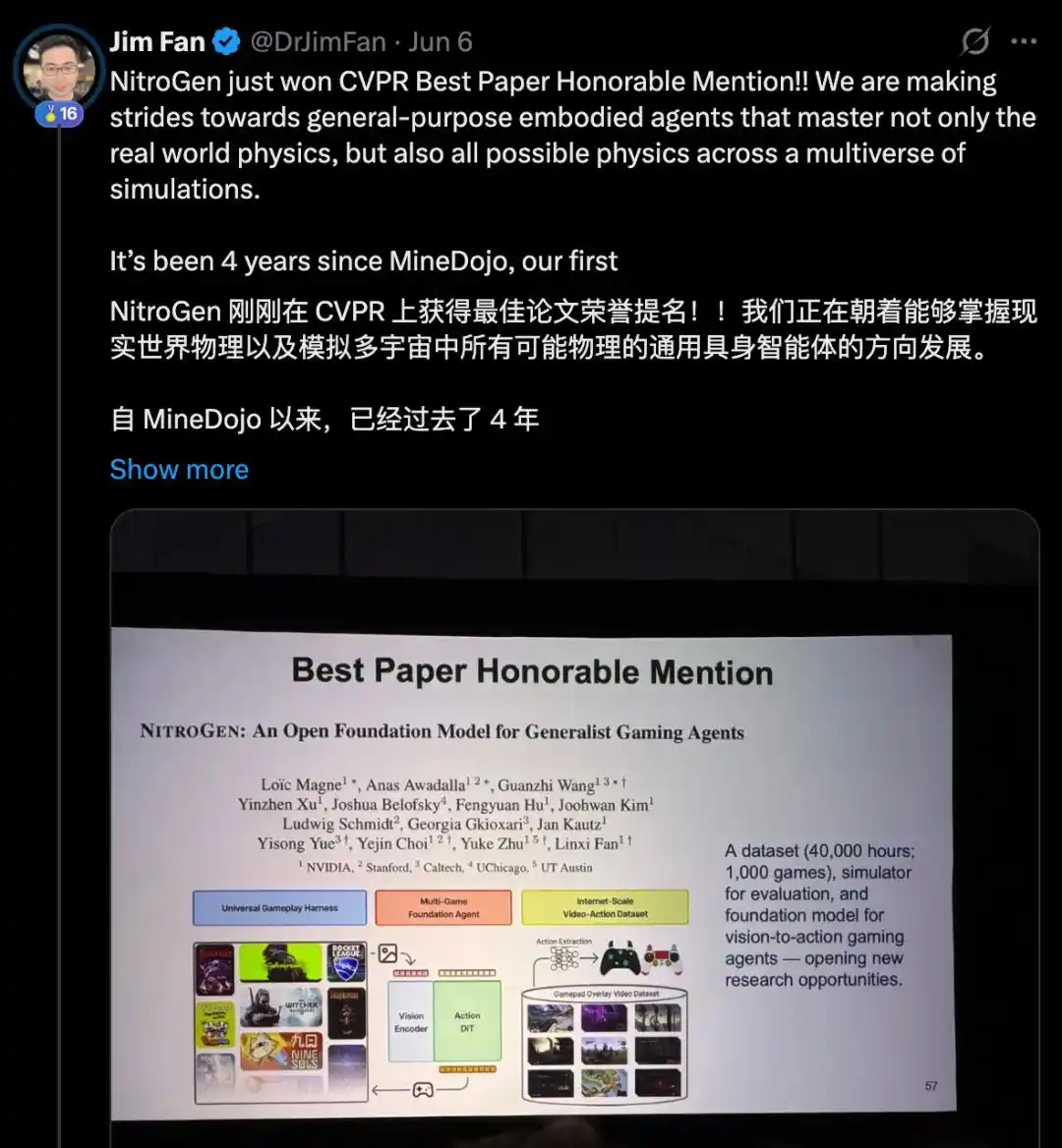
That hindsight matters because the modern agent stack looks very different from what researchers had in 2016. Karpathy noted that today’s developers are largely not trying to solve the problem using the old reinforcement-learning-first toolbox. The field has shifted dramatically. He also referenced the trajectory of Jim Fan, who worked on World of Bits and is now a senior research scientist at NVIDIA, where he has led high-profile projects such as Voyager and MineDojo. In other words, the industry is still pursuing agents, but not along the same path that seemed plausible a decade ago.
Easy to demo, hard to turn into a product
From that experience, Karpathy outlined three broad lessons. First, he said developers should stop trying to make agents “do everything” before getting the base models right. He pointed out that when he joined Anthropic’s pretraining team in May 2026, one of his first public statements was that frontier work on LLMs would remain especially important for the next several years. For many observers, that move itself was a signal: even amid peak enthusiasm around agent applications, Karpathy chose to return to pretraining and foundational model research.

Second, he argued that agents are easy to demo but may take ten years to become real products. He compared the field to autonomous driving and VR. In autonomous driving, getting a car to complete a short, controlled demonstration is one thing; building a product that is safe, scalable, and commercially viable is another, and it took roughly a decade of sustained work. He said VR followed a similar pattern, with impressive demos appearing long before durable consumer products emerged. In his view, agents belong to the same class of technology: highly intuitive, highly demo-friendly, but brutally difficult to operationalize.
Third, Karpathy said the real product is not the agent wrapper itself, but the underlying capability stack. If the foundation is strong enough, useful agent behavior will emerge naturally. If the foundation is weak, then layering orchestration, workflows, and interfaces on top will only create fragile systems. His broader message was that the industry should not assume agents can skip the long engineering cycle that other difficult technologies have already gone through.
Neuroscience as a source of design inspiration
Karpathy then shifted from critique to future direction, arguing that neuroscience may offer valuable clues for the next stage of agent design. He posed a series of questions about what the equivalents of different brain structures might be inside artificial systems. What corresponds to the hippocampus for memory, indexing, and retrieval? What plays the role of the basal ganglia in action selection and execution? What resembles the thalamus as a coordinating hub where multiple internal signals compete for priority?

His point was not to force one-to-one biological analogies, but to remind developers that the field still lacks a deep understanding of what intelligence actually is. He recommended David Eagleman’s book “Brain and Behavior: A Cognitive Neuroscience Perspective” to the audience and suggested that AI research may once again benefit from borrowing ideas from biological cognition. Just as early deep learning drew inspiration from neurons, he argued, future progress in agents may depend on a renewed willingness to study how brains organize memory, decisions, and internal coordination.
Why Karpathy says the edge may belong to builders, not big labs
Although much of his talk was interpreted as a warning against hype, Karpathy ended on a more encouraging note for startups and independent developers. He said the true frontier in agents is not necessarily locked up inside OpenAI, DeepMind, or other major labs. In his view, many of the people closest to the cutting edge are individual builders and small teams experimenting in the open.

He explained that large labs have years of accumulated experience in training Transformer-based language models at scale. When a new training paper appears, those organizations often already know what was tried internally, what failed, and why. But agent research is different. No major institution has a five-year unbeatable lead in agent capability in the same way that some do in foundation model training. That makes the field structurally more open.
As a result, Karpathy argued that startups, hackers, and independent researchers may be unusually well positioned in this phase of the market. Their advantage is not bigger compute or better incumbency, but speed, flexibility, and the ability to change direction quickly. His final message was not “don’t build agents.” It was “don’t skip the basics.” For developers willing to commit to foundational model work, long-cycle engineering, and a deeper investigation into the nature of intelligence, the agent race is still very much open.