

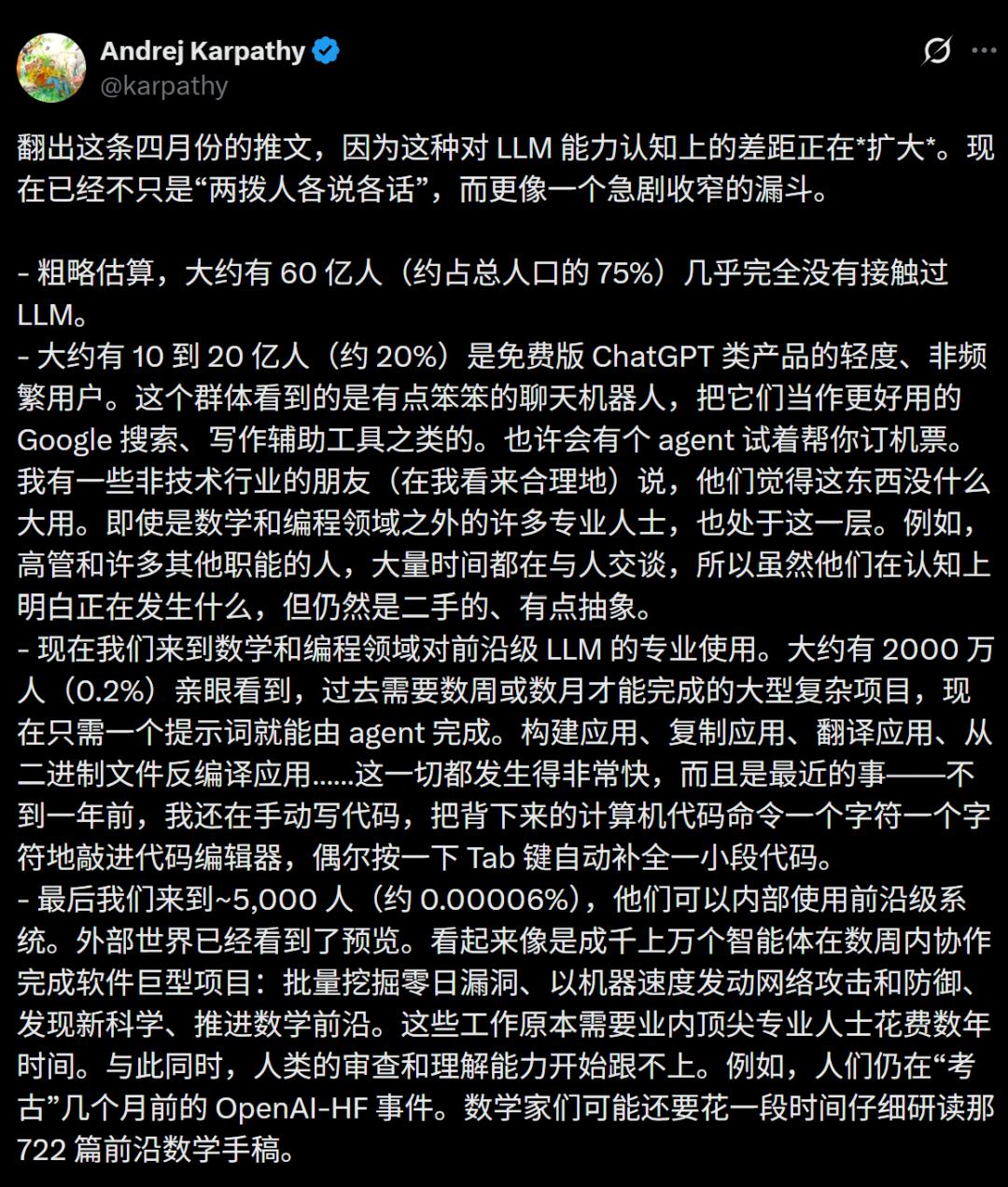
Andrej Karpathy said on X that public understanding of AI is going through what he called a sharp "cognitive collapse," with different groups judging the technology from entirely different levels of access. In his framing, the gap is not just about opinion. It comes from the fact that most people are not using the same systems, or anything close to them.
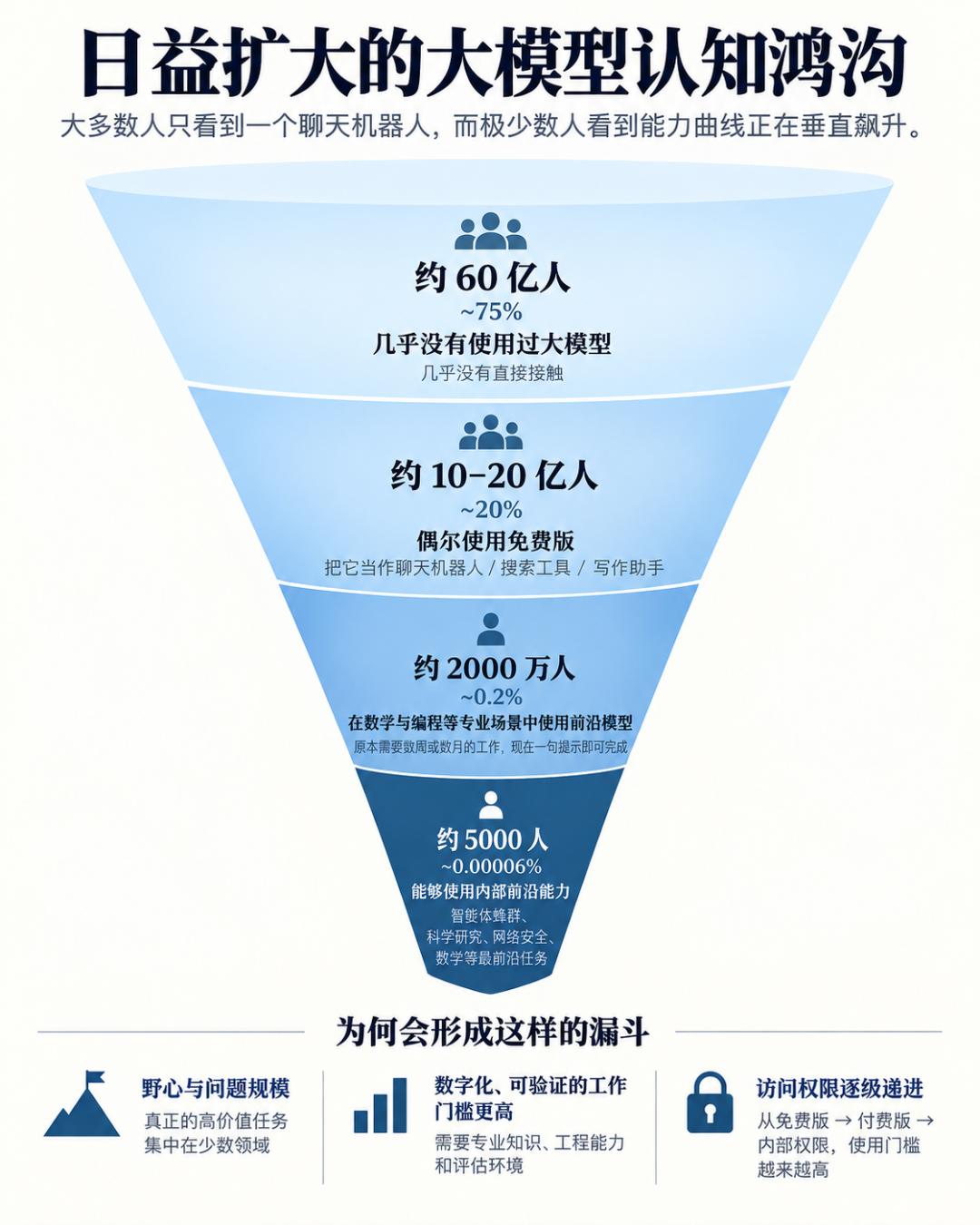
He described the situation as a steep four-level funnel. At the broad base are people who have barely touched large language models. At the narrow top are a tiny number of insiders with access to frontier internal systems. Karpathy’s point was simple: the AI most people laugh at online is not the same AI being used at the edge of the field.
About 6 billion people are still outside the LLM experience
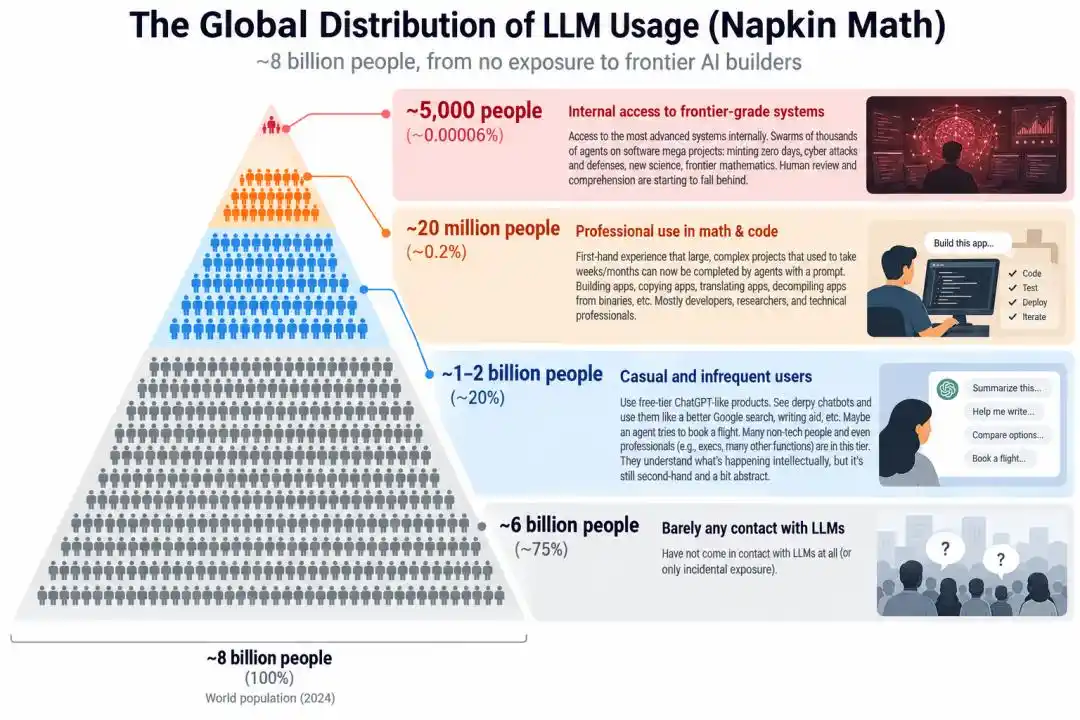
Karpathy’s "napkin math" starts with the largest group. He estimated that around 6 billion people, or about 75% of the world’s population, have had little to no contact with any LLM. For them, AI still lives mostly in headlines and science fiction rather than in daily routines.
That matters because it means a technology often described in Silicon Valley as a fourth industrial revolution has not actually entered the lives of most people. Debate about AI starts from radically different lived experience, and in many cases from no direct experience at all.
Another 1 billion to 2 billion people only see a clumsy assistant
The second layer in his funnel covers about 1 billion to 2 billion people, or roughly 20% of the global population. These are occasional users of free products similar to ChatGPT. In that group, AI is still seen as a clumsy chatbot, maybe a better search tool, maybe a writing helper, maybe a basic agent that tries to book a flight.
Karpathy said many of his non-technical friends still feel these systems are not especially useful in everyday life. He added that many professionals outside math and coding, including many corporate executives, remain in the same tier. They know, in an abstract sense, that AI is moving fast, but that knowledge is secondhand.
He tied this to recency bias and usage level. A lot of people built their view of AI from last year’s free ChatGPT experience or from social media clips showing systems failing in public. One example he cited was a widely shared video of OpenAI’s advanced voice mode stumbling over a simple question about whether someone should drive or walk to a car wash.
That kind of content shapes perception. People watch AI hallucinate in short videos, laugh, and conclude that the technology is overhyped. Karpathy’s warning was that free versions and older models do not represent what the latest frontier agents can do, especially systems such as OpenAI Codex and Claude Code.
Roughly 20 million specialists are already seeing a different curve
The third layer is much smaller, about 20 million people, or 0.2% of the global population. Karpathy said this group is concentrated in math and programming. They pay for frontier agent models such as Codex and Claude Code and use them directly for coding, mathematics, and research.
Inside that group, he said, a kind of collective "agent dizziness" is spreading because they are watching capability improve on a very steep slope. He described the shift through his own experience. Less than a year ago, he said, he was still writing code by hand, typing familiar commands into an editor character by character and occasionally pressing Tab for a small autocomplete suggestion.
Now the workflow looks different. Projects that once took top engineers months can, in his telling, be completed by frontier agents from a single prompt in a short period of time. He listed building applications, copying applications, translating applications, and decompiling applications from binaries among the tasks now being handled.

He also said that once these models are given access to a computer terminal, users can watch them "melt" programming problems that would otherwise take weeks. In the article’s account, OpenAI’s highest-end paid Codex model can run silently in the background for an hour and then refactor a large codebase or identify and exploit vulnerabilities in a complex system.
Karpathy quoted a widely circulated line to capture the divide: "Your level of awe at AI is perfectly correlated with how often you use AI to write code." His argument is that this group of specialists is moving up a near-vertical learning curve and seeing not only the speed of capability gains but also the security implications that come with them.
Only about 5,000 insiders, he said, have seen the frontier directly
At the narrowest end of the funnel, Karpathy estimated that only around 5,000 people worldwide, or 0.00006% of the global population, have access to the most advanced internal systems inside AI companies. He compared that number with Mount Everest: about 7,500 people have reached the summit, and in his telling, fewer people have seen the limits of frontier AI than have stood on Everest.

Those insiders are not looking at the same products the public sees. Karpathy described the outside world as seeing only a preview version of AI capability. Inside labs, he said, what exists is closer to "agent swarms": thousands of agents coordinating like a hive, working for weeks without human intervention on major software efforts.
He said those systems are being used to find zero-day vulnerabilities, run cyber offense and defense exercises, discover new science, and push the frontier of mathematics. In the article’s description, these are tasks that would normally take top experts years.
Karpathy also argued that human review is starting to lag machine output. He gave two examples. One was the "OpenAI-Hugging Face incident," which he said is long past, yet researchers are still doing "archaeology" in large machine-generated logs. The other was a set of 722 AI-generated mathematics manuscripts that top mathematicians still need significant time to digest before they can follow the logic in full.
Why the gap is so extreme
Karpathy offered three reasons for the funnel becoming so sharp.

Ambition and problem size matter
First, he said the impact of AI scales with the ambition of the user and the size of the problem. If someone only asks a model to draft an email or look up a recipe, the system is not being pushed anywhere near its limit. The strongest effects show up when users bring a reservoir of difficult, urgent problems they genuinely care about solving.
Code and math have clear reward signals
Second, he said the strongest gains are showing up in code and mathematics because those fields are digital, economically valuable, and easy to verify. He linked that to reinforcement learning. In coding and math, right and wrong are much clearer, which creates a verifiable reward function and makes training more efficient.
Writing poetry or prose is different. Quality is more subjective, so the feedback loop is less precise. At the same time, code and math sit in high-value B2B settings, which means the best teams and the largest resource pools inside major tech companies are concentrated there.
Access itself is splitting perception
Third, Karpathy said access tiers are physically separating how people understand AI. Free versions, paid versions, and internal access form three distinct steps. Most of the public interacts with constrained or older products. Paid users and internal researchers are seeing something else entirely.
His conclusion was that humanity is in a strange moment where, at the same second, the AI visible to the public and the AI visible inside frontier labs no longer seem to belong to the same era. His warning was blunt: behind the mask of a foolish-looking AI, a prototype of superintelligence may already be waking up under the eyes of a very small number of people.
The reference cited in the source article is Karpathy’s post on X. The MarsBit piece also states that the article came from the WeChat public account "Xinzhiyuan," written by Aeneas.


