
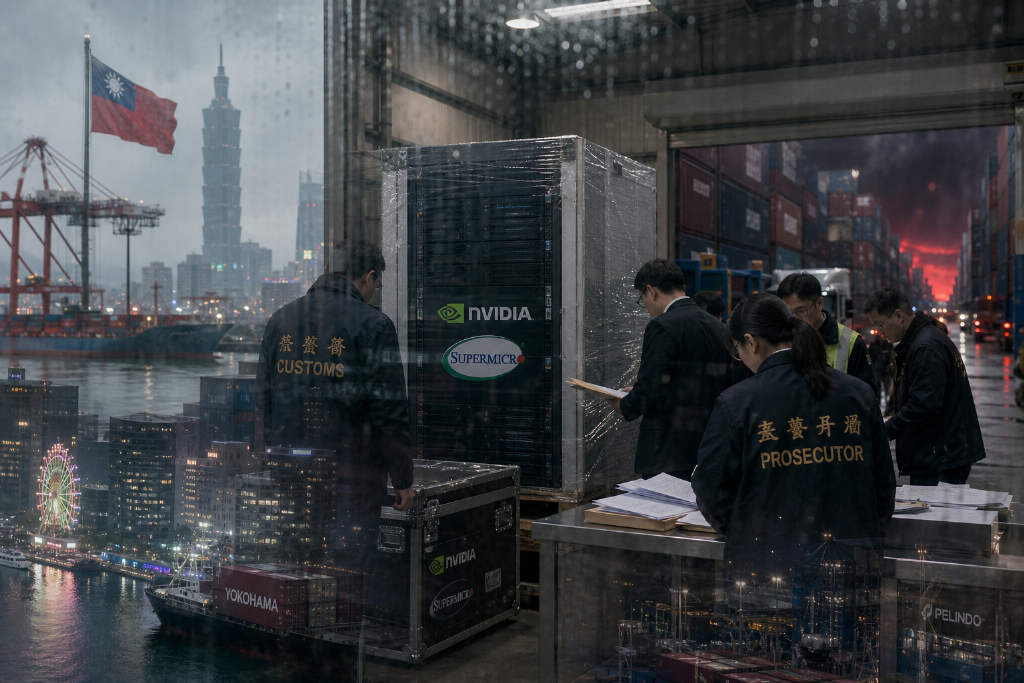
Prosecutors in Keelung have charged suspects in an alleged scheme that used forged documents to move high-end servers into China. The indictment says Feihu Technology worked with employees linked to Nvidia and Super Micro Computer to cover the shipment of advanced servers, with 130 Nvidia-chip servers approved for export and 74 of them later routed through Indonesia, Japan, and Hong Kong into China. Prosecutors estimated the illegal profit at more than NT$600 million.
Whitelist status became the channel for approved shipments
The report says a whitelist refers to buyers that have passed export compliance and fund-flow screening by the original manufacturer and the exporting government, are considered legitimate end users, have no apparent resale risk, and are not on sanctions lists. Once a company is placed on that list, later shipments do not need to go through the same review each time. Feihu Technology was described as a whitelist member for Nvidia and presented itself publicly as an artificial intelligence developer.
According to the indictment, Nvidia Taiwan senior manager Chang Teng-lung, Supermicro Taiwan senior sales associate vice president Lin Chang-chun, and Lu Yang-kai knew the real buyers behind Feihu were from China but did not report the buyers' background or source of funds to their companies.
Mirror Weekly reported that Feihu also placed fake servers inside a real machine room to pass on-site inspections by the original manufacturer. After shipment approvals were secured, the servers were allegedly sent in batches through Indonesia, Japan, and Hong Kong before reaching China.
The report also said the servers sold for NT$15 million in Taiwan and could fetch NT$30 million on the Chinese black market. Mirror Weekly further said Feihu spent heavily to host a celebration trip to Yokohama for the people involved, with food, alcohol, and Japanese adult video actresses accompanying the event.
The case expanded after an allegedly forged export permit was exposed
Based on investigation details cited by Mirror Weekly, Feihu later realized that Lin Chang-chun had bypassed the company and privately connected with nominal buyer Li Sen-kui, which Feihu interpreted as an attempt to take over the business. Because the decision on whether the goods could leave depended on Lin, Feihu did not openly confront him. Instead, it opened another line through another nominal buyer, Wang Kai-ping, and planned to let Dejin, where Wang was then serving concurrently as an independent director, take over the shipment process.
The report says the goods were split into two routes in early April this year. Eight servers cleared customs and were flown to Japan before being transferred to a receiving company in Shanghai. Another 56 units were held at Taipei Customs while awaiting export. A customs officer handling the case found the shipment suspicious and asked the customs broker to provide a strategic goods export permit issued by the Ministry of Economic Affairs. The report says such a permit is required to control exports of sensitive high-tech goods and that the servers could not legally leave Taiwan without it.
The workaround, according to the report, was for the customs broker and Wang Kai-ping to create a permit by computer compositing. Once customs entered the details into the system for verification, the forgery was immediately detected, and the investigation widened.
Chen Ming-jie, the alleged figure behind Feihu and nicknamed Tiger, left the country and went into hiding in China after learning the direction of the case, and is now wanted.
Prosecutors are still tracing possible accomplices
The report says prosecutors, working with the Coast Guard Administration, expanded the investigation and traced the behind-the-scenes operation to Chinese state security units. It also pointed to another case involving the same manufacturer: the U.S. Department of Justice charged Supermicro co-founder Liao Yi-hsien and Taiwan sales manager Chang Jui-tsang, along with a third person, in March this year, accusing them of smuggling at least $2.5 billion in U.S. AI technology into China. The alleged methods in that case also involved forged documents and fake machines used for inspections. Liao has been arrested, while Chang remains at large.
The original report said the two cases followed almost the same script: paperwork appeared compliant before the scandal surfaced, and the alleged masterminds were in China afterward.
The report also said that, so far, the three companies involved have not filed civil claims against their own employees. Keelung prosecutors are still checking whether other accomplices were involved. The case has been indicted and has not reached a final verdict.