
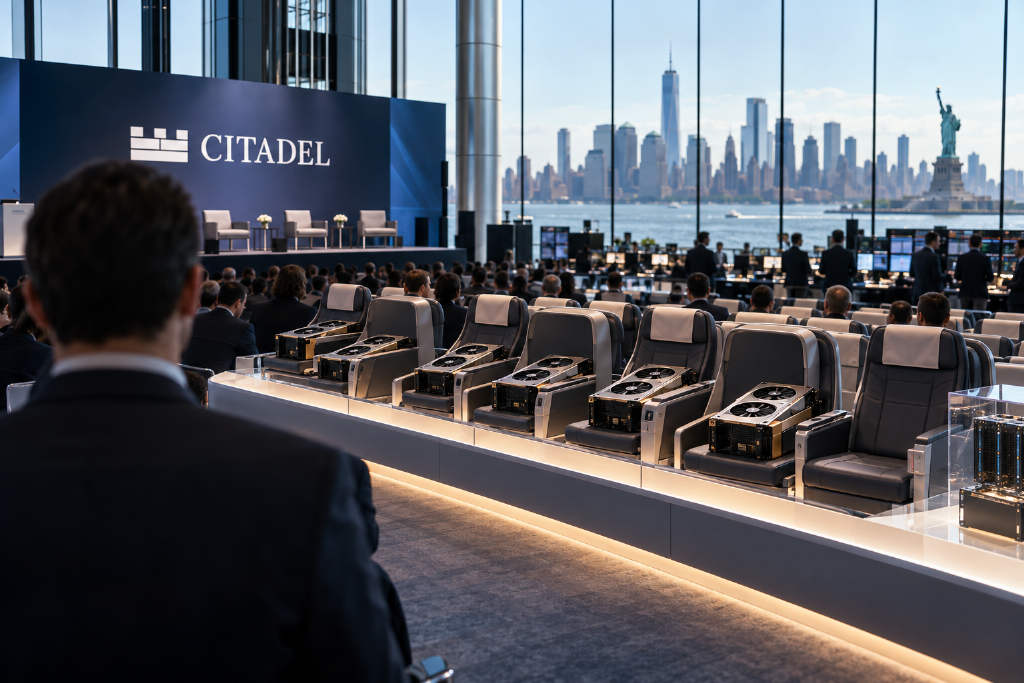
Citadel founder Ken Griffin said Tuesday that investors are "almost certainly" in an AI bubble, though he did not tell them to dump AI stocks.
Speaking at Citadel’s Future of Global Markets Conference in New York on Oct. 20, Griffin said, "What’s left in the wake of these bubbles, if we want to use that word, is often game changing for the world. And the companies that are on the other side of that bubble are the market leaders for decades to come."
Bubble talk without a call to sell
The point reaches beyond technology investors. AI buildout has supported equity markets over the past year, which means many index funds and retirement accounts also hold exposure to the theme. A bubble forms when prices rise much faster than the underlying businesses can justify, until valuations run into reality.
Citadel, a hedge fund that manages money for wealthy clients and institutions, has been active in markets shaped by that trade. Griffin’s argument was that even if current conditions look like a bubble, that does not settle the long-term question.
"Any radical transformation of our economy is generally intertwined with a bubble," he said, invoking the internet boom and adding that he wished he had kept his Amazon stock.
He argued that companies emerging on the other side of a bubble often lead markets for decades, while stopping short of predicting a collapse.
Citadel’s own use of AI agents
Griffin used his own firm as an example of AI’s practical value. He said AI agents, software that can carry out multistep tasks on their own, have reduced some high-level research work at Citadel from weeks to a couple of hours.
Why Griffin compares GPUs with airline seats
Griffin compared GPUs, the graphics chips used by many companies to train and run AI models, to airline seats. In both cases, he said, the marginal cost is very low. Serving one more customer adds little extra cost, which means prices can break lower once supply gets ahead of demand.
He pointed to the telecom boom around 2000, when companies laid more fiber-optic cable than demand required and communication prices fell. He also questioned whether chips that are already five or six years old, but still command what he called extraordinary rental rates, can keep doing so for another five or six years.
Customers are becoming more selective
Buyers are getting pickier, Griffin said. They are sorting out which tasks justify premium models from OpenAI and Anthropic and which can run on cheaper open-source alternatives that users can download and run on their own computers.
He added that corporate America has been uneven in extracting value from AI. Some companies are reviewing their bills from AI labs and asking where the productivity gains are.
Large spending forecasts remain in place
Gartner forecasts worldwide AI spending at nearly $1.5 trillion for 2025, covering everything from chips and servers to AI-enabled phones.
Nvidia CEO Jensen Huang said at Davos in January that the industry is only "a few hundred billion dollars" into what he called the largest infrastructure buildout in human history, with trillions more still to come.
If customers push back on premium pricing, chipmakers and cloud companies that are counting on that spending would be the first to feel it.
Citadel also bought discounted AI-linked stocks
On July 30, Situational Awareness, a hedge fund founded by former OpenAI researcher Leopold Aschenbrenner, sold most of its public stock portfolio to Citadel at roughly a 10% discount after its value reportedly fell about 67% in July.
The fund had borrowed as much as four times its capital to buy AI stocks, using leverage. As prices fell, lenders asked for more collateral every day. Selling because lenders demand it rather than by choice is known as forced selling, and it can feed on itself because each sale pushes prices lower and triggers more collateral calls.
In an August letter to clients, Griffin wrote that Citadel had since shed more than 80% of the risk in that portfolio. That means the same executive now warning about a bubble also bought discounted stocks tied to the trade.
Earlier warning on energy risk
Earlier this year, Griffin warned that if the Strait of Hormuz, a key oil shipping lane, remained closed for another six to 12 months, energy prices would rise materially and push the world into recession.
Wall Street is watching capex growth slow
Goldman Sachs Research noted in December that Wall Street analysts expect growth in capital spending by the largest AI infrastructure builders, money going into chips and data centers, to slow from 75% in the third quarter of 2025 to 25% by the end of 2026.



