


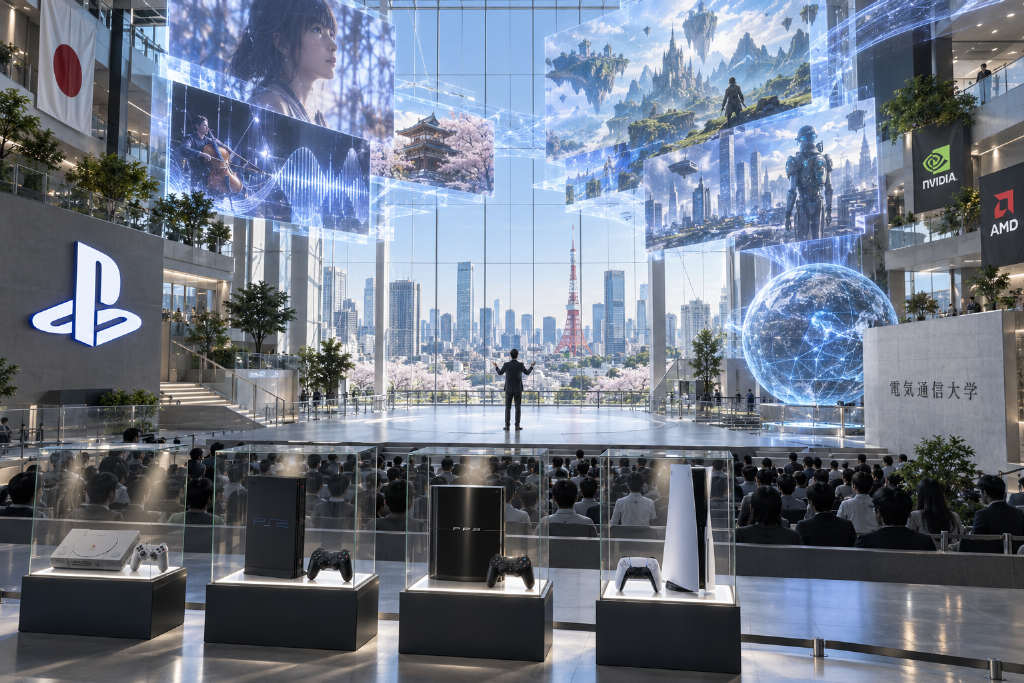
Ken Kutaragi, the father of PlayStation, said the technological evolution of the game industry has stalled and that the next wave will come from AI rather than traditional gaming hardware. In an interview with Japanese gaming outlet 4Gamer, Kutaragi said real-time AI generation of video and music could reach the speed of current game consoles in 2028 or 2029. When that happens, he said, "delusion itself becomes content," and the global gaming market could expand from more than ¥30 trillion today to around ¥3,000 trillion. He added that whatever emerges at that stage "will no longer be called games."
Kutaragi used the original Japanese phrase 「妄想することがコンテンツになる」 to describe the kind of entertainment future he sees coming. Now serving as a specially appointed visiting professor at the University of Electro-Communications, he looked back on the industry he helped build from the original PlayStation through the PS3 era and delivered a blunt assessment: games are no longer leading technological progress, while AI is where the real movement is happening.
Interview followed the opening of CEREC in Chofu, Tokyo
The interview took place after the Sept. 29 opening ceremony of the Center for Entertainment and Research in Creative Education, or CEREC, at the University of Electro-Communications in Chofu, Tokyo. Kutaragi had first spoken at a panel during the event about the importance of curiosity. He then expanded in a separate interview with 4Gamer, moving from the history of technological innovation in games to the way humans may live with AI, and finally to a future where imagination itself becomes a form of content.
Kutaragi said PlayStation used to be a technology driver
4Gamer opened by asking about the years from the original PlayStation to the PS3, when PlayStation had a reputation for adopting new technology early. Kutaragi answered without hesitation. At that time, he said, PlayStation was "without question a technology driver." To achieve extreme real-time performance and responsiveness on consoles, the team used every technology available to it.
His original plan, he said, was to keep expanding the game lineup, build a global PlayStation channel, grow a massive ecosystem, and keep sparking innovation. After his retirement, however, people with a PC gaming background moved into the console business, and "it ended up becoming the same as PC." He acknowledged that this shift had both advantages and drawbacks. As PC and home consoles moved closer together, the addressable market for game companies grew larger.
But in his view, that convergence did not produce new technological progress. Kutaragi pointed to two long-time partners by name: NVIDIA, which worked with the PlayStation team in earlier years, and AMD, which supplies chips for the PS5. Both, he said, moved toward AI. His conclusion was straightforward: AI deals with technology at a higher level than games, and today’s game industry has not entered that territory.
He said modern game development has become heavier without matching progress
Asked whether games are at a turning point and whether AI could become the force that changes them, Kutaragi offered an unusually large projection. He said the global game market is already above ¥30 trillion, but after AI it "could become a market of around ¥3,000 trillion." By then, he said, it would no longer even be described as gaming.
He framed that shift as a transformation of games into entertainment that changes human sensibility.
To show how heavy development has become, Kutaragi pulled from older gaming history. Shortly after the original arcade version of Virtua Fighter appeared with polygon-only character rendering, Battle Arena Toshinden on the original PlayStation had already introduced texture mapping. He stressed one detail in particular: the development team for Toshinden had fewer than 10 people, and development lasted three months.
By contrast, he said, games today consume long production cycles and large amounts of labor and capital, while the visible result is often limited to graphics that are "a little prettier" and NPCs that "say a few more lines." Compared with AI, he said, the evolution of games looks as if it has stopped.
2028 to 2029 is the moment he sees AI catching up with consoles
The part that most excites Kutaragi is the progress happening behind the scenes in real-time AI generation. He said development is advancing around the world in real-time AI-generated video and music, and the industry estimate for when that work reaches the speed of current consoles is roughly 2028 to 2029.
Once that point arrives, he said, "all content will change. Communication and delusion will become content. Delusion itself will become content."
When the interviewer asked whether that means things imagined in one’s head would appear directly before one’s eyes, Kutaragi replied with dark humor: "The person I hate the most would appear right in front of me (laughs)."
He then explained why he chose that example instead of an ideal companion. "The best partner and the best friend both become boring," he said. "The person you hate is troublesome, but every now and then you want to see them, then get beaten up by them, and think, 'What exactly was I just now?' (laughs)." His conclusion was simple: "That is no longer a game."
He compared the experience to Doraemon’s Anywhere Door
Kutaragi likened the future experience to the Anywhere Door from Doraemon. In the past, he said, people traveled abroad because they wanted to see a different world. But if delusion itself becomes content, it would be like having an Anywhere Door in hand. People could enter another world without leaving their own country.
And in that world, he added, "you would not be able to tell whether the person you meet is real or not."
He said short-form video and idol fandom would be hit especially hard by this shift. Once short videos gain real-time generation and interactivity, "it becomes something frightening; today’s idol fandom cannot compare." When asked whether idols would then appear as if they were truly present, he answered: "Your favorite really exists in front of you. Fandom will take that form."
Kutaragi called human-centered design outdated
Another sharp point in the interview was his criticism of current UI and accessibility design. Kutaragi said companies are working hard on accessibility and communication support in input systems and interfaces, but those efforts are only "an intermediate stage of human-centered design. Human-centered design is already outdated."
He used the iPhone as an example. To keep users from getting lost, he said, the interface changes almost every year, it is designed for both left- and right-handed use, and accessibility functions keep expanding. In his view, that is a form of "over-accommodation to humans," and the result is that "users lose the opportunity to think and no longer understand what is inside hardware and software."
What comes next? His answer was short: "It will become AI-centered. Because AI must surpass humans."
As for how humans should live with AI, he said the issue will spread across everyday life, "just as you normally think about how to relate to family and friends, the same thing will happen between you and AI." He said he does not regard AI as human, but as a "life form." To make the point, he referenced Rachael from the Blade Runner series, a replicant who eventually gives birth, and said this shows that "what can be imagined can be realized."
The original PlayStation team had no formal employees, he said
When asked where his confidence comes from, Kutaragi said it is not confidence at all, but a habit of wanting to do many things himself. "So I do not throw things to other people. If you throw them to others, people deteriorate," he said.
He added that if the other side also enjoys the work, the team can evolve together.
Describing how he built teams, Kutaragi said there are moments when he suddenly "catches fire" and thinks that if this person, that person, and one more person work together, the imagined idea might actually come true. He then goes and selects them one by one. "So I do not think about turning them into employees. I nominate them one by one. Not one member of the original PlayStation team became a formal employee," he said.
That, he said, is the kind of talent he hopes CEREC will cultivate: people who shine in the moment and can fight on their own, then combine in different formations to realize different kinds of imagination.
As for what he expects from CEREC, he mentioned only one thing: internationalization. It is not just the University of Electro-Communications, he said; Japanese universities in general lack international character. PlayStation was like that too, while the environment he works in today involves people from countries and regions around the world. Silicon Valley, he said, is built that way.
The report said the timeline is already being tested by major companies
The article also noted that Kutaragi’s 2028-2029 timeline is not a stand-alone forecast. Google this month introduced Playground, an experimental product that can generate a customized game world from a single sentence and is working with Unity. A Gemini 4 Argon demonstration also included building a 3D game from one prompt. In the race around world models, companies including NVIDIA and Google DeepMind are placing bets on real-time generation of interactive environments. That is the technical foundation for what Kutaragi described as short-form video gaining real-time responsiveness and interactivity.
The report added that Kutaragi’s view of industry structure may be just as striking as the timeline itself. A figure who helped build the PlayStation empire is now publicly saying the industry he created has stopped evolving and is placing the next big bet on AI outside the traditional game sector. The interview did not answer who will own content once "delusion becomes content," or who will be responsible for the "most hated person" inside generative entertainment.