
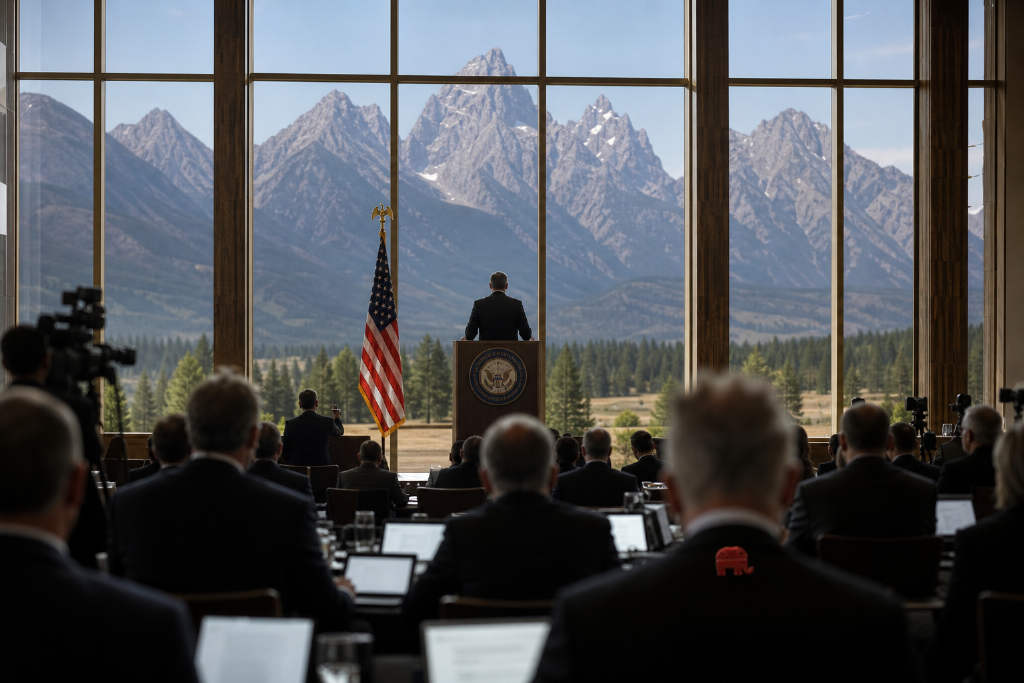
Only 100 days after replacing Jerome Powell, Federal Reserve Chair Kevin Warsh, personally chosen by Donald Trump, has already pulled markets back into a debate over whether another rate hike is still on the table.
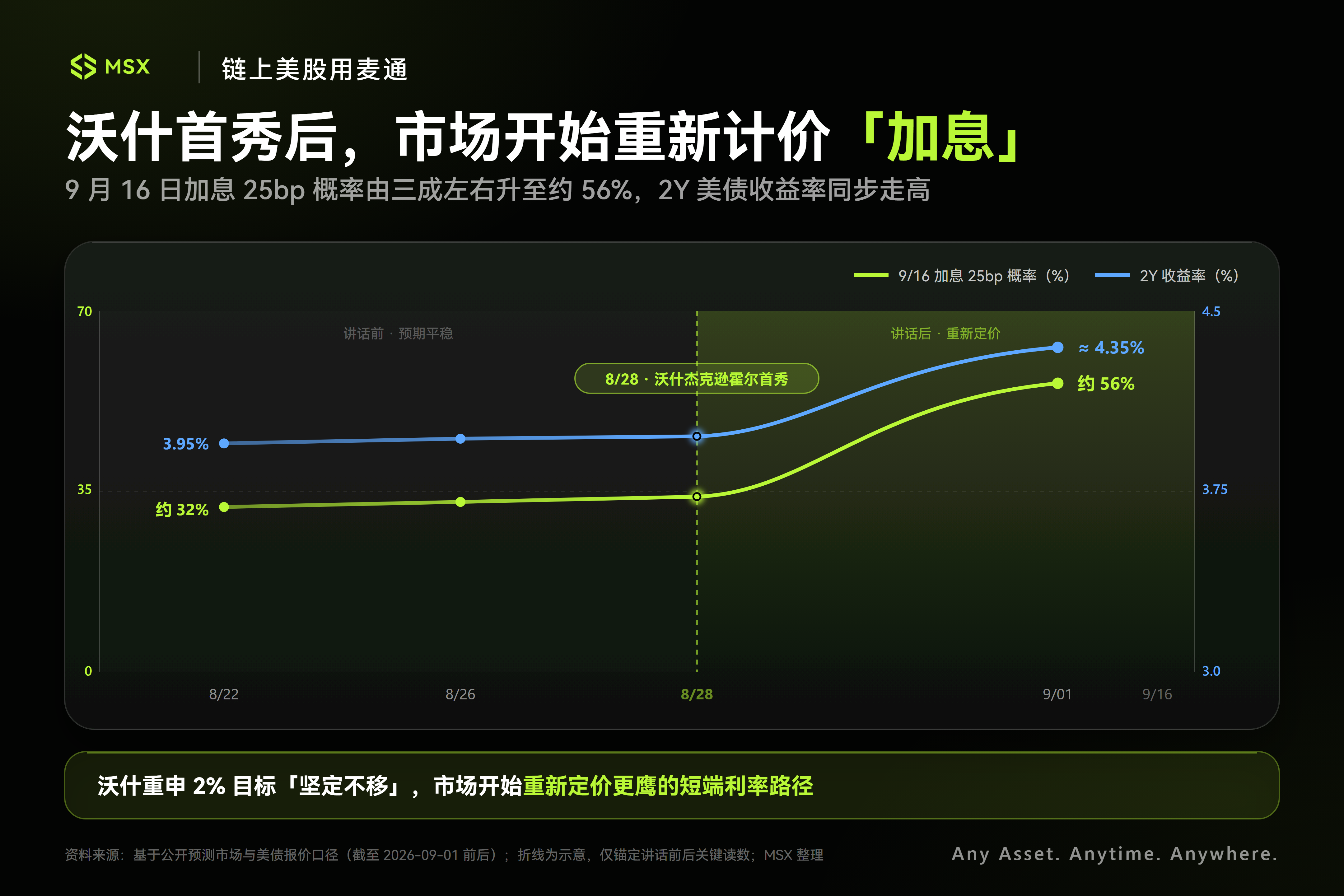
In his Jackson Hole debut on Aug. 28, Warsh said the Fed’s 2% inflation target remains firm and added that current data do not show a “meaningful improvement” in the inflation trend. Markets repriced fast after that speech.
At the time of writing in the source article, prediction markets were assigning roughly a 56% chance to a 25-basis-point rate hike on Sept. 16, up from a little above 30% beforehand.
Trump’s public reaction made the move more striking. Instead of attacking Warsh the way he had repeatedly gone after Powell, Trump said he “greatly respects” Warsh and that “he will do what he has to do,” according to the article.
That set up the central question in Odaily’s piece: does Warsh’s hawkish posture mean he is breaking with Trump? The article’s answer leans the other way. Warsh may be acting tough precisely because he remains one of Trump’s own, and because independence has to be demonstrated first.
Why Warsh may need to sound hawkish now
Judging from the Jackson Hole speech alone, Warsh does not look like the low-rate Fed chair many would associate with Trump. He not only stressed that inflation is still too high, but also argued for a much more restrictive redesign of how the Fed operates.
The article says Warsh wants unconventional tools such as quantitative easing, or QE, reserved for real crises. It also says he wants the Fed to cut back on what the piece describes as spoon-feeding markets through excessive communication. For years, Wall Street has watched dot plots, press conferences, and policy hints to guess whether the next meeting would bring a hike or a cut. Warsh appears deeply uncomfortable with that setup.
In the article’s telling, Warsh sees a self-reinforcing “Hall of Mirrors” when markets wait every day for the Fed to reveal “what the next trade should be,” while the Fed in turn uses market prices to judge the economy.
Odaily notes that Warsh served as a Fed governor about 20 years ago. Compared with the technocratic style associated since the Ben Bernanke era, one built on economic models, dot plots, and forward guidance, Warsh is presented as more of a reformer trying to reshape central-bank logic from outside the prevailing system.
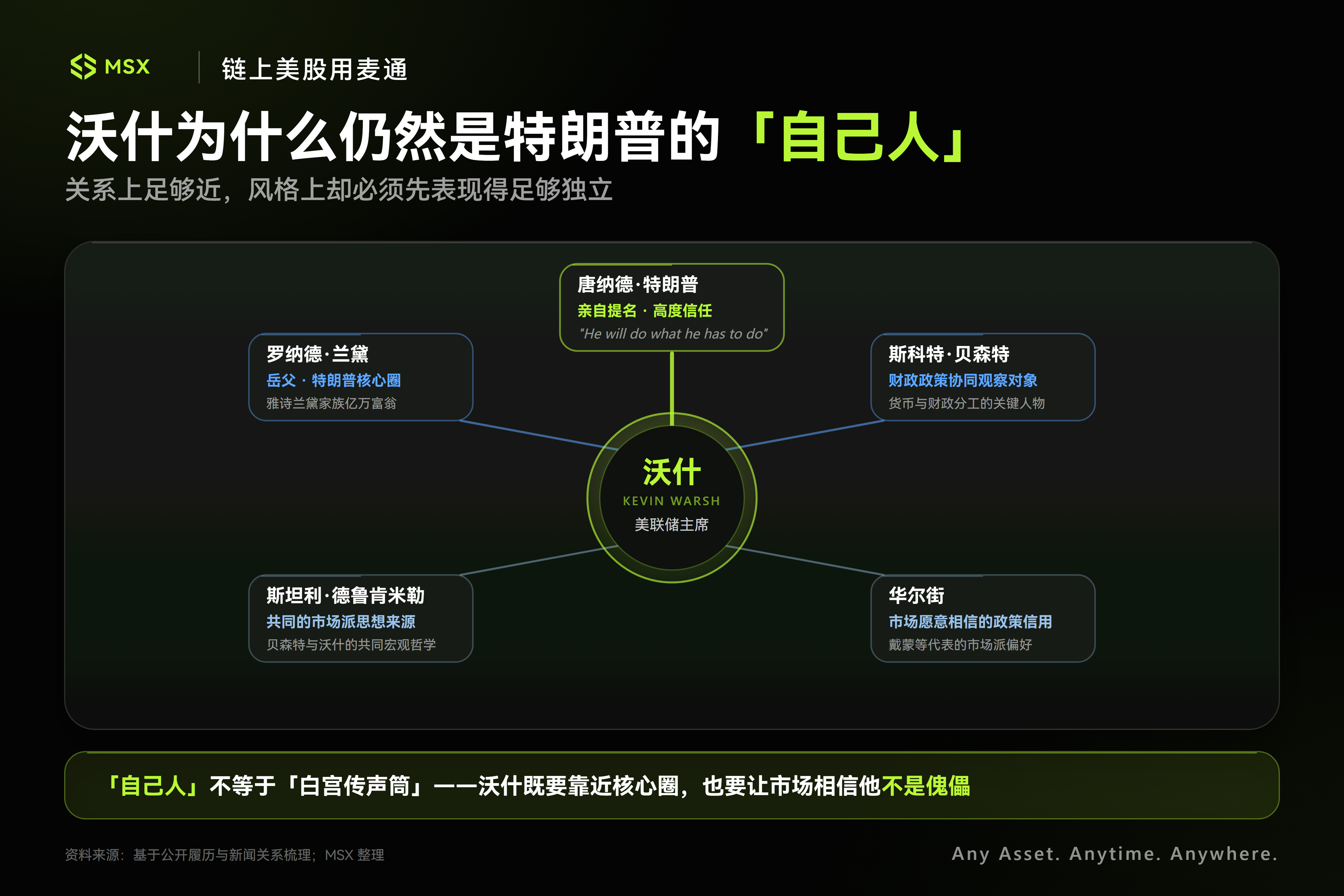
From that angle, the point of his hawkish start is straightforward: rebuild policy credibility as quickly as possible. The article argues that for a chair selected directly by Trump, any market perception that the Fed has lost independence could send long-dated Treasury yields higher and unanchor inflation expectations, feeding back into the economy. For Trump as well, a chair who first proves he is not obedient may later be better positioned to cut rates credibly.
Political links, Wall Street credentials, and Druckenmiller’s influence
The article says MSX Maitong Research Institute had already focused on Warsh last year when evaluating possible Fed chair candidates. It argues that Warsh stood out because he combined an establishment résumé accepted by both Wall Street and the Fed system with personal ties close to Trump.
One example cited is Warsh’s father-in-law, Ronald Lauder of the Estée Lauder family. The article says Lauder and Trump have known each other since their University of Pennsylvania days and have maintained a long-standing personal relationship, with Lauder described as an important ally in Trump’s political and business circles.
It also points to a shared market-oriented intellectual influence between Warsh and current U.S. Treasury Secretary Bessent: Stanley Druckenmiller. According to the article, Bessent spent many years at Soros Fund and was heavily influenced by Druckenmiller, while Warsh stayed very close to Druckenmiller after leaving the Fed and later became a business partner.
The piece stops short of calling them members of the same school in any formal sense. Still, it highlights the fact that America’s key monetary and fiscal policy posts are now held by two people shaped by Druckenmiller’s market philosophy.
That context matters for how the article reads Trump’s comment that he respects Warsh. At minimum, it suggests Warsh still belongs to the camp that is allowed to show independence. The stronger he can make the case that he is not a political puppet, the more room he may have later if easing becomes necessary.
“Hawkish in public, dovish in reserve”
Odaily frames one possible reading of Warsh this way: hawkish in the short run, while keeping open the option of future easing.
It is careful not to overstate the case. The article explicitly says this does not mean Warsh has decided to cut rates later, and that there is no evidence supporting that conclusion now. The more precise point is that Warsh introduced a new possibility tied to AI.
It quotes his line: “The potential for substantially higher growth is on the rise.” In the article’s interpretation, if the U.S. can sustain faster growth while inflation cools, the Fed would not have to wait for obvious economic weakness before gaining room to cut.

From there, the article lays out a three-step path.
Step one: restore inflation credibility
Warsh’s biggest immediate constraint remains inflation running above the 2% target. In that setting, easing too soon could stimulate demand again and push long-term inflation expectations higher.
That is why, in the article’s view, Warsh must first convince markets that 2% is not a slogan and that the Fed would tighten again if needed, whether or not it actually hikes on Sept. 16.
Odaily says Sept. 16 matters because labor data and the CPI release due on Sept. 11 will determine whether Warsh has enough support to turn his Jackson Hole rhetoric into action. If inflation remains sticky and employment stays resilient, a September hike cannot be ruled out. If the data weaken quickly, he can hold instead. Either way, the article argues that credibility has to come first so any later easing is read as inflation-permitted normalization rather than a politically driven cut under White House pressure.
Step two: wait for the supply side to open room for cuts
The next issue to watch is whether AI productivity moves from narrative to macro data.
Odaily says AI was one of the easiest points to miss in Warsh’s Jackson Hole speech even though he devoted substantial attention to whether AI is becoming a new factor of production and whether it can deliver lasting productivity gains.
The logic laid out in the article is central to its thesis. If AI, capital spending, energy expansion, and deregulation truly raise the U.S. economy’s supply capacity, then the country could move toward the mix Trump wants most: growth that stays strong while inflation moves lower.
That would be very different from the recession-led rate-cut cycles of the past. For equities, the article says, it could be more comfortable than a traditional easing setup because earnings per share, or EPS, would still be rising while discount rates start to fall.
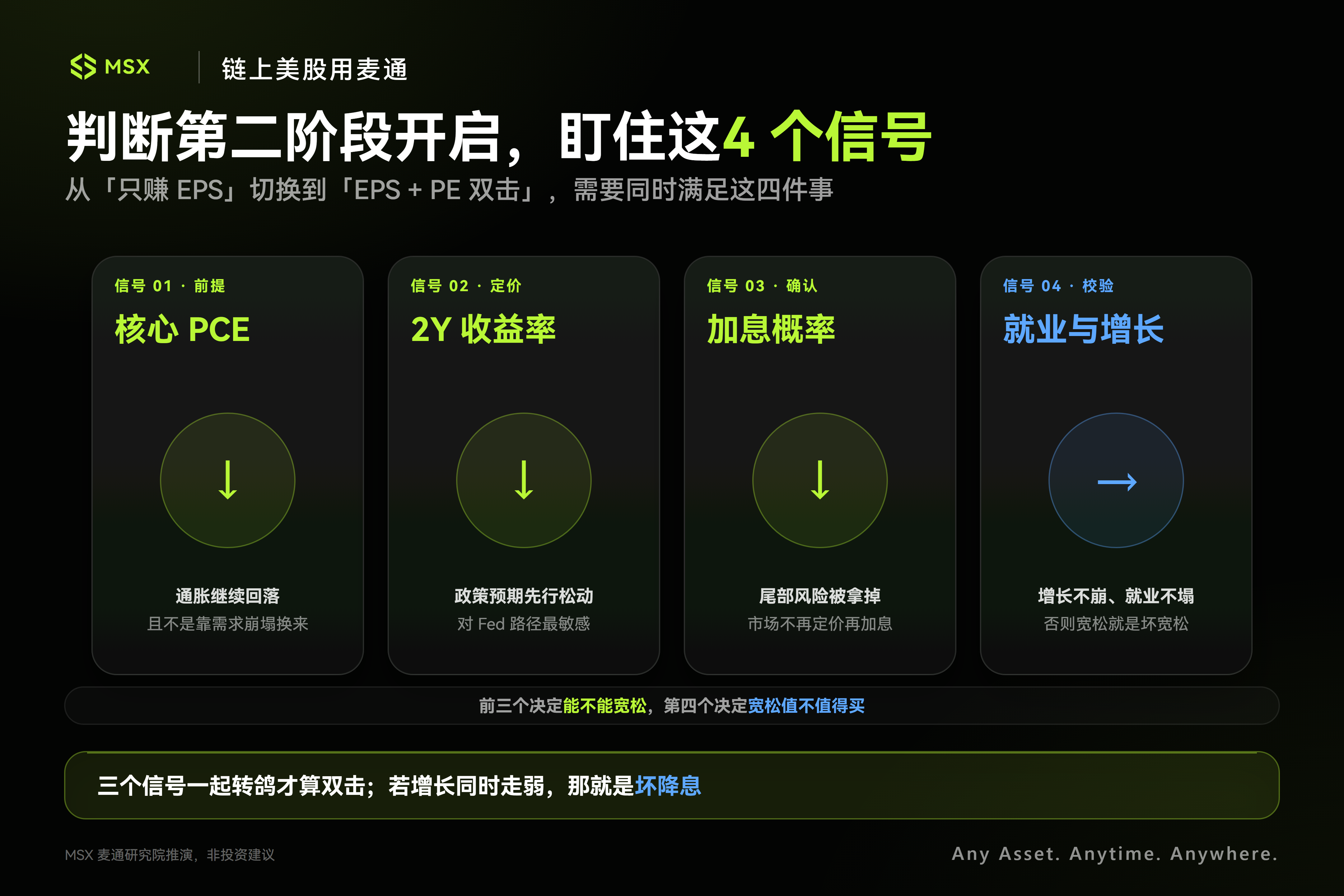
If Personal Consumption Expenditures, or PCE, inflation retreats, the 2-year Treasury yield declines, and the economy and labor market do not crack, then the market narrative could shift from “recession leads to cuts” to “productivity gains lower inflation and allow a soft-landing or even no-landing style easing path.”

Step three: a new split between Treasury and the Fed
The article also highlights Warsh’s relationship with Bessent. It says the two may share one broad objective: preventing long-term U.S. funding costs from spinning out of control. Their methods, though, are not the same.
Bessent is described as more willing to influence long-end financing conditions through Treasury buybacks of long-dated debt and market-structure adjustments. Warsh, by contrast, is portrayed as more trusting of market pricing and more opposed to large-scale balance-sheet intervention in the bond market by the Fed.
Because of that, Odaily argues it makes more sense to think in terms of a new division of labor than a coordinated effort to “push rates lower.” In that setup, the Treasury would deal more with structure and liquidity in the long-end Treasury market, while the Fed would pull its main toolset back toward short-term rates.
If that arrangement holds, the U.S. could end up with an easing cycle unlike those of the past decade and a half: defend inflation credibility and long-bond market credibility first, then lower short-end policy rates when conditions permit, while keeping the Fed balance sheet relatively restrained.
If this macro logic holds, what does the stock market trade first?
For investors, the article says, the more useful question is not simply whether Warsh is politically aligned with the White House. It is where money would flow first if his macro framework starts to play out. MSX Maitong Research Institute breaks that into three trades that may unfold in sequence.
Trade one: AI earnings
With rates still high and the Fed again discussing possible tightening, the most comfortable assets are not those that need quick cuts the most. They are companies able to absorb valuation pressure through their own earnings growth even if high rates persist.
That is why the article still favors high-quality AI leaders and the infrastructure chain around the “AI Factory.” The list it gives includes AI chips, hyperscalers, data centers, networking, storage, and power and energy infrastructure.
What those assets have in common is earnings growth strong enough to offset the pressure from a higher discount rate. In this first phase, the market is mainly trading upward EPS revisions. The names most likely to keep attracting capital in a higher-for-longer environment are those that can turn AI capital expenditure into revenue, profit, and free cash flow.
By contrast, long-duration growth stocks built mostly on distant narratives and still lacking stable profits remain exposed to high rates. The article’s point is that AI itself may keep splitting into two groups: profitable AI and growth stories without earnings support.
Trade two: AI valuation
Odaily then points to three signals worth watching together: lower PCE, a break lower in the 2-year Treasury yield, and a sharp drop in the market-implied probability of additional Fed hikes.
If all three appear while employment and broader activity remain intact, the market may start to believe that growth is still acceptable, corporate earnings are still climbing, and inflation has eased enough for the Fed to stop tightening and prepare for a turn.
At that point, the AI leaders that already rose in phase one could enter a second rerating. Earlier gains would have been driven mostly by higher EPS. In this phase, the setup turns into higher EPS plus a lower discount rate.
The article calls that one of the most comfortable stretches in the entire AI trade because earnings would avoid the deep downgrades typical of a recession, while valuations regain support from falling rates.
Seen this way, AI leaders are not just phase-one assets. They may span the first two stages at once: first making money from earnings, then from valuation expansion.
Trade three: “easing beta”
Only after the decline in rates is clearly confirmed, the article says, is capital likely to spread out from AI leaders into the broader market. That is when assets most hurt by elevated funding costs over the past few years may show the biggest valuation elasticity.
The names and sectors listed are Russell 2000 via IWM, real estate investment trusts via XLRE, homebuilders such as XHB and ITB, biotech via XBI, some regional banks via KRE, and crypto high-beta proxies including COIN and MSTR.
These trades differ from phase one because they do not depend only on growth. They need funding costs to fall in a real way. Small caps rely more heavily on bank credit and capital-market financing. REITs and housing-related industries are highly sensitive to financing conditions. Biotech is a classic long-duration segment. Crypto high-beta names are especially sensitive to U.S. dollar liquidity and changes in risk appetite.
The reverse also holds. If Warsh stays hawkish and both the dollar and real rates move higher, this same group may become the most sensitive set of assets to any liquidity tightening.
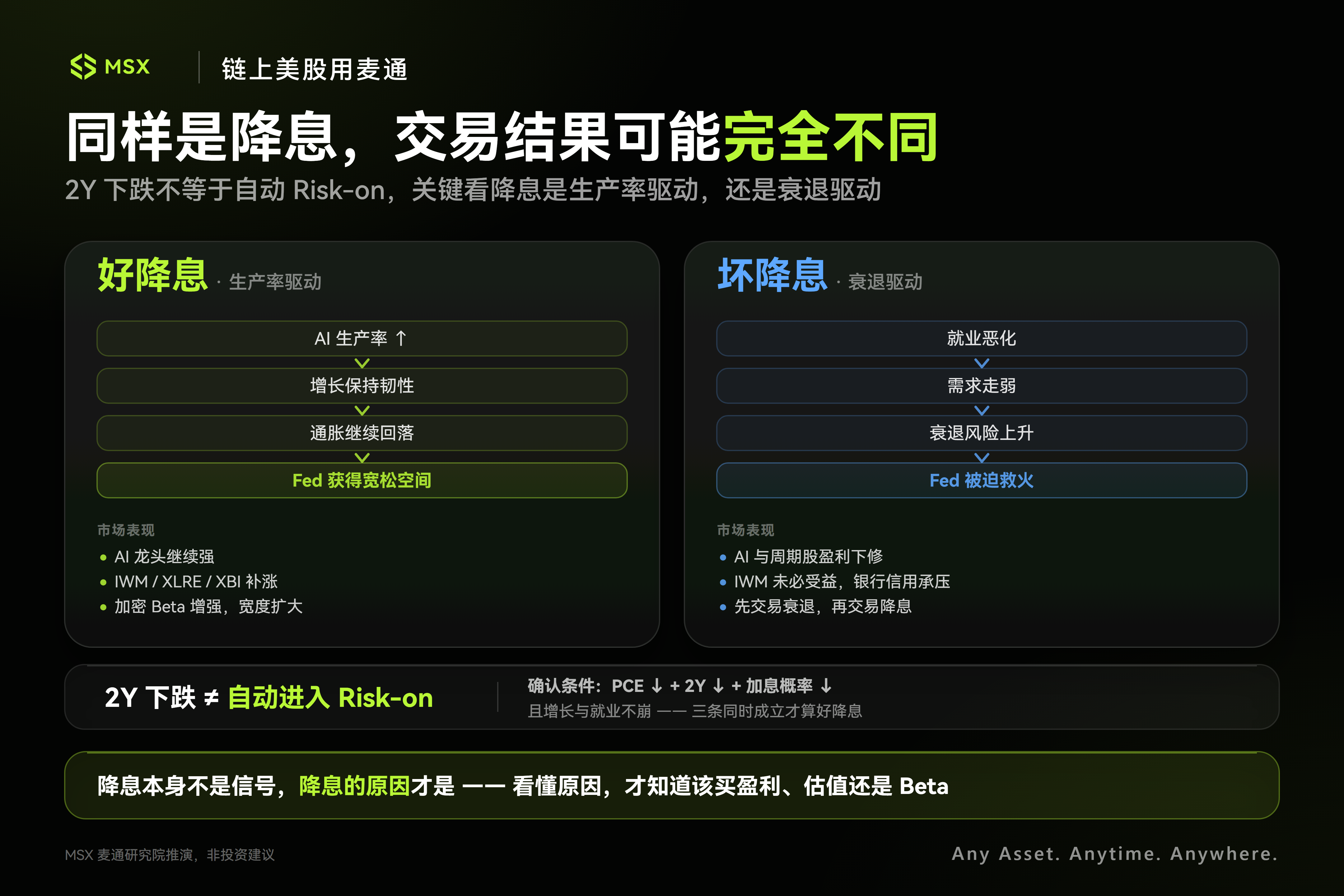
Not all rate cuts are the same trade
The article closes by stressing that not every easing cycle benefits the same set of assets.
If the future path looks like “AI productivity rises, growth stays resilient, inflation falls, and the Fed gains room to cut,” that would be the more favorable version. In that case, AI leaders could remain strong while small caps, REITs, biotech, and crypto beta names catch up, broadening the market.
If the path instead becomes “employment suddenly weakens, recession hits, inflation falls, and the Fed is forced to cut,” the script changes entirely. Even if the 2-year Treasury yield drops just as fast, small caps, regional banks, and cyclical stocks may not benefit right away because markets would first price in earnings downgrades and credit risk.
Those are two very different scenarios.
The next three months will test Warsh’s first policy script
Odaily ends by arguing that Warsh is clearly not an outsider. He served as a Fed governor, lived through the 2008 financial crisis, and spent years in both Wall Street and U.S. policy circles.
If the past two decades of the Fed are seen as an increasingly intricate machine built on models, forward guidance, and market communication, then Warsh is presented as someone trying to rewrite how that machine works: say less, promise less, rely less on QE, and let markets do more of the pricing themselves.
For Trump, the article says, only a Fed chair who can persuade the bond market that he is not a political instrument will later have the credibility to bring benchmark rates down for real. That is why Warsh looking more hawkish today may actually preserve more optionality for the future.
From Sept. 16 to Oct. 28 and Dec. 9, the next three months should reveal what the first full script of the Warsh era looks like.