Hawkish Smoke Screen: The Hidden Path to September Rate Cuts
Federal Reserve Chair Kevin Warsh's hawkish posture may be less genuine than it appears. In his latest report, Academy Securities' Peter Tchir argues that markets have priced in a 75% probability of a September rate hike and expect a cumulative 1.25 hikes by year-end, but this consensus overlooks a real path to September cuts that Warsh appears to be quietly laying. By striking a hawkish tone, Warsh has suppressed tail risks on long-end yields—the 10-year Treasury yield fell from 4.46% to 4.37% this week—while preserving room for a data-driven pivot later. Tchir suggests the ultimate goal could be a September rate cut followed by another in October, conveniently timed ahead of the midterm elections.

Political Economy Shadow: Hawkishness as Strategy, Not Conviction
Tchir reads Warsh's motives through a political economy lens. The Trump administration's policy objectives have not changed—the president knows real estate and understands the importance of low rates. It is hard to imagine Trump tolerating a persistent hawk from his own chosen Fed chair, unless it is a coordinated strategy. Tchir envisions this scenario: Warsh convinces Trump that dovish signals now would be disastrous. By appearing hawkish, he can suppress long-end yields, maintain the appearance of Fed independence, and steer Wall Street analysts and media toward full pricing of rate hikes. Then, as data gradually 'cooperate,' he can pivot to cuts on 'data-driven' grounds, blaming previous Fed leadership for 'using wrong data and acting too late.' The fact that Warsh's father-in-law is a major Trump donor may not be irrelevant.

Inflation Data Narrative Shift: From PCE to Real-Time Metrics and Neutral Rate Battle
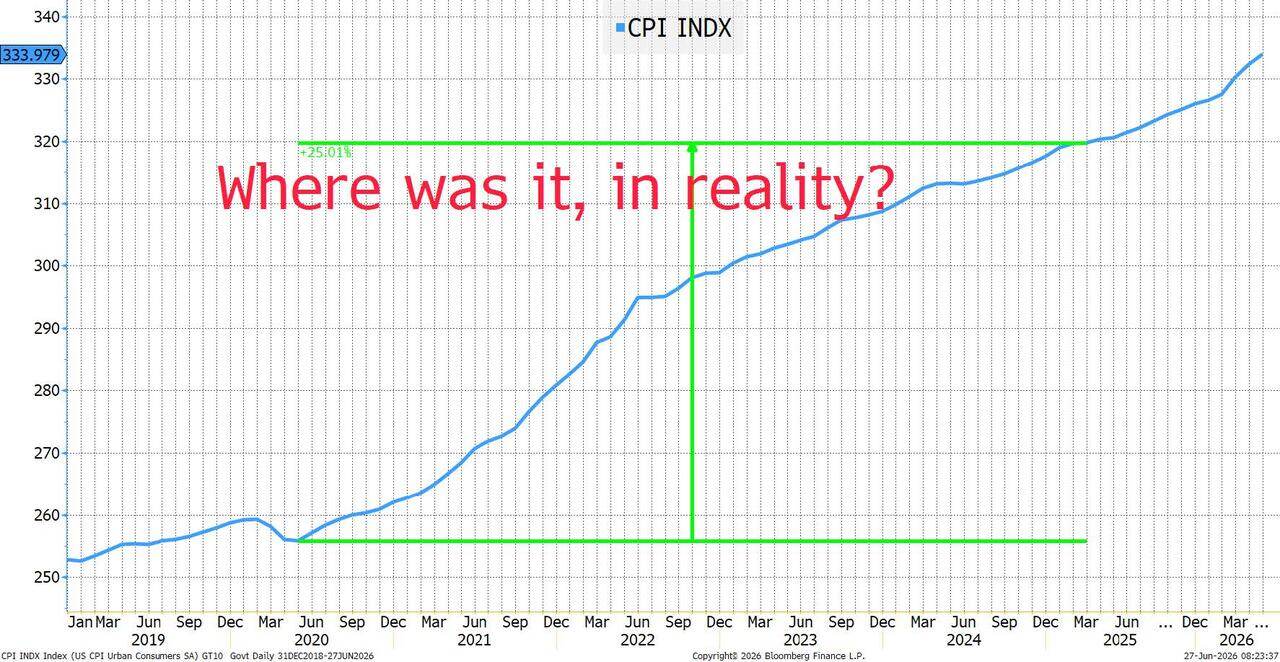
The most substantive part of Tchir's argument is a systematic challenge to the current inflation measurement framework. He states unequivocally that PCE is not the preferred indicator of Warsh's Fed; it was more a preference of the Bernanke era. The Fed could shift to using the Cleveland Fed's own developed metrics without introducing external data, thereby justifying rate cuts. Tchir also cites Truflation's real-time inflation data, which shows core inflation currently around 1.45%, persistently below 1.8% since February 2026. Warsh has recently hinted that the 'big digit' (integer portion) of inflation numbers matters more than precise figures. Tchir believes markets are being gradually conditioned to accept '2-point-something' as close to the 2% target. Once the data narrative shifts, technical barriers to cuts are significantly reduced.

On the neutral rate, Tchir references work by former Fed insider Miran. The neutral rate is inherently difficult to measure, with a wide estimation range. If the new Fed leadership can argue that the previous estimate was too high, that alone could provide theoretical grounds for 50-100 basis points of cuts while blaming the 'old Fed's errors.'

Contrarian Take on AI Inflation and Investment Strategy
Addressing market fears of AI-driven inflation, Tchir offers a reverse reading. Apple's recent price increase led to a stock decline, suggesting consumer pricing power is being questioned. If a top-tier consumer company struggles to pass through price hikes, ordinary firms have even less room. A chip company reported that memory prices have not surged due to AI demand; some products are cheaper than five years ago. AI and data center spending are indeed inflationary, but that dimension is separate from the affordability issues facing ordinary consumers. More critically, higher rates have almost no dampening effect on AI/data center spending—tech companies trading at 100x earnings are insensitive to 50bp moves. The real victims of rate hikes are ordinary borrowers unrelated to AI inflation.

Based on this analysis, Tchir expects markets to reprice rate cut expectations, with the most certain opportunity in the short end of the yield curve—long short-end Treasuries, betting on front-end yield declines. For the long end, he maintains a neutral to mildly bullish stance, believing Treasury Secretary Bessent wants the 10-year yield back to '3-handle' and that Warsh has removed long-end tail risks via hawkish rhetoric. In equities, he recommends significant overweight in energy, especially global nuclear power assets; within the defense and security theme, overweight biotech/pharma and underweight chips. He is cautious on AI and big tech valuations, warning that potential secondary offerings from large tech companies could weigh on stock prices.