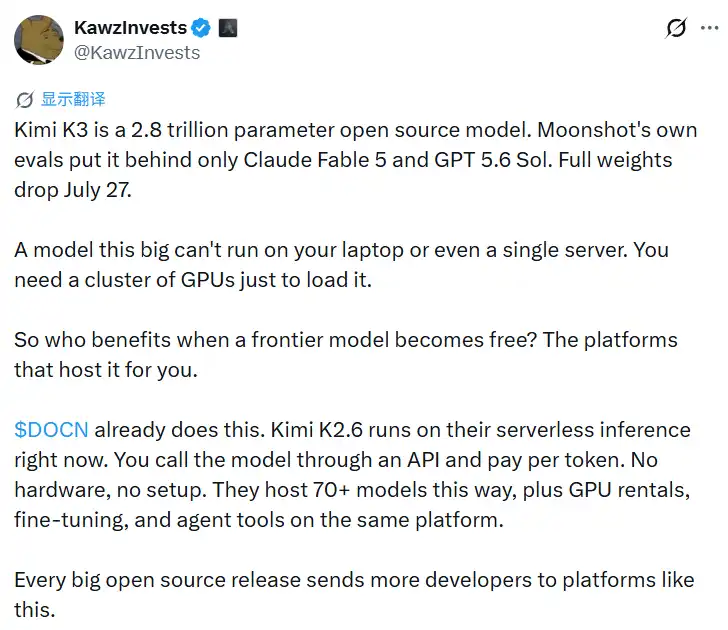
KawzInvests, a newly prominent U.S. stock researcher, said on July 17 that Kimi K3 is an open-source model with 2.8 trillion parameters. According to Moonshot’s own evaluation, the model trails only Claude Fable 5 and GPT 5.6 Sol, with full weights scheduled for release on July 27. KawzInvests argued that a model of that size cannot run on an ordinary user laptop or even a single server, which could make cloud hosting platforms the main beneficiaries if this class of open-source model gains wide adoption. As an example, he pointed to DigitalOcean (DOCN), which already supports hosted deployment for Kimi K2.6. Beyond DOCN, the same investment logic could also apply to neocloud companies including Amazon, Microsoft, NBIS, and RIEN. The comments were cited by BlockBeats in a market analysis update.
BlockBeats reported on July 17 that KawzInvests (@KawzInvests), a newly prominent U.S. equity researcher, said Kimi K3 is an open-source model with 2.8 trillion parameters.
Moonshot’s own evaluation, according to the post, shows Kimi K3 ranks behind only Claude Fable 5 and GPT 5.6 Sol. Full weights are set to be released on July 27.
KawzInvests said a model of that size cannot run on a regular consumer laptop or even a single server. If open-source models of this kind become popular, cloud hosting platforms could be among the companies that benefit.
He cited DigitalOcean (DOCN) as one example, noting that the company already supports hosted deployment services for Kimi K2.6. Aside from DOCN, the same investment thesis could also extend to neocloud companies such as Amazon, Microsoft, NBIS, and RIEN.
This article was originally published by Bit.Fan. For more cryptocurrency news and market insights, visit www.bit.fan. Disclaimer:
The market information, project data, and third-party content displayed on this platform are for industry information sharing only and do not constitute any form of investment advice or return commitment.
Cryptocurrency trading carries high risks. Users should fully assess their risk tolerance and make independent decisions. All profits, losses, and legal responsibilities are borne by the users themselves.