
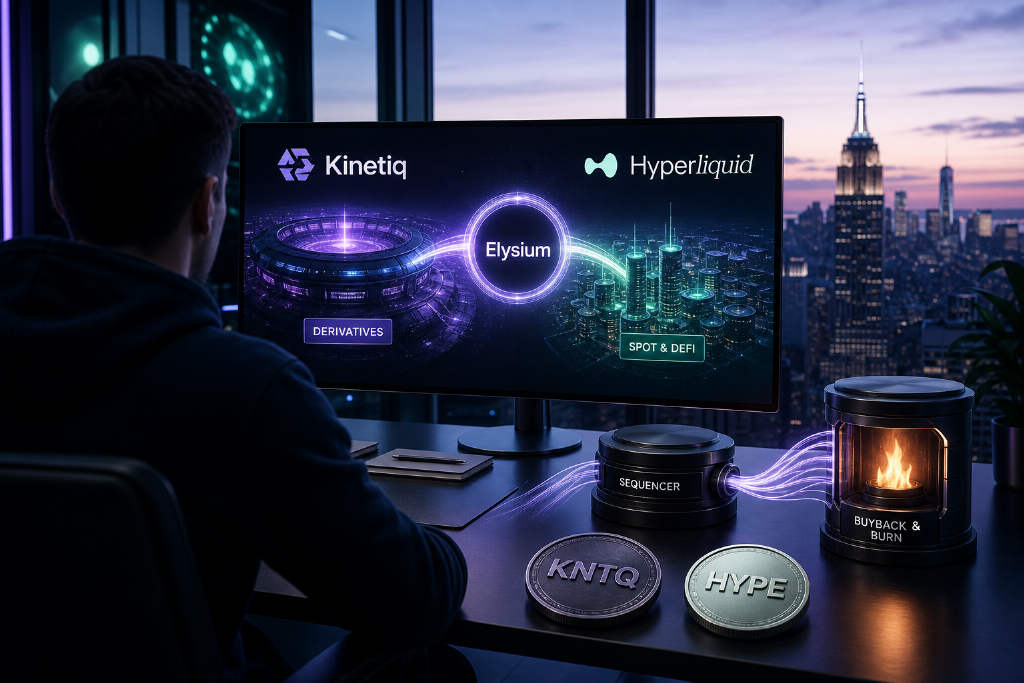
Kinetiq, a liquid staking protocol, announced on Aug. 24 that it is launching Elysium, a high-performance Layer 2 network tailored to the Hyperliquid ecosystem. The news pushed its native token KNTQ up more than 30% in short-term trading, with fully diluted valuation briefly reaching $270 million.
PANews framed the move as a response to two pressures at once: Hyperliquid’s long-standing imbalance between strong perpetuals activity and weaker spot and DeFi activity, and Kinetiq’s own need to find a new growth driver as its staking business slows.
Elysium targets a missing spot and application layer inside Hyperliquid
The launch comes against what PANews described as a structural mismatch in the Hyperliquid ecosystem. Perpetual futures have remained the standout product, while spot trading and DeFi applications have struggled to gain similar traction.
Hyperliquid has become a leader in on-chain perpetuals on the strength of its trading depth, but activity in its spot market has not kept pace with the size of its derivatives business. According to PANews, spot volume has stayed at low levels since last October.
Kinetiq, one of the leading liquid staking protocols in the Hyperliquid ecosystem, currently has total value locked of more than $1.2 billion. Even so, protocol revenue over the past 30 days was only $200,000, a sign that the core business may be hitting growth limits.
Elysium is aimed squarely at that gap. PANews said the network is intended to provide a higher-throughput execution environment that allows PropAMM-style applications to access HyperCore order book data directly, creating a full asset path that runs through:
- token issuance
- AMM liquidity bootstrapping
- the HyperCore spot market
- the HIP-3 perpetual market
That places Elysium in a broader role than simply adding another Layer 2 to the ecosystem. The stated objective is to open HyperCore’s trading infrastructure to more applications and let developers reuse ecosystem liquidity at lower cost.
If that model works, Hyperliquid could move beyond being a platform centered on perpetual futures and toward a structure that combines trading infrastructure with app-chain style execution.
HYPE will be used as gas instead of a separate token
Unlike many Layer 2 networks that introduce their own gas token, Elysium will use HYPE directly as the network gas asset. PANews said the design reflects both ecosystem coordination and value flow considerations.
For users, the setup removes the need to hold an additional gas token before trading or deploying applications on Elysium. It also gives HYPE, already a core asset in the ecosystem, a cleaner connection across HyperCore, HyperEVM, and Elysium, improving composability between different execution environments.
For HYPE itself, the utility profile expands. PANews said HYPE’s value capture has so far come mainly from Layer 1 governance, staking demand, and fee income. With execution layers such as Elysium appearing, HYPE could shift from being a native Layer 1 governance asset to becoming a base payment asset used across the wider Hyperliquid application ecosystem.
PANews also cautioned against assuming that gas demand automatically translates into linear buy pressure for HYPE. If Elysium’s transaction costs remain very low, the amount of HYPE consumed per transaction could be limited. In that case, the token’s economic value as a gas asset would depend more on whether Elysium attracts real users, real applications, and real trading activity than on the gas design alone.
Kinetiq is looking for a second growth engine as liquid staking slows
Kinetiq’s main product is liquid staking. Users stake HYPE, receive kHYPE, and earn staking yield. That business, however, is facing slower growth. PANews reported that kHYPE circulating supply was down about 66% year over year compared with last September and has remained under pressure through the most recent quarter.
Against that backdrop, Elysium introduces a new revenue source: sequencer fees. Under the disclosed allocation model, Elysium’s sequencer income will be split by a fixed ratio, with 50% directed to buybacks and burns of KNTQ.
If Elysium can generate meaningful trading volume, network activity would then feed into KNTQ buyback and burn demand. PANews described this as an attempt to build a value-capture loop of network activity, sequencer revenue, and token buybacks and burns.
That also changes the way the market may value KNTQ. Previously, its valuation was tied mainly to Kinetiq’s liquid staking business. The addition of Layer 2 infrastructure opens another growth path, which PANews identified as one of the key reasons KNTQ rallied more than 30% after the announcement.
Lower cold-start risk does not remove core Layer 2 challenges
PANews said Elysium starts with an advantage because it is building on top of Hyperliquid’s existing ecosystem rather than launching as a standalone chain from zero. Hyperliquid already has established trading infrastructure and an installed user base, which in theory gives Elysium access to existing liquidity and market data and lowers the difficulty of getting a new network off the ground.
Technically, Elysium is built with OP Stack, which PANews said should help control infrastructure development costs while relying on a more mature modular framework.
Even so, Layer 2 competition is not only about performance. PANews argued that Elysium still faces the common three-sided trap seen across L2 ecosystems: without applications, there is no real trading demand; without deep liquidity, applications struggle to retain users; without users, developers have little reason to keep building. Each side depends on the others, and a weak link can lock the network into a negative loop.
A deeper risk comes from Hyperliquid itself. If HyperEVM eventually expands through native technical upgrades into the same part of the stack Elysium is targeting, the case for an independent L2 and its room to grow could come under pressure.
PANews also pointed to familiar L2 risks that remain in place, including sequencer design, cross-chain asset security, cross-execution-environment interaction, and upgrade permissions.
Different implications for HYPE and KNTQ
From a tokenomics perspective, PANews said the implications for HYPE and KNTQ are not the same.
For HYPE, the main effect is a wider set of use cases and a broader ecosystem boundary. Elysium’s potential value lies in strengthening HYPE’s role as an ecosystem currency. In the near term, though, the scale of gas consumption on Elysium remains uncertain, and PANews said that may not produce immediate organic new buying.
For KNTQ, the issue is a repricing of its growth logic. The success or failure of Elysium could have a direct effect on KNTQ’s intrinsic value. If the network gains traction, sequencer fee income could provide ongoing support for buybacks and burns. If activity falls short, the real contribution of that value-capture mechanism may stay limited.
The key operating data to watch next, according to PANews, include daily active users, transaction count, gas consumption, spot trading volume, the scale of liquidity migration into HyperCore, and actual sequencer revenue. Those figures are likely to determine whether the Elysium thesis holds up.
For now, the first test is whether liquidity already sitting inside Hyperliquid can be converted into real demand across spot trading, DeFi, and the application layer.