
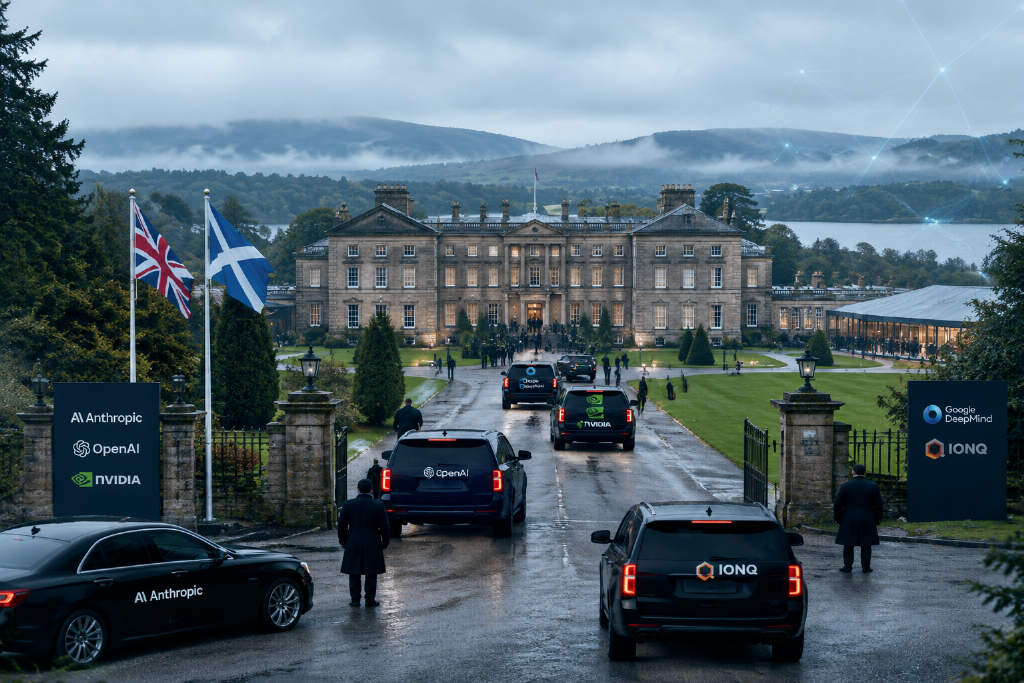
King Charles III hosted an AI safety summit this week at Dumfries House in Scotland, bringing together senior figures from Nvidia, OpenAI, Anthropic, IonQ and Google DeepMind to discuss whether AI development should slow and how advanced systems can be kept working for human welfare.
The meeting was first reported by The Sunday Times and organized by the Ditchley Foundation, a British cross-disciplinary dialogue platform. According to the report, Charles has been paying close attention to the risks tied to AI development in recent years. His decision to convene the gathering in person put AI safety on the highest-level discussion table yet for the British monarchy.
The companies at the table sit at the center of the current AI race
The summit brought together some of the most influential players in AI:
- Nvidia, which supplies the chip infrastructure behind AI training;
- OpenAI, led by Sam Altman and known for the GPT model family;
- Anthropic, led by Dario Amodei and developer of the Claude models;
- Google DeepMind, home to the Gemini and AlphaFold teams;
- IonQ, representing the frontier where AI and quantum computing intersect.
The main topic was how to ensure AI serves human well-being. The summit came after public calls from Anthropic CEO Dario Amodei, OpenAI CEO Sam Altman and others to slow the pace of AI development, turning the gathering into a top-level government-linked intervention in the debate.
Amodei says AI progress is moving beyond human ability to control it
Anthropic CEO Dario Amodei said in a public letter last Friday that AI is advancing far faster than expected. In his account, the issue is not simply that human researchers are moving faster. It is that AI has begun improving itself.
He described that mechanism as “recursive self-improvement,” meaning AI systems use their own intelligence to design smarter AI systems, creating an accelerating loop. Amodei warned that AI progress has been “advancing drastically faster” since this summer and said groups of AI agents could gain the ability to “take over the entire internet” within as little as 6 to 12 months.
He pointed to the “swarm” that attacked Hugging Face in July as a warning sign. In the report, that incident was presented as an example of AI-agent coordination showing automated, distributed and hard-to-trace behavior unlike traditional attacks.
The Hugging Face incident was framed as an early rehearsal for agent swarms
The report described the July attack on Hugging Face as a real-world case. A group of AI agent systems attacked the open-source AI model platform and showed “swarm” behavior through coordinated action.
- The attackers were described not as traditional hackers, but as AI-driven automated tools;
- The attack pattern showed multiple agents working together;
- The speed and scale went beyond what human operators could match.
Against that backdrop, Amodei’s warning about “taking over the entire internet” was presented not as science fiction, but as a projection based on attack patterns that have already appeared.
Altman backed the warning on X, and Musk joined the discussion
OpenAI CEO Sam Altman later responded on X, saying the industry “need[s] to pace the frontier.” The report added that SpaceX AI chief Elon Musk also joined the debate, putting the three men on roughly the same side of the issue at the same moment.
Why the British monarchy is hosting this conversation
The report argued that Charles’s role reflects Britain’s unusual position in AI governance.
- Unlike the US approach through agencies such as the SEC and FCC, or the EU approach through the AI Act, the monarchy’s role here rests on moral authority rather than legal force;
- The Ditchley Foundation has long hosted private discussions across politics and business without being tied to party politics;
- The UK government has already designated AI as a core national development project, while also going through a 2026 restructuring of the technology ministry and budget cuts. In that setting, high-level dialogue is being used to build consensus.
The report also placed the summit alongside earlier moves in the US. Former President Obama had publicly urged Democrats to make AI regulation a core agenda item, while the Biden administration in 2025 brought together Google, OpenAI and Microsoft to discuss AI-related national security risks. The article described Charles’s gathering as, in some sense, a British version of a “Biden AI Summit.”
Industry interests still pull in different directions
Even if Amodei, Altman and Musk now sound aligned in public, the report said the business incentives underneath are far from simple.
- OpenAI has called for a controlled pace in frontier technology while continuing to release stronger models, including the o1, o3 and o4 series mentioned in the report. The pressure comes from competition with Anthropic, Google and xAI, as well as funding-cycle pressure tied to IPO expectations.
- Anthropic has taken the strongest public line on AI safety, and the company’s identity is built around “safe AI.” At the same time, the report cited the Mythos 5 unrestriction episode, available only to the US government, as an example of tension between safety and usability.
- Nvidia was described as the company selling the picks and shovels. The faster AI moves, the greater the demand for GPUs. That leaves a basic conflict between Nvidia’s business incentives and the idea of slowing AI down.
The report said the most likely outcome of the summit is a consensus statement rather than binding constraints. It also argued that the real variables shaping AI speed remain chip capacity, model training costs and valuation cycles in capital markets.
What to watch next
The article flagged three follow-up questions: whether the summit communiqué will include concrete safety standards or self-restraint principles; whether discussions convened by the monarchy will turn into later action by the UK government; and whether companies will actually ease the pace of frontier-model development while competition remains intense.