
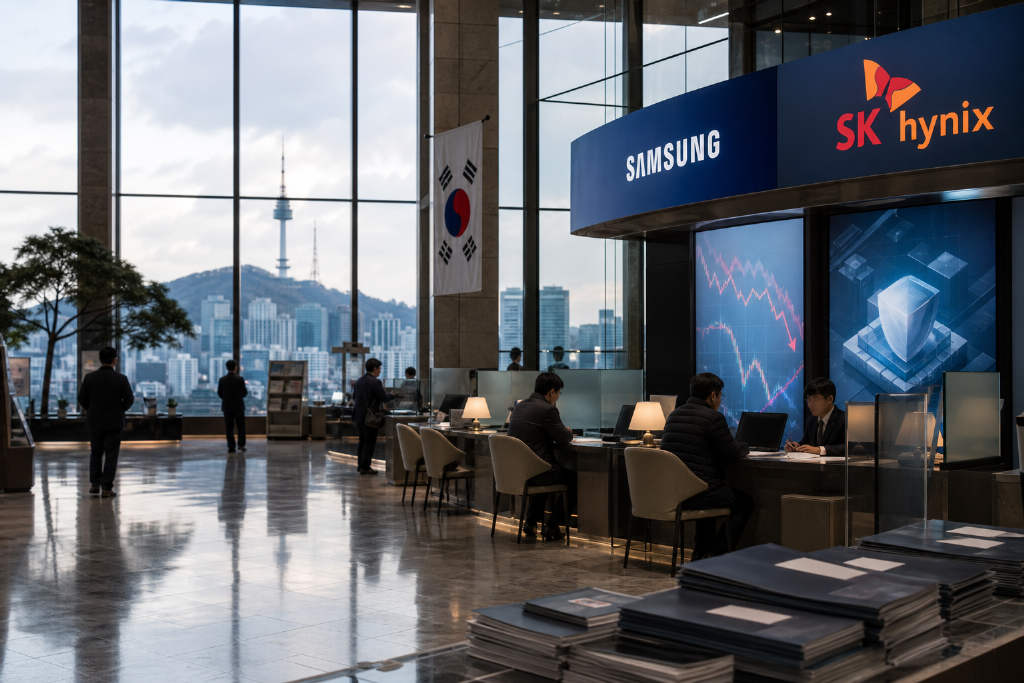
South Korean retail investors have not turned cautious after a historic stock-market selloff. Instead, they are moving from single-stock leveraged exchange-traded funds into more complex equity-linked securities, or ELS. Bloomberg reported on Aug. 23 that South Korea’s ELS sales reached about 3.5 trillion won in July, the highest level since April 2023, with products tied to Samsung Electronics and SK Hynix drawing the strongest demand.
Some brokerages have been offering annualized coupons of 40% to 50% to attract buyers. The rush comes just after a sharp market correction. The KOSPI at one point dropped 22% last month, and regulators began trying to restrain heavy retail trading in single-stock leveraged ETFs, which were seen as adding to market volatility.
Samsung Electronics and SK Hynix-linked products lead demand
ELS are structured products whose returns are tied to the performance of stocks or indexes. Put simply, investors can earn high coupons if the underlying assets do not fall below specified thresholds. If the market drops hard enough, they can also face large losses on principal. Recent swings in the stock market have made it possible for issuers to offer richer coupons on these products.
Earlier this month, Meritz Securities launched an ELS tied to both Samsung Electronics and SK Hynix, offering annualized returns of as much as 43.4%. That yield comes with clear risk. Under the product terms, investors could face principal losses if either Samsung Electronics or SK Hynix falls 70% at any point during the life of the product and remains far below its initial price at maturity.
Kiwoom Securities went further with a product linked to SK Hynix and LG Electronics, offering annualized coupons of up to 50%. If the payout conditions are not met, the brokerage disclosed potential losses of 30% to 100%. In other words, a quoted 50% annual yield is not a fixed return like a time deposit. It is compensation for taking on tail risk tied to a steep drop in the underlying stocks.
Higher volatility has pushed coupons higher
Maxence Visseau, chief investment officer at Arkevium Capital, said ELS issuance typically increases after market corrections or sharp rises in volatility, because entry prices for stocks are lower and the products can offer higher coupons.
Samsung Electronics and SK Hynix have both rebounded in August, but their shares are still at least 22% below the record highs reached in June. For ELS buyers, the wager is not necessarily that the two stocks will surge right away. It may simply be the view that even if the shares move sideways or slip a bit more, another catastrophic collapse is unlikely.
Visseau warned that the danger lies in confusing a strong company with a safe entry price.
Retail money shifts after regulators move on leveraged ETFs
The ELS surge also points to a change in where South Korean retail money is going. When the KOSPI fell 22% last month, single-stock leveraged ETFs that were popular with local retail traders were seen as having amplified volatility, prompting regulators to start limiting frenzied trading in those products.
Bloomberg said one of the biggest stock selloffs in recent memory does not appear to have reduced retail investors’ appetite for risk. Instead, investors are moving from one high-risk instrument to another.