


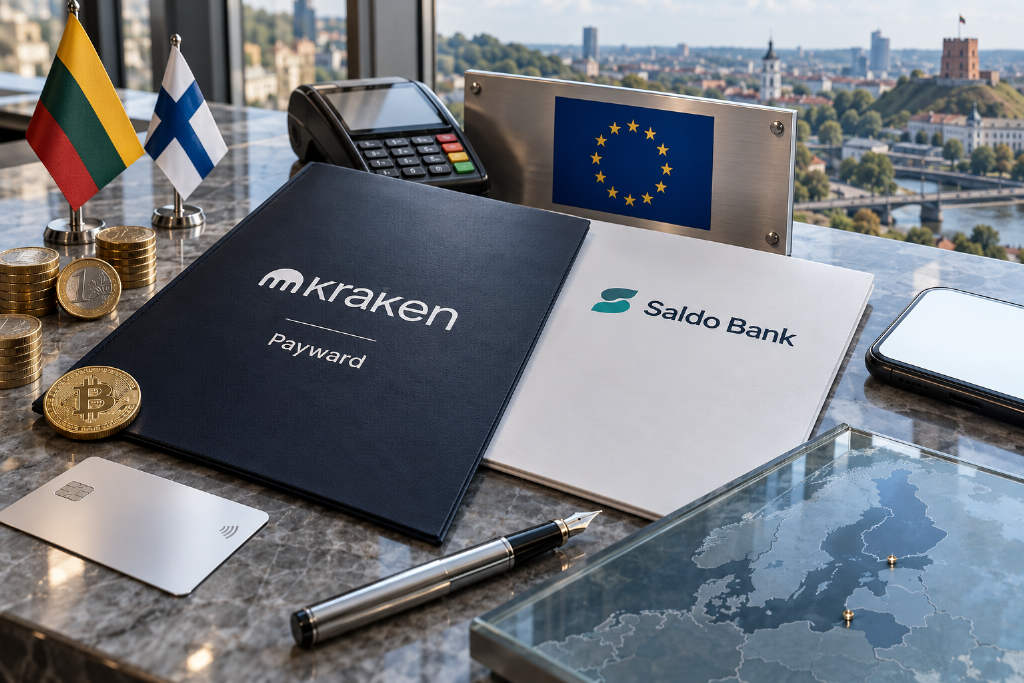
Payward, the parent company of Kraken, said it has signed a definitive agreement to acquire Lithuania’s Saldo Bank. The actual counterparty is Saldo Finance Oy, the bank’s Finnish parent company. Financial terms were not disclosed, and the deal is expected to close in 2027, subject to regulatory approval.

Saldo Bank is not a large lender, but it holds an asset Payward has been seeking for years: an EU banking license. The bank currently operates in Lithuania, Finland, Sweden and Germany, and it also has the relevant access credentials for the Dutch market. Its existing business covers retail term deposits, consumer loans, small and medium-sized business lending, credit cards and embedded finance services.
Payward said that after the acquisition closes, it plans to combine banking deposits and lending, payments, credit cards and digital asset services so customers can manage cash, cryptocurrencies, tokenized stocks and credit products within one financial system.
The company described the transaction as Europe’s first bank acquisition by a digital asset firm. One of the central figures behind that push is Arjun Sethi, co-CEO of both Kraken and Payward. His own career arc tracks a broader shift in which crypto capital is moving deeper into traditional financial infrastructure.
From social gaming founder to venture capitalist
Sethi, now 43, did not start in finance. He grew up in Silicon Valley, worked with software early on, and later moved into internet startups. In the second half of the 2000s, Facebook’s rise turned social games and platform-based apps into a major startup theme. Sethi was part of that wave.
Around 2007, he founded social gaming company Roflplay. In 2009, the company was acquired by social app developer Lolapps, and Sethi joined the management team there. Lolapps was also focused on building social games and applications around Facebook. As the company entered a period of rapid growth, operating pressures grew with it, and the then-CEO proposed that Sethi take over the business.
At the time, Sethi had limited experience in restructuring and operational management. He turned to IBM former CEO Lou Gerstner’s book Who Says Elephants Can’t Dance?, studying how Gerstner led IBM through a turnaround. He wrote useful ideas from the book onto index cards and tried to apply those management methods inside the company.

In March 2010, Sethi formally became CEO of Lolapps. Social game developers at the time had to keep buying traffic, measuring retention and adjusting products based on user data. That period helped shape a management style that would stay with him: use data to understand user behavior, then move faster on product iteration and marketing decisions.
During that stretch, Lolapps released a range of entertainment and interactive products familiar to Facebook users, including a once-popular Sex and the City character personality test. Products under the Lolapps umbrella at one point reached 100 million monthly active users, and the business was ultimately sold for $240 million.
Sethi later moved into mobile messaging. In 2013, he co-launched MessageMe, aiming to compete for users as apps such as WhatsApp were expanding quickly. MessageMe grew fast in its early phase. About two and a half months after launch, it had passed 5 million users and drew backing from Andreessen Horowitz, Greylock Partners and Google Ventures.
Yahoo acquired MessageMe in October 2014. Sethi then joined Yahoo, where he worked on growth, data science and emerging products.
Those two startup cycles took him through both rapid expansion and post-acquisition integration. They also shifted his attention toward helping other startups find growth opportunities. During his founder years, he had already begun making angel investments through personal networks. Over time, he came to believe that investment firms also needed a more systematic way to evaluate a company’s growth potential.
Around 2016, Sethi joined Social Capital, the venture firm founded by former Facebook executive and investor Chamath Palihapitiya, as a partner. In 2018, he co-founded Tribe Capital with Social Capital co-founder Ted Maidenberg and partner Jonathan Hsu, completing his move from internet entrepreneur to full-time venture investor.

Unlike many venture firms that lean heavily on founder pedigree, market size and sector experience, Tribe Capital put more weight on operating data. Its approach included analyzing retention, revenue growth, customer mix and product-market fit to identify companies with durable growth potential. For Sethi, that framework matched the way he had already learned to run businesses.
That venture work also became his entry point into crypto finance.
From a discarded bitcoin computer to Kraken’s leadership
After Tribe Capital was formed, its investment scope expanded from internet software into fintech, crypto and artificial intelligence. Its portfolio includes Carta, Docker and xAI. Sethi has also made personal investments in companies such as Gusto, Lyft and Opendoor.
Outside venture investing, he was spending more time around crypto. Sethi has said he nearly had an early bitcoin windfall. While running an internet company years ago, a developer gave him a computer containing bitcoin mined earlier on. He later threw the machine away. By his own estimate, those coins could be worth $300 million to $400 million today.
The real turning point came through Tribe Capital’s investment in Kraken. In 2021, Sethi joined Kraken’s board and began taking part in the exchange’s development as both an investor and a director.
Over the following years, he lived through the industry’s move from a bull market into the deep reset that followed the collapse of FTX. He also built closer working ties with Kraken founder Jesse Powell and Thanh Luu. In October 2024, Kraken named Sethi co-CEO, with Dave Ripley continuing to lead the company alongside him.

After taking the role, Sethi’s home in Menlo Park, not far from Stanford University, became an important work site for Kraken. The report describes a black Cybertruck that rarely moves, electronics in an open garage, people coming and going, sparse interior decoration and a German shepherd in the backyard.
Powell said Sethi had helped Kraken through several difficult periods since joining the board in 2021, which is why he earned the trust of the leadership team.
For Sethi, data remained the core decision tool across product operations, investing and management. He said Powell wanted him to bring the quantitative management methods he had used in earlier companies into Kraken and help the business expand beyond the exchange itself.
Restructuring, flat management and internal debate
Not long after taking charge, Sethi pushed through organizational changes. Kraken said it would cut management layers, simplify the internal structure and reduce headcount. He also adopted a flat management model that is unusual for a company of that size, with a large number of business leaders reporting directly to him.
In early 2025, Sethi said in an interview that he had roughly 50 to 70 direct reports and had built six or seven automation tools to process the heavy flow of information coming from GitHub, email and Slack.
That highly centralized style drew mixed reactions internally. A September 2025 investigative report by Fortune, citing former executives, said Sethi placed more emphasis on data and execution efficiency and less on employee morale and the legacy management structure. Another former executive told the magazine that the changes could help Kraken improve efficiency and prepare for a future IPO.
Dual roles across Kraken and Tribe Capital
While running Kraken, Sethi has remained chairman of Tribe Capital. That leaves him at the center of both a crypto exchange and a venture firm.

The overlap became more visible in financing activity. In September 2025, Kraken completed a $500 million funding round at a $15 billion valuation. Investors in that round included Tribe Capital and Sethi personally.
Two months later, Kraken said it had secured $800 million in financing commitments and brought in institutional investors including Citadel Securities at a $20 billion valuation.
According to Kraken’s own announcement, Tribe Capital accounted for a major portion of that round, and Sethi’s family office also made a large investment commitment. As Kraken’s valuation rose, Sethi’s relationship with the company came to span executive authority, an existing board role, and both personal and institutional capital exposure.
A former executive interviewed by Fortune raised concerns that Sethi’s continued role as Tribe Capital chairman could create conflicts of interest between investment decisions and company management. A Kraken spokesperson responded that Sethi does not run Tribe Capital’s day-to-day operations and that his dual role had been approved by Kraken’s board and Tribe Capital’s limited partner advisory committee.
Those capital links extended further in January 2026, when a special purpose acquisition company called KRAKacquisition Corp listed on Nasdaq and raised $345 million.
SEC filing documents show that the sponsor, NCTK Sponsor LLC, was formed jointly by Kraken, Tribe Capital and Natural Capital. The three parties hold equal membership interests in the sponsor entity and each appoints one representative to its management committee, which oversees the securities it holds and related investment decisions. KRAKacquisition said it would focus on merger targets at the intersection of traditional finance, fintech, cryptocurrency and decentralized finance.
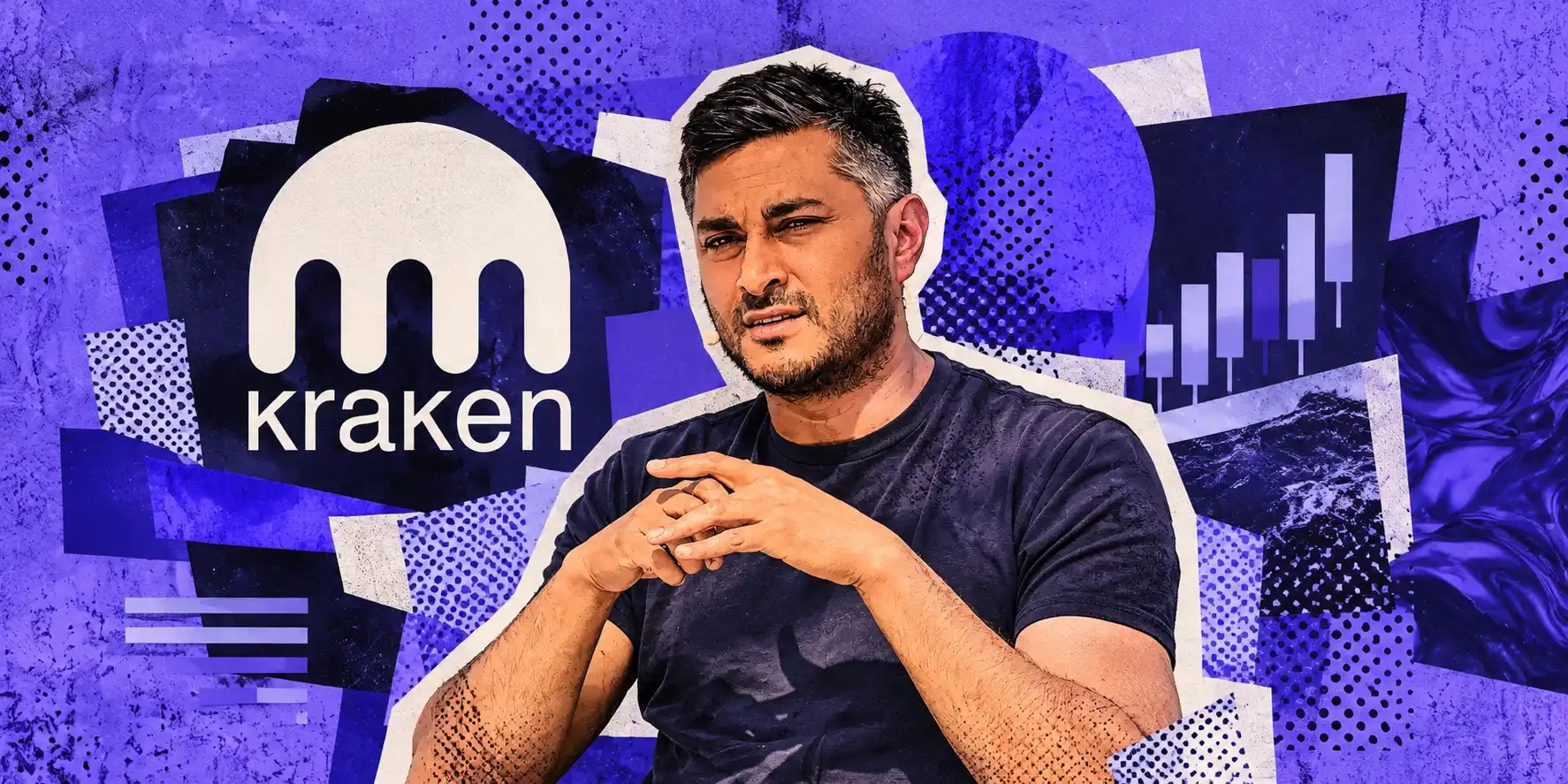
From investing in Kraken and joining its board, to becoming co-CEO, participating in financings through Tribe Capital and a family office, and then co-sponsoring a SPAC, Sethi’s ties to Kraken have developed into a layered mix of capital and governance relationships.
A faster acquisition pace and a broader financial stack
After Sethi moved into Kraken’s management ranks, the company’s acquisition pace picked up sharply.
In March 2025, Kraken said it would acquire U.S. futures trading platform NinjaTrader for $1.5 billion. The deal brought established futures trading software, a trader customer base and infrastructure tied to traditional derivatives markets. NinjaTrader had about 2 million customers at the time, giving Kraken a direct route into the U.S. traditional futures market beyond its existing crypto trading users.
That same year, Kraken also acquired Small Exchange, Breakout and Capitalise.ai, adding capabilities in U.S. derivatives trading, trader services and automated trading.
In tokenized assets, Kraken launched xStocks and then acquired Backed Finance, the issuer behind the tokenized stock product, bringing issuance and trading of tokenized equities into the same group structure.
Acquisitions continued in 2026. In February, Payward acquired token management platform Magna to expand token distribution, vesting management and related infrastructure services. In May, Payward completed its acquisition of U.S. derivatives platform Bitnomial for up to $550 million. That transaction gave it licenses and infrastructure tied to futures brokerage, contract markets and derivatives clearing under the U.S. Commodity Futures Trading Commission framework. In July, Payward also completed the acquisition of stablecoin payments and card issuance infrastructure company Reap, in a deal previously announced at up to $600 million.

Both the Bitnomial and Reap transactions used a mix of cash and equity, and the related agreements implied a $20 billion equity valuation for Payward.
Taken together, the business logic is straightforward. NinjaTrader expanded the user base in traditional trading markets. Bitnomial added regulated U.S. derivatives trading and clearing capability. Backed Finance and xStocks strengthened the tokenized stock business. Reap brought payments, card issuance and cross-border money movement into the group.
Now Saldo Bank adds traditional banking deposits, lending and payment infrastructure. Payward’s aim is to build a financial services system spanning trading, custody, payments, financing and asset management, then offer those services through different brands to retail traders, institutional clients and fintech companies.
The bank deal is only the opening move
In the October 14 acquisition announcement, Sethi said Payward Banking had been under construction for years and that the group was filling in financial infrastructure market by market and license by license. He said institutions that control the core financial relationship with customers can build from deposits, lending and payments into trading, wealth management and treasury products.
The acquisition streak also raises the operating burden. As an investor, Sethi could spread risk across a portfolio and decide which companies had long-term growth potential. As Payward co-CEO, he now has to carry direct responsibility for integration, organizational management, capital allocation and regulatory compliance.
Payward has already used acquisitions to secure more licenses and business capabilities. The next test is whether it can integrate businesses spread across different markets and regulatory systems into a financial group that can generate sustained profits. For Sethi, a former venture capitalist now running an exchange group, buying a European bank is not the end point. It is the start of a harder integration challenge.