
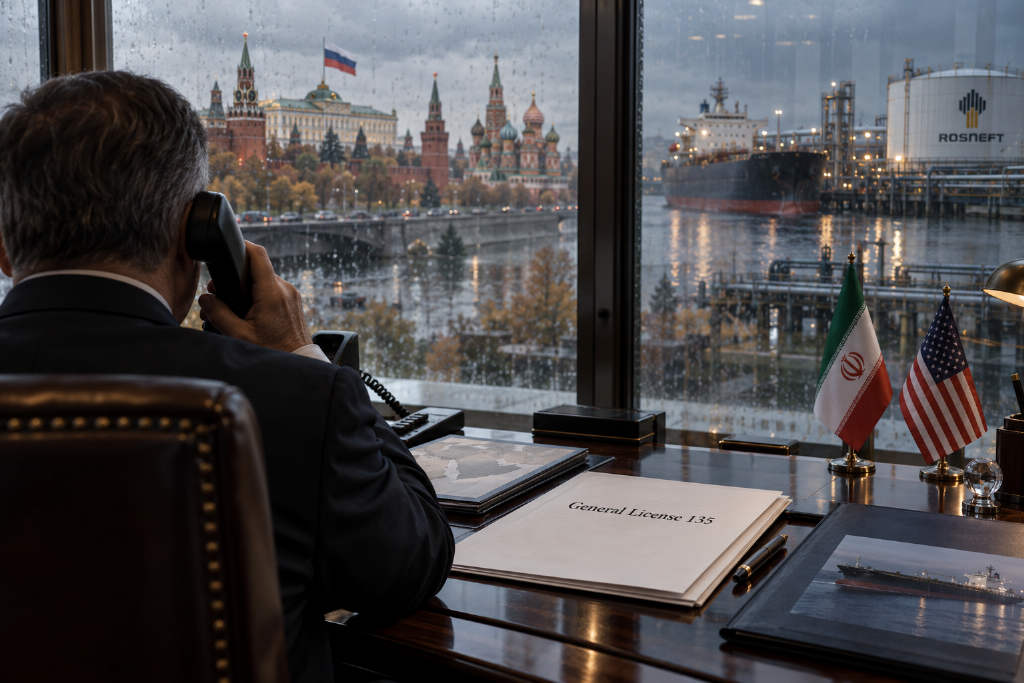
The Kremlin said President Vladimir Putin relayed Iran’s views on a possible end to the conflict during an Oct. 9 phone call with U.S. President Donald Trump after coordinating with Iranian President Masoud Pezeshkian, according to TASS. The Kremlin did not spell out the specific terms raised by Iran, and the White House did not respond to CNBC’s request for comment.
Putin spoke with Pezeshkian twice in Turkmenistan before the Trump call
Kremlin spokesman Dmitry Peskov said Putin met Pezeshkian twice while attending a Commonwealth of Independent States summit and a Caspian environmental summit in Turkmenistan. In one of those meetings, Putin told the Iranian president in advance that he would be speaking with Trump.
Peskov said that, after coordinating with the Iranian president, Putin then conveyed Iran’s views on a possible settlement of the conflict to Trump. Russia, Iran and Azerbaijan also held a trilateral meeting during the summit period.
Details posted on the Kremlin website by presidential aide Yuri Ushakov said the call took place late on Oct. 9 after Putin returned to Russia from Turkmenistan. The two leaders also discussed Ukraine.
Ushakov said that despite periodic hardline rhetoric in public, the United States has continued indirect dialogue with Iran through Qatar. He also said Russia’s earlier proposal to move Iran’s highly enriched uranium to Russia "remains valid."
The report said the war began on Feb. 28 with U.S. and Israeli airstrikes on Iran, and that a temporary ceasefire arrangement signed by Washington and Tehran in June quickly fell apart.
Trump said Russia would supply more than 4 million tons of diesel
The same call also turned to energy. In a Truth Social post on Oct. 9, Trump said Russia would immediately supply more than 300,000 tons of diesel to the global market, followed by 500,000 tons in November, then 1 million tons, and later another 3 million tons depending on the condition of Russian refineries.
Ushakov said the two sides discussed major economic projects in detail, including supplies of Russian petroleum products to the United States and global markets. Asked whether Washington had offered concessions to Moscow, he said the U.S. side would provide further clarification.
U.S. Treasury issued General License No. 135
The U.S. Treasury Department’s Office of Foreign Assets Control issued General License No. 135 on the same day, authorizing transactions related to the sale, transport, discharge and import of Russian-produced diesel, including imports into the United States. The license runs until 12:01 a.m. Eastern Time on April 7, 2027.
The authorization does not cover debits from accounts held at U.S. financial institutions by the Central Bank of Russia, the Russian National Wealth Fund, or the Russian Ministry of Finance.
CNBC reported that continued Ukrainian attacks on Russian refineries forced Moscow to ban diesel exports. It also said Iran and Yemen’s Houthi group have attacked refineries in the Middle East, driving global diesel prices sharply higher. Trump is facing political pressure to push fuel prices down ahead of the November midterm elections, and said at the end of September that he was seriously considering a diesel export ban.
Zelenskyy called the diesel arrangement a gift to Putin
Ukrainian President Volodymyr Zelenskyy wrote on X on Oct. 9 that the diesel deal was "a gift to Putin" and said, "A gift to Putin will not bring peace and will not benefit the civilized world in any way. Russia will ‘repay’ this diesel with more terror and deceit."
He said easing sanctions before Russia makes a clear and lasting commitment to de-escalation would only prolong the war.
CNBC says attacks on tankers in the Strait of Hormuz have continued
On the Middle East front, CNBC reported that Iran has stepped up attacks on tankers passing through the Strait of Hormuz, with vessels coming under attack almost daily. A senior officer in Iran’s Revolutionary Guard said on Oct. 7 that Iran would block all "illegal routes" in the Strait of Hormuz.
With U.S. military escorts operating along the coast of Oman, Middle Eastern crude exports in September recovered to pre-war levels. Trump said on Oct. 8 that he would not attack Iran before the midterm elections.



