

Highly funded Web3 projects are being forced out faster
KuCoin Ventures said in its latest weekly report that the back-to-back Chapter 11 filings of Movement Labs and Storj Labs put the long-term survivability of highly funded Web3 projects back in focus. The report drew a clear distinction between the two cases. Movement’s problems were linked to token issuance, market-making arrangements and internal governance failures. Storj, by contrast, is using court-supervised restructuring to deal with legacy debt while keeping the business running.
Its broader point was that fundraising size, technology narrative and token valuation can offer only temporary support. They do not replace governance, a sound capital structure or the ability to sustain commercialization over time.
Movement: large fundraising, small remaining assets
KuCoin Ventures described Movement as the sharper warning sign. The project quickly attracted capital through its Move programming language angle and its Ethereum Layer 2 narrative, raising more than $40 million publicly and at one point pursuing another round at roughly a $3 billion valuation.
But bankruptcy filings from MVMT Labs showed listed assets of only about $100,000 to $500,000 and liabilities of as much as $10 million. The report said the contrast between the scale of past funding and the amount of remaining assets was stark.
It identified the turning point as the market-making setup around the MOVE token launch. Agreements tied to Rentech and Web3Port gave a single counterparty access to a large amount of MOVE. About 66 million tokens were then sold quickly in the early stage after launch, pushing the price lower and setting off restrictions on market-making accounts, token buybacks, internal investigations and management changes.
For KuCoin Ventures, the core problem was not simply one concentrated selloff. It was the lack of effective checks across counterparty selection, contract review, authority balance and information disclosure. In that reading, the project’s technology path and capital backing never translated into a governance structure strong enough to match them, and the token liquidity issue spread into fundraising, team stability and the balance sheet.
Storj: balance-sheet restructuring rather than a network shutdown
Storj represented a different type of pressure in the report, one that built over a longer period. As an early decentralized cloud storage project, Storj already has an operating network and an actual product in the market. Even so, the company chose Chapter 11 to clean up legacy debt.
KuCoin Ventures noted that the company has stressed the process is aimed mainly at the corporate capital structure. Network services and existing STORJ functions remain in operation. That makes the case closer to a balance-sheet restructuring than a direct shutdown of business activity or the network itself.
The report said this matters because having a working product and real customers does not automatically mean a company is sustainable. For infrastructure projects with long operating cycles, mismatches among early financing terms, legacy debt, fixed costs and revenue growth may show up gradually once financing conditions tighten. If business growth cannot cover ongoing investment, the company may still need asset sales, equity adjustments or court restructuring to relieve financial pressure even if network demand remains.
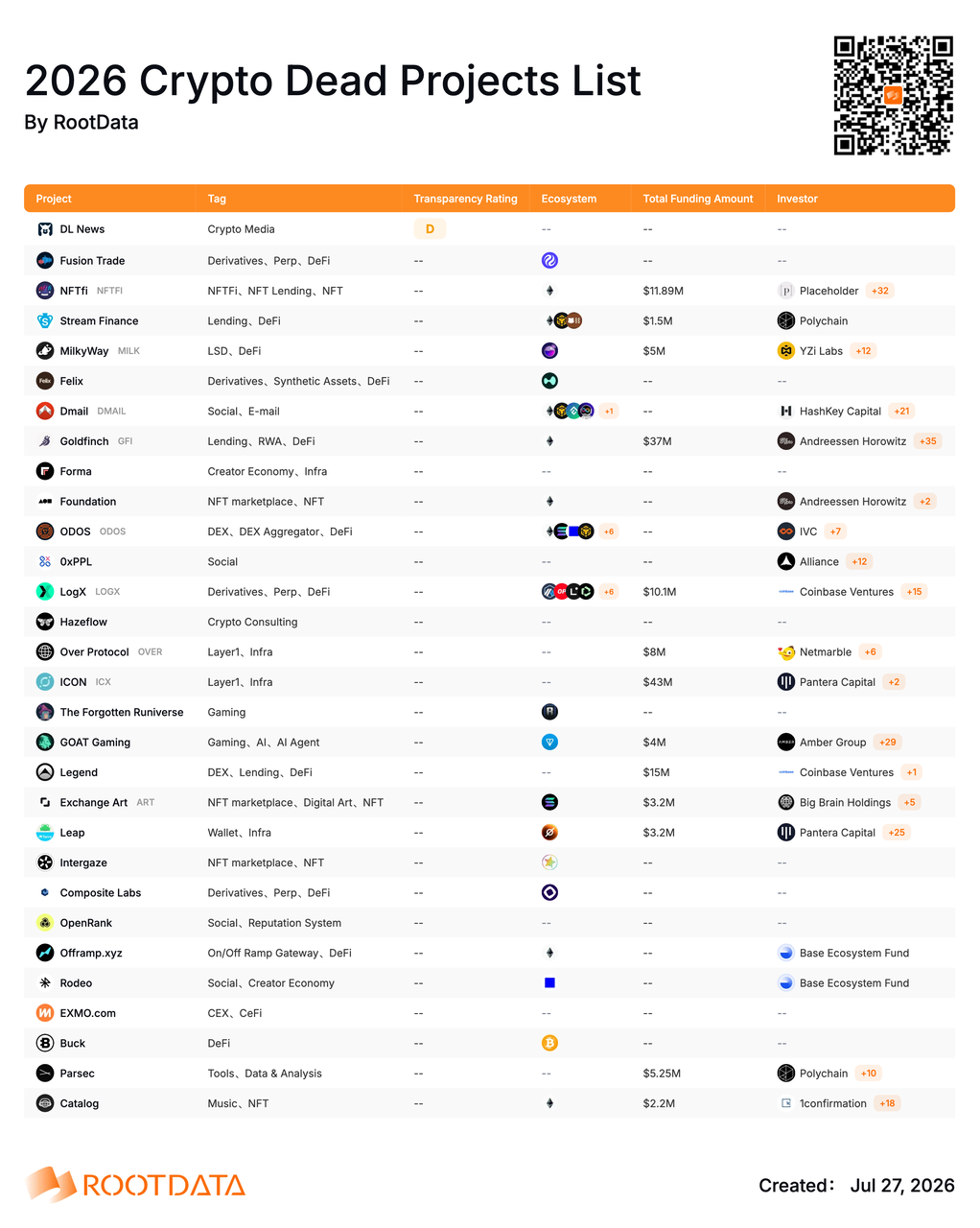
RootData says more than 100 crypto projects have shut down, filed for bankruptcy or gone inactive in 2026
KuCoin Ventures said Movement and Storj are not isolated cases. Citing RootData, the report said more than 100 crypto projects have closed, filed for bankruptcy or entered long-term inactivity so far in 2026. The list spans DeFi, NFT, GameFi, Layer 2, wallets and infrastructure.
The direct reasons vary, but the report said many of these projects share the same pressures: difficulty raising follow-on capital, weak product adoption, revenue that cannot cover operating costs and slower growth after token incentives lose force. It also pointed to some trading platforms that have stopped operations or started orderly liquidation, which it said reflects an industry still concentrating resources in larger players with scale, liquidity and steadier revenue. Mid- and long-tail platforms without scale effects, clear differentiation or durable income face rising operating and compliance pressure.
KuCoin Ventures framed Movement and Storj as two different washout paths. One moved quickly from a high valuation to restructuring after governance and token issuance mechanisms failed. The other accumulated strain over time through legacy debt and operating efficiency issues. Together, the report said, they show that survival metrics for Web3 projects are shifting away from financing size, valuation and narrative heat and toward internal controls, real revenue, product adoption, cash burn and balance-sheet quality.
It argued that this round of project exits is not simply a story of “highly funded projects failing.” It is a re-rating of how efficiently capital was allocated in the last cycle. In a bull market, fundraising ability, technology labels and token expectations can mask weak governance, poor adoption and an imbalanced cost structure. Once follow-on funding becomes harder and token liquidity falls, those weaknesses show up more directly in cash flow and the balance sheet.
The report said investors may need to move their focus away from how much a project raised, who invested and how high the valuation was, and toward runway, revenue quality, legacy debt, token liquidity and governance design. In that view, the next stage of Web3 competition is not just about raising capital and launching a token. It is about keeping a real business operating without continuous outside financing.
Energy shock reshapes rate expectations and pushes liquidity into fewer assets
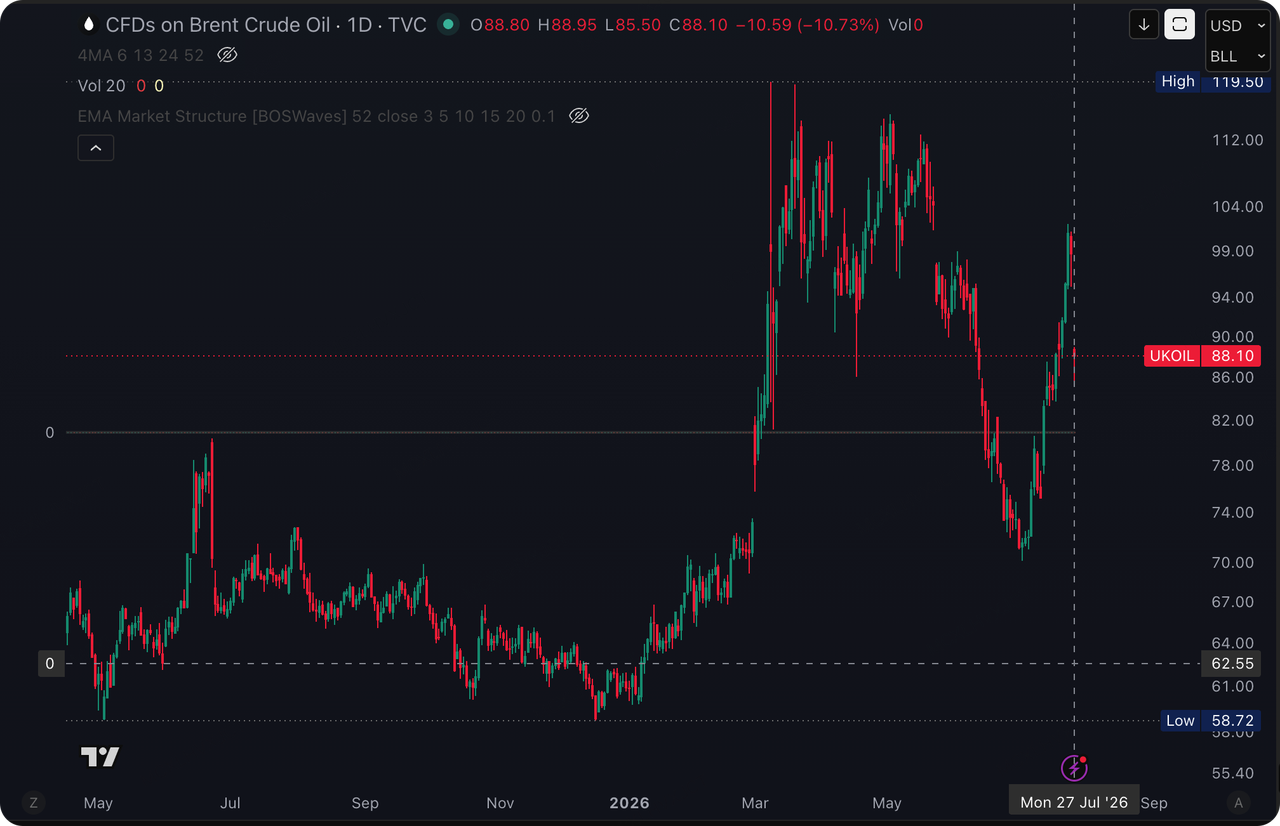
In its market signal section, KuCoin Ventures said last week’s main global market tension shifted from growth and easing expectations toward the risk that an energy shock could revive inflation pressure. Brent crude briefly climbed back above $100 a barrel. Shipping through both the Strait of Hormuz and the Red Sea was disrupted at the same time, prompting markets to reassess how energy prices could feed through to household consumption, corporate costs and monetary policy.
The report said the weekend pause in direct attacks between the U.S. and Iran helped oil pull back and eased worries over an immediate Federal Reserve rate hike. Still, the cooler diplomatic tone has not fully flowed through to physical supply chains. Vessel traffic through Hormuz remains low, and shipping insurance, rerouting costs and refined-product crack spreads have not normalized.
Long-dated U.S. Treasurys did not recover in step. The 10-year and 30-year Treasury yields both climbed last week, reaching about 4.68% and 5.16%, respectively. According to the report, markets are demanding compensation not only for energy-related inflation risk but also for fiscal deficits, Treasury supply and term premium.
KuCoin Ventures added that AI-related stocks came under more pressure as investor attention shifted from headline revenue growth and capital spending size to whether AI investment can generate durable free cash flow and actual returns.
Tariffs and supply-chain costs remain a medium-term variable
The report also said U.S. tariff policy remains a medium-term cost factor. Under Section 301, the U.S. imposed tariffs of as much as 12.5% on 59 countries and the European Union, replacing temporary global tariffs that expired. Further industry probes into overcapacity, semiconductors, robotics and industrial machinery are still under way. Actual effective tax rates and exemption terms at the product level could become a key variable for companies reassessing supply chains and investment plans.
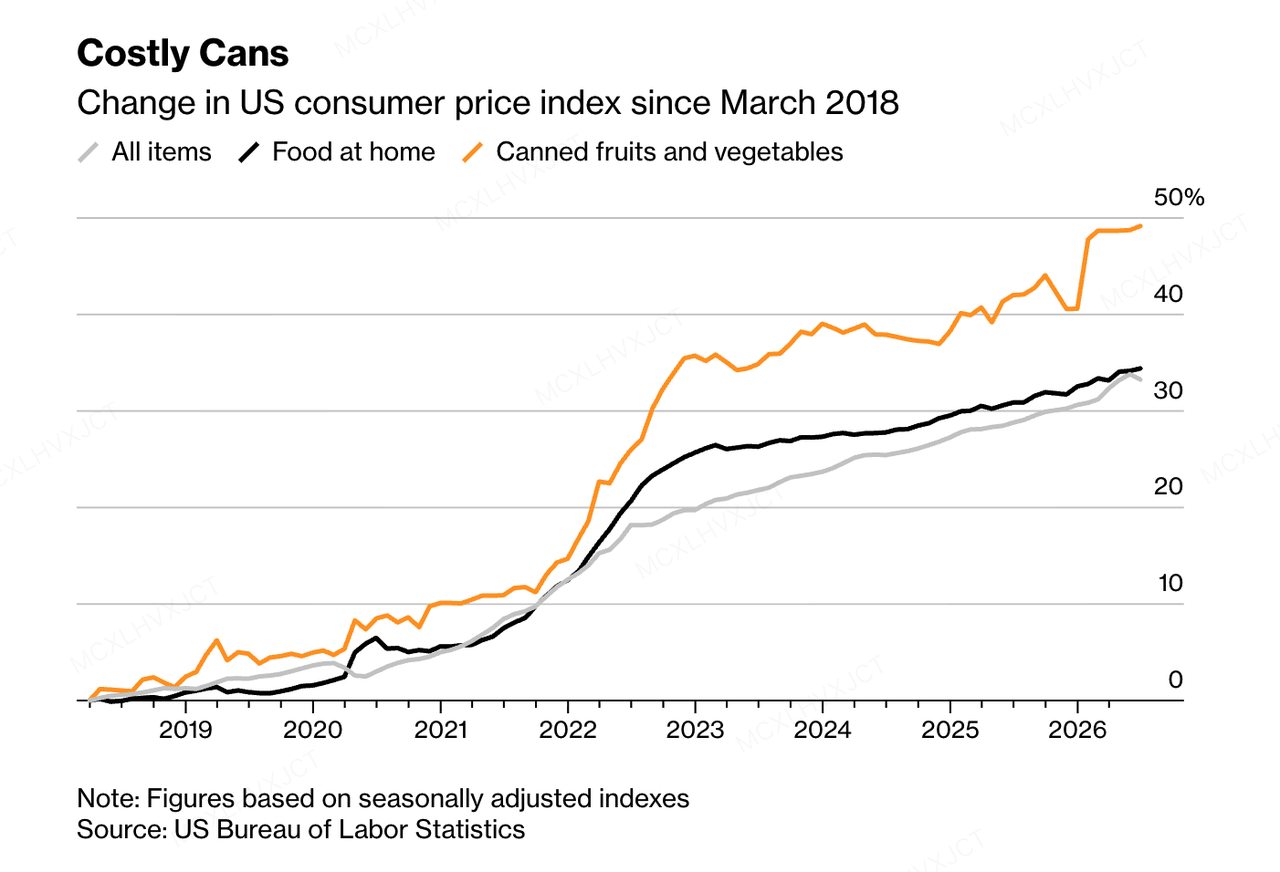
To illustrate the point, KuCoin Ventures cited the U.S. tinplate can industry. After steel tariffs were imposed, domestic low-margin tinplate capacity did not rise materially, while can makers became more dependent on more expensive imported material. Since 2018, U.S. empty can production prices have risen by nearly 80%, while prices for canned fruits and vegetables have risen by nearly 50%. In the report’s reading, tariff effects may not be limited to a one-off rise in import prices. They can also create stickier inflation pressure by weakening supply-chain efficiency, squeezing profit margins and pushing raw-material costs through the system.
China shows the same concentration in policy-backed tech assets
KuCoin Ventures said China’s real GDP grew 4.7% in the first half of the year, with economic momentum softening in the second quarter and showing a K-shaped pattern: stronger external demand and AI-linked sectors, weaker domestic demand. Markets expect the July Politburo meeting to speed up budgeted bond issuance and the execution of existing policy tools, with policy support potentially tilting more toward household income and services consumption.
The report also highlighted ChangXin Memory Technologies. On July 27, the company rose 472% on its first trading day, opened with a market value of about RMB 3.3 trillion and saw roughly 212 times oversubscription in the retail tranche. KuCoin Ventures said that points to continued concentration in Chinese equities around AI, semiconductors and technology self-sufficiency, where policy and industrial trends reinforce each other.
Its conclusion here was straightforward: total global liquidity has not obviously dried up, but the cost of capital for risk assets has moved higher, and allocations are concentrating further in a smaller group of assets backed by policy support, industry tailwinds or dependable cash flow.
Bitcoin holds near $65,000 while ETF flows split
Bitcoin briefly touched $65,504 intraday on July 27 before easing back to around $65,100, the report said. It identified $65,000 as the immediate line in the market between buyers and sellers. If support at $62,500 breaks, the rebound structure built since July could be damaged, with $60,000 returning as a possible test area.
Across altcoins, KuCoin Ventures said the rise in oil prices, higher Treasury yields and stronger macro risk aversion pushed total crypto market capitalization back to about $2.30 trillion, while major assets including Ethereum and Solana also came under pressure.
Spot Bitcoin ETF volume falls to the lowest level for a full week since October 2024
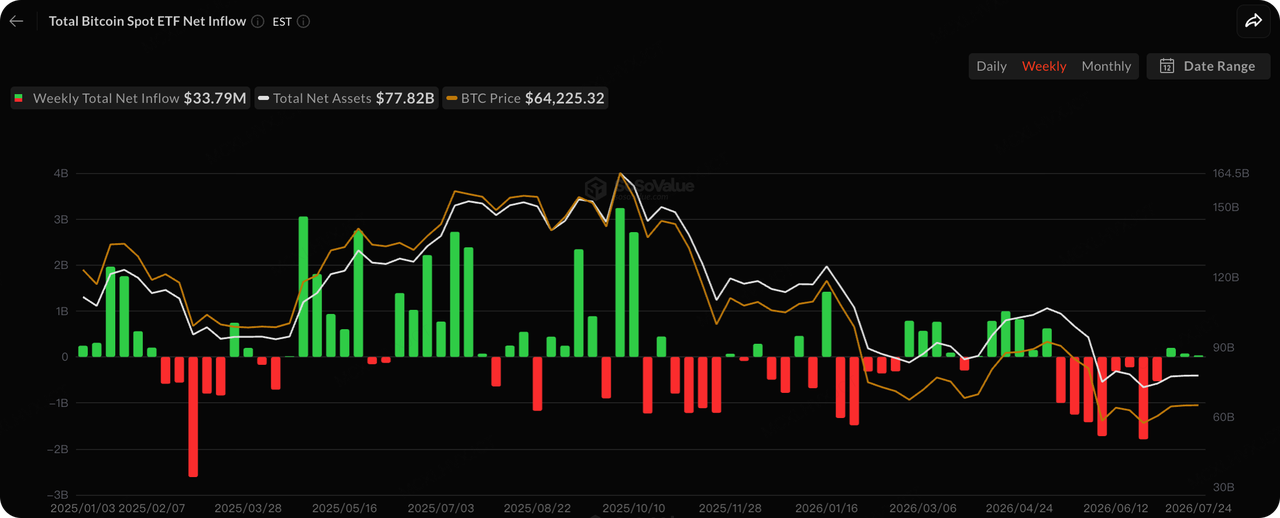
Spot Bitcoin ETFs recorded about $8.05 billion in weekly trading volume, the report said, the lowest for a full trading week since October 2024. The products still posted about $33.79 million in net inflows for the week and extended their streak to three straight positive weeks, but the pace weakened sharply.
After strong inflows in the first half of the week, Thursday and Friday saw net outflows of about $225 million and $240 million, almost wiping out earlier gains. BlackRock’s IBIT recorded about $95.5 million in net outflows for the week. Total net assets across BTC ETFs stand at about $77.82 billion.
Spot Ethereum ETFs outperform Bitcoin ETFs for a second straight week
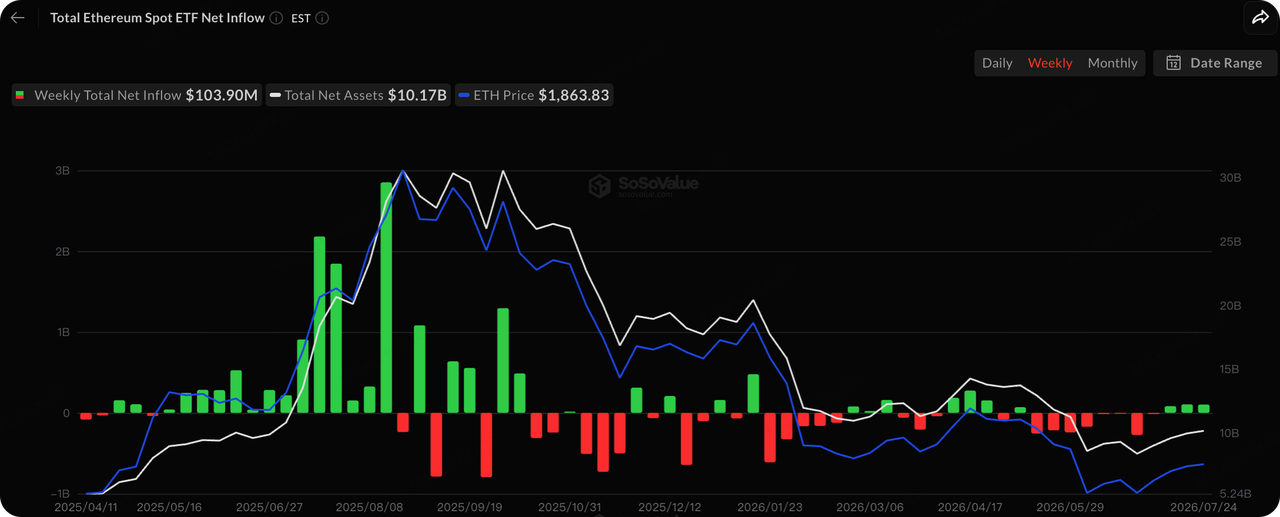
Ethereum spot ETFs looked stronger. KuCoin Ventures said they brought in about $103 million in net inflows for the week, topping Bitcoin ETFs on that metric for a second consecutive week. BlackRock’s ETHA accounted for about $96.3 million of those inflows, which the report said points to a marginal short-term shift in institutional allocations toward Ethereum. Total net assets across ETH ETFs are about $10.17 billion.
Global stablecoin market cap stands at $310.36 billion
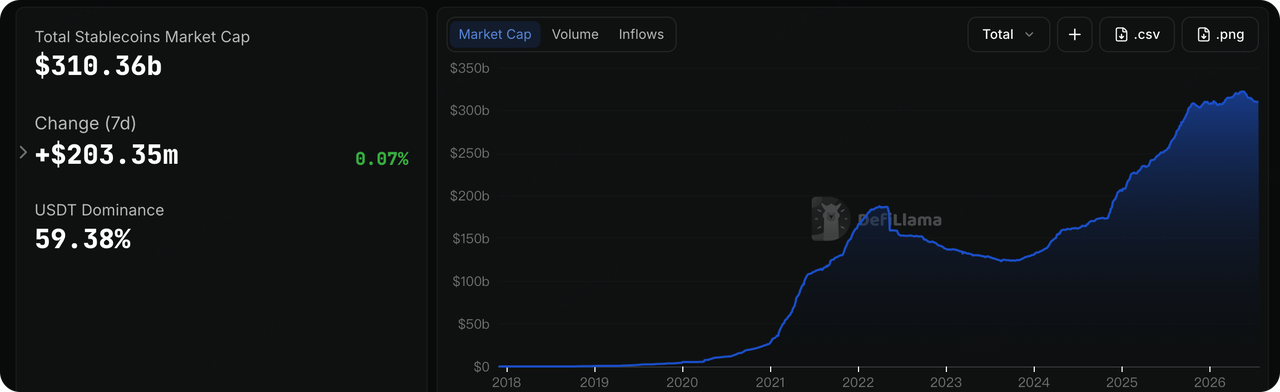
As of the report date, total global stablecoin market capitalization was about $310.36 billion, up about 0.07% over seven days and down about 1.12% over 30 days. USDT supply was about $184.28 billion, giving it a market share of about 59.4%. USDC supply was about $73.56 billion. Both grew only slightly over the past week.
FedWatch puts the probability of a 25-basis-point July hike at 36.3%
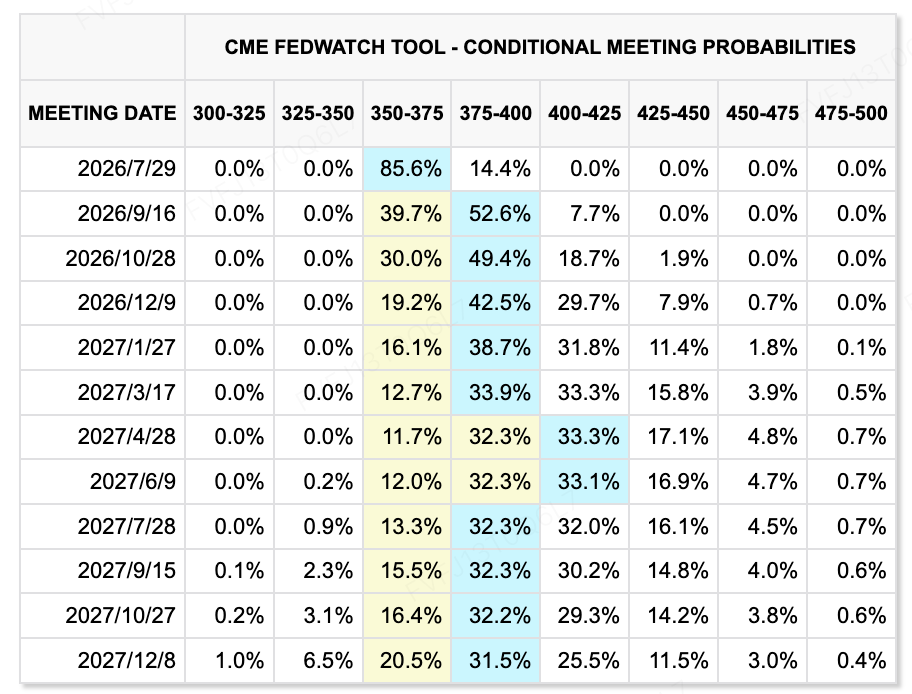
Citing the latest CME FedWatch data, KuCoin Ventures said markets were pricing a 36.3% chance of a 25-basis-point Federal Reserve rate hike on July 29 and a 63.7% chance that the federal funds rate would remain unchanged at 3.50% to 3.75%. The hike probability has risen quickly from 14.4% a week earlier. The report said that means markets no longer treat a hike as a negligible tail scenario, even though no change remains the base case.
It also argued that the uncertainty is coming not only from oil prices but from a shift in how the Fed communicates. Since Warsh took office, the central bank has cut back on forward guidance and stressed decisions based on real-time data, making it harder for markets to lock in a policy path early.
That has created a rare split, the report said. Interest-rate markets are assigning more than a 30% chance to a hike, while a Bloomberg survey of 76 economists still shows all of them expecting no change at the July meeting. Even if the Fed leaves rates unchanged, lower communication transparency and a less certain policy path could keep volatility elevated in fed funds futures, the dollar and short-dated Treasurys.
Events to watch this week
Beyond macro data and central bank meetings, the report said a number of large technology companies will release earnings next week. Markets will be watching cloud growth, AI-related revenue and capital expenditure guidance. KuCoin Ventures said the issue is not whether AI demand exists, but whether heavy spending can convert over time into revenue, profit and free cash flow. Tech stock performance may still feed into crypto through the Nasdaq, real rates and broader risk appetite.
- July 27: China industrial profits data.
- July 28-29: Federal Reserve meeting. There will be no updated economic projections or dot plot. Markets will focus on the policy statement, the vote split and the chair’s press conference. Beyond the rate decision itself, how the Fed describes energy prices, tariff inflation and the labor market may matter more for forward rate pricing.
- July 30: U.S. second-quarter GDP advance estimate and U.S. PCE inflation data.
- July 31: Bank of Japan meeting; China official manufacturing and non-manufacturing PMI; expiration of the European Union window to renew economic sanctions on Russia.
- August 1 / August 5: U.S. ISM manufacturing and non-manufacturing PMI.
- August 7: U.S. nonfarm payrolls and trade data.
Primary-market funding is still concentrated in later-stage projects and stablecoin infrastructure
KuCoin Ventures said the primary crypto market still shows no broad-based recovery. Capital remains concentrated in projects with larger financing rounds, clearer business models or an institutional customer base.
Citing Galaxy Research data for the first quarter of 2026, the report said the industry completed about 355 financing deals totaling around $4 billion. That was down about 50% quarter on quarter, and roughly 57% of the capital went to later-stage projects. KuCoin Ventures said the pattern matches the direction of recent large disclosed financings.
Augustus raises $180 million in Series B
Among last week’s standout deals, stablecoin and cross-border clearing infrastructure company Augustus announced a $180 million Series B round at a $1 billion post-money valuation. Tiger Global led the round, with participation from Hummingbird, QED and founders from companies including Nubank, Ramp, Circle and Deel. Total funding now stands at about $210 million. The company said the new capital will mainly be used to expand among banks and fintech clients in Latin America, Southeast Asia, the Middle East and Africa.
KuCoin Ventures said Augustus is focused on building a clearing bank that connects traditional banking rails with blockchain networks. Its platform is intended to support Swift, ACH, SEPA, bank accounts and stablecoin payments at the same time, offering financial institutions dollar accounts, cross-border settlement and liquidity management. The company already provides euro clearing through a regulated European entity and has disclosed clients that include Kraken and other financial and crypto institutions.
The report added that Augustus received preliminary conditional approval in May from the U.S. Office of the Comptroller of the Currency for Augustus National Bank. Unlike a national trust bank with a narrower scope, the company is applying to establish a full-service national bank covered by deposit insurance. It also plans to set up a separate stablecoin subsidiary for issuance, custody, redemption and payments tied to dollar reserve-backed stablecoins.
KuCoin Ventures said it remains uncertain whether Augustus will secure final OCC approval, Federal Deposit Insurance Corporation coverage and related Federal Reserve account access. Even so, the financing shows that bank-grade stablecoin infrastructure now demands more capital strength, regulatory compliance and risk-management capacity. In the report’s view, market resources in this area may keep concentrating in larger well-capitalized institutions.
At the industry level, it said stablecoin competition is extending beyond issuance and payment interfaces into accounts, correspondent banking and clearing. Institutional attention may increasingly center on how to embed stablecoin settlement into existing banking systems and cross-border payment networks.
About KuCoin Ventures and the report disclaimer
The report described KuCoin Ventures as the main investment arm of the KuCoin exchange. KuCoin says it serves more than 40 million users across more than 200 countries and regions. KuCoin Ventures said it invests in disruptive crypto and blockchain projects for the Web3 era and supports builders through financial and strategic resources, with a focus on Web3 infrastructure, artificial intelligence, consumer applications, decentralized finance and payments.
The report also included a disclaimer saying the content is for general market information only and may contain information from third-party, commercial or sponsored sources. It said the material does not constitute legal, compliance, financial or investment advice, an offer or solicitation, or any guarantee. It added that investing and trading involve risk, past performance does not guarantee future results, and users should conduct their own research and make their own judgments.