
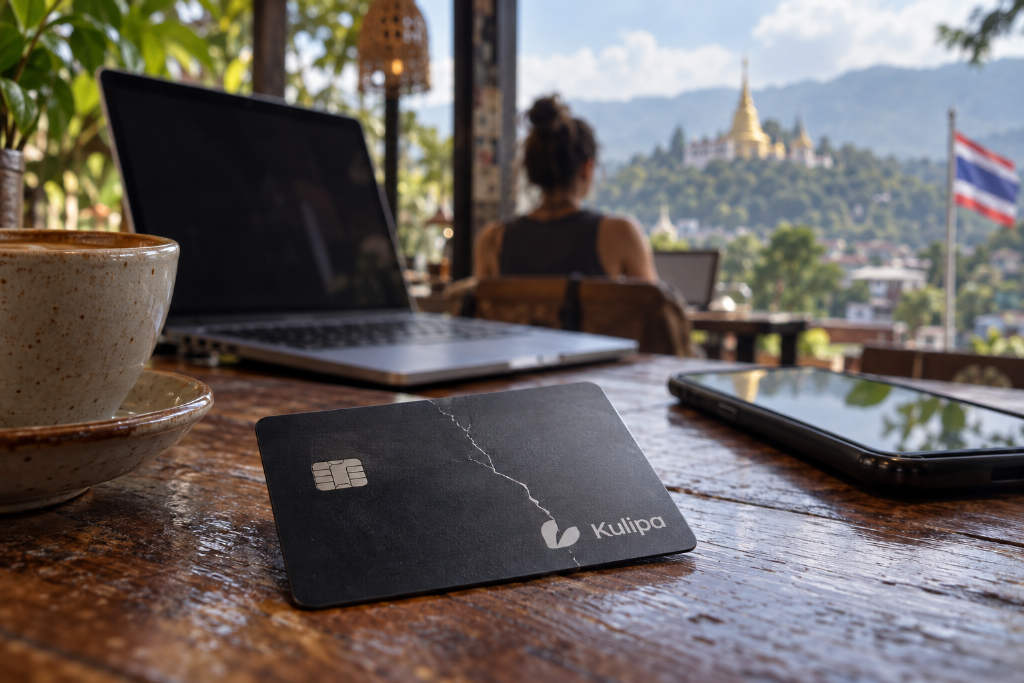
A PANews article says the life of a WEB3 digital nomad is often sold as freedom: living in Chiang Mai, working with clients in New York, building projects in Singapore, earning globally and lowering costs through geographic arbitrage.
That freedom can break down fast. The article describes cases where a user tries to renew Anthropic in a cafe and the card is declined, then another card is declined too, and a friend’s card finally works only for the account to be banned the next day. In a milder version, a ChatGPT subscription never goes through even after multiple card changes, with the checkout page stuck in limbo.
Its argument is that the problem may not be the network, risk controls or luck. It may sit with the issuer behind the card, and with the fact that many crypto cards do not come with a bank account that actually belongs to the user.
Kulipa shutdown disrupted about 20 client card programs
On July 29, 2026, stablecoin card issuer Kulipa stopped operating because of solvency problems, according to the article. Around 20 wallet and fintech clients were affected, including Solflare, Ready, Flutterwave and nSave, and their card programs were interrupted at the same time.
Solflare’s virtual and physical cards became invalid from July 28. Ready said only that its issuer was winding down. The article says many users found out their cards no longer worked only when a payment failed.
Less than six months before shutting down, Kulipa had completed a $6.2 million seed round co-led by Flourish Ventures and 1kx. In April, a16z crypto included Kulipa in its stablecoin infrastructure map as an issuer worth watching. Three months later, the company was gone.
The article says the pattern extends beyond Kulipa
PANews says this was not a one-off event. In the first half of 2026, Polish regulators revoked Quicko’s payment license. Thirteen days later, three crypto cards in different regions stopped working at the same time: CEX.IO Card, Trustee Plus and IN1.
Mastercard also shut down UnCash’s no-KYC card. UnCash itself described that move as a fatal blow to its operating capacity.
The article’s conclusion is blunt: these companies did not fail because their products were too weak, and they did not die because users left. They failed in the same place — rented licenses.
BIN sponsorship leaves the real payment switch with the licensed institution
The article explains that a Visa or Mastercard accepted globally must be issued by a licensed bank or electronic money institution. Most crypto companies are not Principal Members, so they rent a BIN, the issuing right tied to the first six digits of a card number.
That setup is known as BIN sponsorship. In this model, the crypto company handles branding, wallets and user support, while the licensed bank in the background manages compliance, settlement and the relationship with the card network.
Those arrangements are written into cardholder agreements, but almost nobody reads them. The card may show a crypto brand, the registration may happen in another app, and the bank that decides whether the card still works may be an institution the user never signed with directly. In the article’s words, an entity that never appears on the card face controls the payment switch.
If that licensed partner wants out, loses its license or runs into trouble first, the card can stop working within days. What users usually receive is a regulatory notice and a customer service page.
Stablecoin card growth has not removed the underlying fragility
The article says Visa’s stablecoin settlement volume reached a $20 billion annualized run rate in the second quarter of fiscal 2026, up from one-fifteenth of that level a year earlier. More than 160 stablecoin card programs are active globally.
At the same time, Kulipa shut down, Fiat24 paused crypto top-ups and account opening, Quicko lost its license, and UnCash was cut off by Mastercard.
Romeo Fardeen, an analyst at Alea Research, said in a review of Kulipa that the real moat in payments is the license. He said Kulipa used a light model that did not touch customer funds and relied on rented licenses, which made it a survival model: keep growing to stay alive, then hope the next funding round can pay for a license.
Thin card economics add pressure to the model
The article also points to weak unit economics. Interchange on European debit cards is only 0.2%, and that still has to be split among the issuing bank, the card network and the processor.
Consumer-facing crypto cards depend on issuance fees, membership fees and limited interchange sharing. PANews says that is hard to square with cashback, KYC, risk controls, customer support, card issuance and compliance costs. In a rented-license structure, every layer takes a slice of the margin.
For digital nomads, receiving money and spending it are often split apart
The article says cross-border collections are already expensive for freelancers. PayPal cross-border payments cost about 4.4% plus a fixed fee, and withdrawing to a bank account adds another charge, with FX spread on top. On a $5,000 invoice, transaction fees, cross-border surcharges and currency conversion can push the loss to around 8%.
Spending is mixed as well: ChatGPT Plus, Claude Pro, OpenAI API, AWS, GCP, Notion, Figma, GitHub Copilot, rent, food and flights. Those expenses sit across online and offline channels, fiat and stablecoins, subscriptions and one-off payments. A card that only pays at checkout does not cover that range.
The article adds that many digital nomads are also freelancers, indie developers and small founders. They spend money, but they also need to get paid. Their clients may be in the U.S., Europe or Southeast Asia, and payments may arrive through ACH, SWIFT or stablecoins. If income and spending run on separate systems, every transfer means another conversion, another withdrawal and more waiting.
Some providers are moving toward embedded banking
While BIN sponsorship remains common, the article says a small group of card providers has taken another route by working with regulated U.S. banks and embedding banking functions directly into their platforms. It names Dogpay, Plasma and Redotpay as examples.
Behind them are what the article calls crypto-friendly banks used for settlement, including DBS in Singapore and Zenus, a chartered bank in the United States.
According to the article, Zenus shifted in 2024 from a consumer digital bank to a U.S. B2B2C embedded banking platform. Through a single API, it provides U.S. dollar accounts, cross-border payments and Visa card issuance to fintechs, e-money institutions, money services businesses and overseas banks in more than 180 countries. Its annualized payment run rate is now $75 billion, monthly total payment volume exceeds $4 billion, and it serves more than 1,300 financial institution clients.
Account ownership can affect payment success rates
The article says the key difference between the two models is who owns the account.
Under BIN sponsorship, users receive mass-issued sub-cards under a company account. The account belongs to the company, and the user is only the cardholder. Under embedded banking, the user opens a U.S. bank account in their own name.
PANews argues that this difference can show up directly in payment success rates. If OpenAI or Anthropic risk systems scan a BIN tied to a pooled issuance setup, the transaction is more likely to be flagged as high risk. If they see a real U.S. bank account, they see a standard account record instead. The article says the core banking architecture in that model embeds compliance into each account event and transaction, covering ACH, FedWire, SWIFT, cards and stablecoins in real time.
The article’s conclusion: digital nomads need an integrated financial rail
The piece says digital nomads do not really need a card that is simply easier to swipe. They need a crypto card setup that puts receiving, storing and spending on the same line.
It lists the features such a product should have:
- Income side: clients can pay directly by ACH or wire into a U.S. bank account in the user’s own name, or through a stablecoin acquiring gateway, cutting out repeated steps between collection, withdrawal, top-up and spending.
- Holding side: a multi-currency wallet can hold stablecoins and digital assets, with balances connected to the card for on-demand top-ups.
- Spending side: three card ranges covering AI subscriptions, cloud services, SaaS, offline POS and ATM cash withdrawals, with support for Apple Pay and Google Pay.
- Acquiring side: users pay in stablecoins while merchants receive fiat or digital assets, with settlement in seconds.
- Merchant accounts: online applications for U.S. dollar accounts in the U.S. for ACH and wire, multi-currency accounts in Singapore for SGD, USD and EUR, and merchant accounts in Canada and Europe, with settlement rails covering SWIFT, ACH, SEPA and FPS across more than 140 countries and regions.
The article also cites Mercuryo, which found that weekend stablecoin cash-out volume averages 86% of weekday volume. In its framing, users do not want a prettier card. They want money that still moves after banks close.
The card, the article says, is only the top layer. What keeps payments usable is the account behind it: whether it is in the user’s own name, whether a regulated bank stands behind it, and whether it will still work when the next Kulipa appears.
For digital nomads who are paid in stablecoins, rely on AI tools for output and move between Southeast Asia and Europe, the stability of payment infrastructure is not just a user experience issue. The article says it determines whether the business can keep running. What they need is not only a better crypto card, but a financial base that connects a real bank account, wallet, acquiring and off-ramping in one line.