
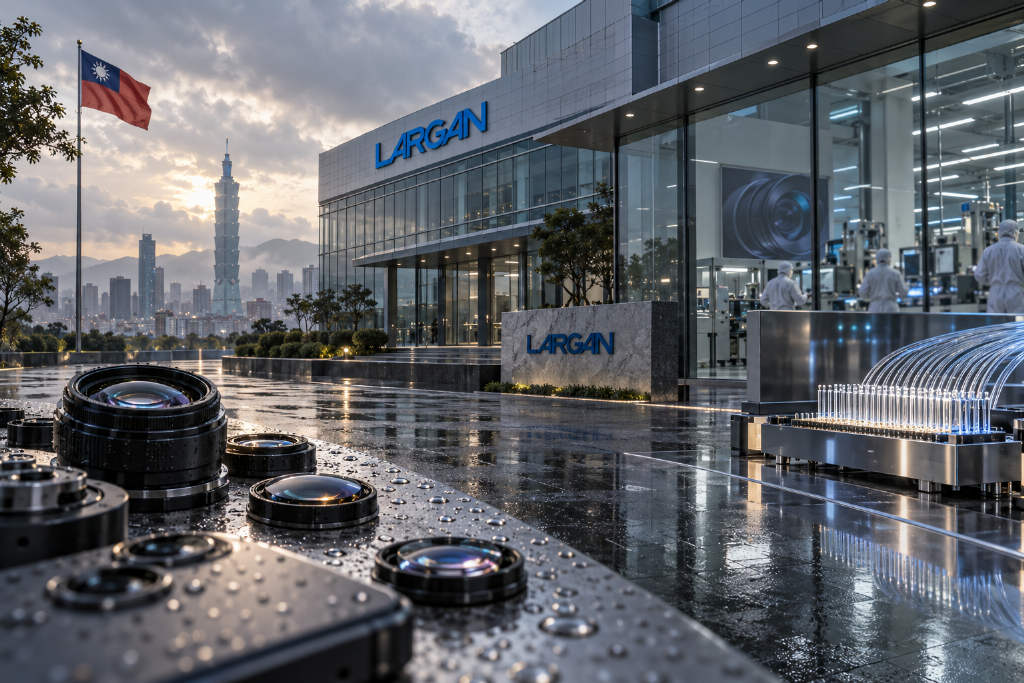
Largan Precision said at its third-quarter investor conference that its fiber array (FA) pilot line has passed customer certification, and capacity for fiber array units (FAU) could begin coming online as early as next year. The update came alongside the company’s 2026 third-quarter results, which showed consolidated revenue of NT$15.651 billion, up 14.54% from the prior quarter but down 11.46% from a year earlier.
Largan said third-quarter gross margin fell to 42.21% as structural costs, including green power procurement, weighed on profitability. The company said fourth-quarter operations are still likely to face pressure. Chairman Lin En-ping also said smartphone customers have lowered production plans, affecting short-term revenue momentum.
Revenue rose quarter on quarter, while margins weakened
For the third quarter of 2026, Largan reported gross profit of NT$6.607 billion, down 2.16% from the previous quarter. Gross margin dropped 7.21 percentage points from 49.42% in the second quarter to 42.21%.
Operating income was NT$4.735 billion, down 8.02% quarter on quarter, and operating margin fell to 30.25%. Net profit after tax reached NT$5.182 billion, up 10.97% from the prior quarter, helped by non-operating income and other factors. Earnings per share came in at NT$39.62, above NT$35.73 in the second quarter but slightly below the first-quarter level.
Fourth-quarter pressure remains as smartphone output is revised down
Looking ahead, Lin said gross margin in November could continue to decline. He said green energy procurement has become a structural cost issue that directly affects margin performance. Because product pricing for next year has already been settled with customers, he said any improvement in the profit structure is expected only after 2028.
Lin also said customers had revised down smartphone production for September, a sign that end-market demand is adjusting.
FA certification clears, with FAU becoming a key focus for next year
In new business development, Largan said its FA pilot line has passed customer certification, and its automated production line received positive feedback. Related capacity is already being installed, with shipments expected to begin as early as the middle of next year.
The company also said it started customer certification work for FAU this month. Largan said it decided to move fully into the FAU segment in order to offer a complete solution and reduce later integration disputes. It added that market demand for both FA and FAU is strong, while current capacity remains insufficient. Part of future production may be outsourced. Margin performance for the product line will depend on yields after actual mass production begins.
Land purchases and capex target clean rooms and production lines
To prepare for future capacity expansion, Largan said it has spent more than NT$8 billion on seven land purchases. Management said all of the newly acquired land will be used to build production lines and clean rooms.
Construction is scheduled to begin next year and finish in 2030. One new plant set to break ground in the middle of next year will be used entirely for FAU mass production.
Financial data showed third-quarter capital expenditure of NT$8.18 billion and depreciation expense of NT$2.04 billion. Because most land payments were completed before the third quarter, the company said it has ample funds on hand and has no plan to raise additional capital.