
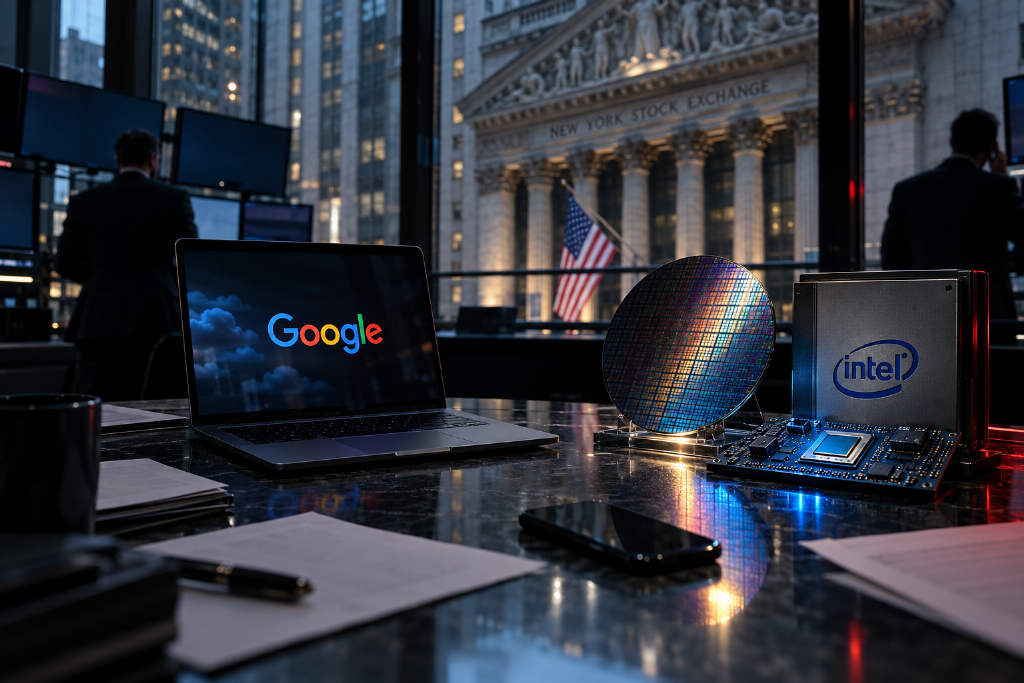
Late-October selloff shifts attention to the quality of AI growth
U.S. tech stocks were hit by a sharp selloff in the final two trading days of October. Alphabet fell 12.6%, Intel dropped 28.6% the next day, and the Philadelphia Semiconductor Index lost about 7.2% on the day.
That happened even though AI-related businesses at both companies were still expanding quickly. Google Cloud revenue rose 103% year over year, and Intel’s data center and AI business grew 78%. The gains were not enough to support their share prices. Alphabet reported weaker-than-expected search advertising revenue and capital spending above operating cash flow. Intel was dealing with soft PC demand, server supply constraints, and foundry losses.
Neither earnings report showed a clear slowdown in AI demand. What changed was the market’s focus. Investors looked harder at capital expenditures, search monetization, and foundry revenue mix as measures of growth quality.
Alphabet: cloud profit surged, but free cash flow turned negative
Alphabet reported third-quarter revenue of $127.577 billion, up 25% from a year earlier. Google Cloud generated $30.709 billion in revenue, up 103%, while operating profit climbed from $3.594 billion a year earlier to $11.121 billion, an increase of about 209%.
The cloud business is now producing meaningful profit, but the company’s core search advertising segment came in below expectations. Google Search revenue rose 12% year over year to $63.35 billion, below analyst expectations of about $64.96 billion. Paid clicks increased 8%, and cost per click rose 4%.
Management said the relatively low ad monetization level of AI Mode is one factor weighing on search revenue growth. AI search is driving more usage, but it has not yet matched the commercial return of traditional search across all scenarios.
Cash flow was another pressure point. Alphabet spent $51.355 billion in capital expenditures during the quarter, above its $42.290 billion in operating cash flow, leaving free cash flow at negative $9.065 billion.
Part of Google Cloud’s revenue growth came from TPU system sales. Google had mainly provided computing power through cloud services in the past. It is now selling full systems that include TPU, networking, storage, and software. Unlike recurring cloud services, hardware sales require the company to buy equipment and build inventory before cash is recovered through delivery.
As of the end of September, Alphabet’s inventory had risen from $2.439 billion at the end of 2025 to $13.308 billion, an increase of nearly $10.9 billion. Management said unsold TPU systems were tying up part of that cash. Not all of the inventory increase came from TPU, but it showed that the new business is placing higher demands on working capital.
Alphabet still held about $265.1 billion in cash, cash equivalents, and short-term marketable securities, so near-term financing capacity is not the main issue. The next questions are whether AI search can improve ad monetization and whether inventory and capital spending tied to TPU system sales can gradually turn into cash returns.
Intel: server growth leaned on ASP, while foundry still lacked stable outside revenue
Intel reported third-quarter revenue of $16.513 billion, up 21% year over year. Revenue from its data center and AI business reached $7.318 billion, up 78%.
Still, the company guided fourth-quarter revenue to only $15 billion to $16 billion, below analyst expectations of about $17.07 billion.
The server business also looked different once broken down. Intel said average selling prices for server chips rose 54% year over year, while unit volume increased about 10%. The price increase mainly came from a higher mix of premium products, with demand-driven pricing contributing less. Server revenue rose sharply, but unit growth lagged far behind revenue growth, meaning much of the increase came from a richer product mix and higher ASP.
Demand from data center customers remains strong, but supply constraints in advanced packaging substrates, memory, and other key components have limited Intel’s ability to fully meet orders.
The PC business faced the opposite problem. Revenue from client computing and physical AI fell 5% year over year, and shipments of traditional PC client chips declined about 14%. Higher memory chip prices pushed up system costs, and price-sensitive customers began cutting purchases. Intel said the effect could last through 2027.
That stood in contrast to earnings from memory makers this week. SK Hynix and Kioxia both posted operating margins of about 80%, and Kioxia’s NAND average selling price still rose more than 20% quarter over quarter. High memory prices are creating strong profits for some upstream suppliers while adding cost and demand pressure for PC chip vendors and device makers.
Intel’s bigger problem remains its foundry business. Intel Foundry generated $6.697 billion in third-quarter revenue, of which about $6.291 billion came from internal group transactions, or roughly 94%. External revenue was only $411 million, up about $379 million year over year, with most of that increase coming from a non-recurring foundry contract. The segment still posted a quarterly loss of $1.853 billion.
Rising internal revenue shows that Intel’s own products are using more advanced process capacity, but outside customer revenue remains limited. The company is still investing in advanced process technology and factory construction. Its ability to attract external customers and raise utilization remains central to improving foundry profitability.
The bond market has also started to show concern about financial risk. On Oct. 30, Intel’s five-year CDS spread widened by 17.5 basis points to about 124.75 basis points, a record high. Growth in server demand did not offset the operating pressure from weak PCs, supply limits, and foundry losses.
Microsoft, Amazon, and Meta show different cash flow outcomes under AI spending
AI-related revenue growth is not translating into the same capital spending pressure across companies.
Microsoft expanded AI investment and still kept free cash flow positive. Azure revenue grew 48% in the quarter, operating cash flow reached $58 billion, and after about $39.4 billion in cash spending on fixed assets, the company still had about $18.6 billion in free cash flow.
Amazon’s AWS revenue rose 39% to $46 billion, and operating profit increased from $11.4 billion to $17.8 billion. But over the past 12 months, the group’s free cash flow swung from a net inflow of $14.8 billion to a net outflow of $42.4 billion, mainly because purchases of property and equipment rose sharply. The company maintained its expectation for about $220 billion in cash capital expenditures in 2026.
Meta also turned to negative free cash flow in the third quarter, with a net outflow of $2.12 billion. Its full-year capital expenditure guidance reached $135 billion to $145 billion. On Oct. 30, S&P Global revised its credit outlook to negative from stable, citing significant uncertainty around future capital spending and free cash flow, while leaving the credit rating itself unchanged.
The cash flow reporting periods are not the same across these companies, so the absolute figures are not directly comparable. Microsoft remained free-cash-flow positive in the quarter. Alphabet tied up substantial funds in TPU inventory and data center construction. Amazon’s free cash flow turned sharply negative over the past year. Meta faced a negative outlook revision because of uncertainty around capital spending and future cash generation.
Selloff spread across tech hardware as investors recalculated spending and returns
Concern over the return on AI investment spread into the broader tech hardware sector. On Oct. 30, AMD and NVIDIA fell 10.9% and 4.2%, while Dell and HP dropped 10.8% and 9.6%. The Philadelphia Semiconductor Index lost about 7.2% that day.
Those companies did not all release new earnings at the same time, so the declines cannot be attributed entirely to deterioration in their own fundamentals. Even so, investor concern over AI capital spending and future cash returns had already started to weigh on other tech names.
This week’s numbers pointed in the same direction. Google Cloud revenue and profit grew quickly, but search advertising missed expectations and TPU inventory absorbed more cash. Intel’s server revenue was driven mainly by premium products and pricing, while actual unit growth remained limited and the foundry business still lacked stable external revenue.
Both companies are still growing AI-related businesses. This time, the market was watching different numbers. Microsoft expanded AI spending and still produced positive free cash flow. Amazon’s free cash flow turned into a net outflow over the past 12 months, and Meta moved negative on a quarterly basis. The selloff does not prove that AI demand is weakening, but it does show that investors are recalculating how much capital growth requires and how much profit and cash that spending can ultimately produce.


