
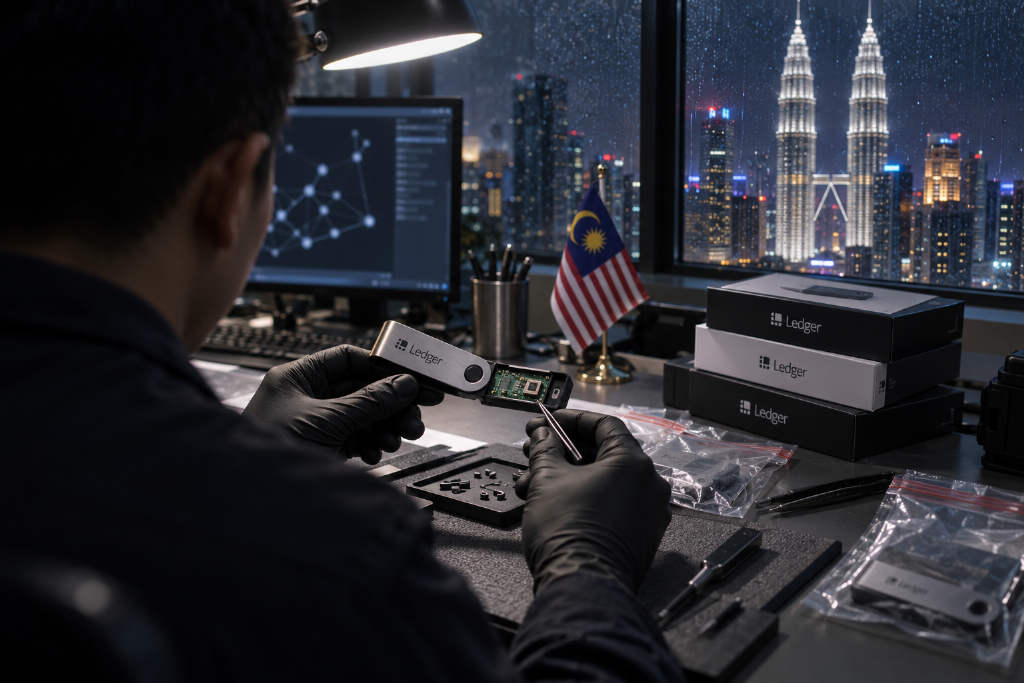
Ledger has confirmed that at least one hardware wallet sold by Malaysian reseller CryptoBilis contained an "unauthorized hardware implant," the first public confirmation from the company that a device was physically tampered with.
In an update posted on Oct. 10 U.S. Eastern Time, Ledger Support said the company is proactively contacting affected users, working with relevant law enforcement agencies, and thanking white-hat security team SEAL 911 for assisting with the investigation. CryptoBilis has confirmed that it stopped selling all hardware wallet inventory until the probe is finished.
Ledger had first said on Oct. 9 that it was investigating reports of lost funds involving users in Southeast Asia, and asked CryptoBilis to halt Ledger device sales and shipments. At that point, an Arkham analyst had estimated losses at more than $80 million.
Ledger says only one device has been confirmed with an implant
In its Oct. 10 update, Ledger did not explain what the implant does. It also did not confirm that the hardware addition was linked to every theft case, or whether other devices had been altered in the same way.
The company said there is currently no indication that Ledger's own security infrastructure, systems, or services were compromised. It also said it is developing stronger anti-tampering measures.
Ledger advised users who bought devices from the reseller not to activate units that have not yet been set up. For users who already initialized a device, the company said they should consider moving assets to another Ledger wallet created with a new recovery phrase. Ledger also warned that scammers often exploit incidents like this and said the company will never ask users for their 24-word recovery phrase.
Bitquery estimates $93.2 million stolen from 315 wallets
The scale of losses cited publicly so far comes from on-chain estimates. Ledger has not confirmed any dollar amount.
On-chain analyst Specter first tracked the theft addresses on Oct. 9 and estimated losses at more than $86 million. Blockchain data firm Bitquery later broadened that tracking and estimated that $93.2 million had been drained from 315 wallets, based on Oct. 9 prices.
According to Bitquery's breakdown, TRON accounted for the largest share, with 131 wallets losing $70.5 million. Bitcoin followed with 122 wallets losing $16.8 million, while Ethereum accounted for 33 wallets and $3.7 million in losses. The rest were spread across BNB Chain, Polygon, and Solana.
Bitquery said the thefts began at around 05:00 UTC on Oct. 9. By Oct. 11, the amount of funds still traceable had fallen from about $88 million to $81 million. The firm also noted that one compromised wallet does not necessarily mean one victim, because a single user may control multiple wallets.
Former co-founder says CryptoBilis was sold in March
Arravind Prabu, a former co-founder of CryptoBilis, replied to community questions on Oct. 9 and said the reseller's social media accounts are now managed by a new operating team. He wrote, "We are bound by a contractual NDA and cannot publicly announce it before Oct. 19," adding that the original team no longer has access to the company's accounts, backend systems, or operations.
Crypto outlet Bitcoin News reported the same day that the former co-founder confirmed the company had been acquired in March and that the previous operators had exited all management and operational roles. Newly surfaced corporate records cited in the report showed that, as of Aug. 3, an individual named Jiaming, with a registered address in Heilongjiang, China, held 100% of CryptoBilis.
Bitcoin News added that there is currently no evidence linking the change in control to the wallet thefts.
CZ raises suspicion, but no official confirmation
Binance founder Changpeng Zhao, known as CZ, reposted a close-up video of the affected wallet in the early hours of Oct. 12 Taiwan time and wrote: "More outrageously, the hackers apparently bought this reseller and had them sign an NDA to keep quiet. There are too many issues here."
Neither Ledger nor law enforcement authorities have publicly confirmed whether the buyer and the hackers are the same party.



