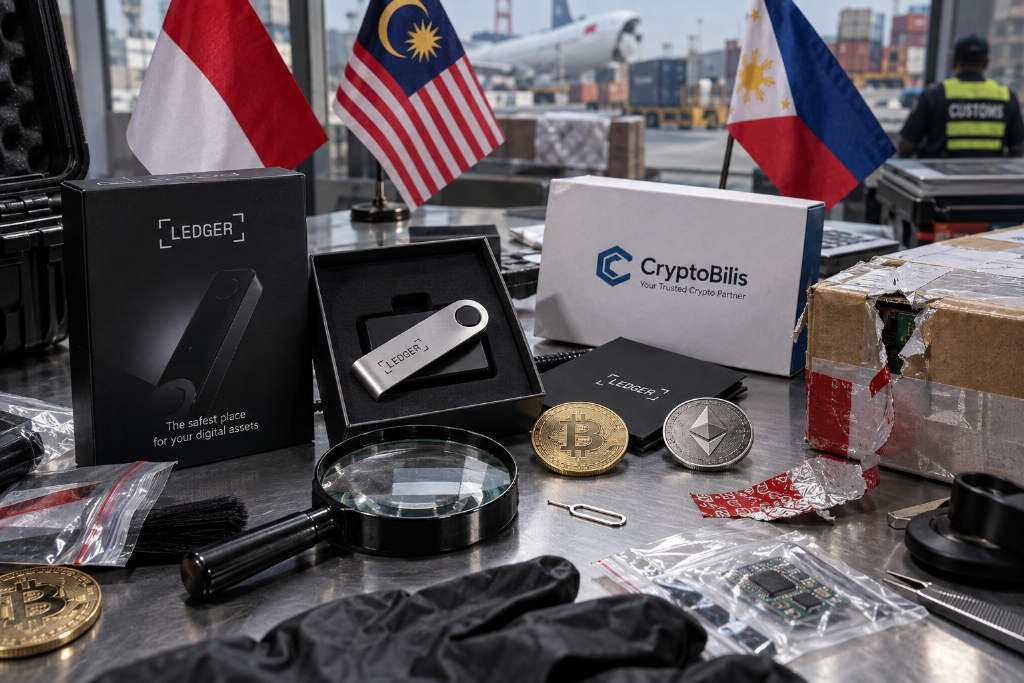
Ledger is investigating reports of asset losses involving users in Southeast Asia who bought devices through reseller CryptoBilis. On Oct. 9, the hardware wallet maker said the affected users had purchased their devices from that channel. On-chain investigator Specter estimated the losses may exceed $86 million and involve Bitcoin, Ether and other crypto assets, although that figure has not been independently confirmed.
The Block identified CryptoBilis as an official Ledger reseller in Indonesia, Malaysia and the Philippines. Ledger’s buying guide tells customers to purchase devices from its official store or authorized resellers and to run a Genuine Check during setup. The incident has now put a sharper question on the table: if the reseller itself becomes the problem, how much protection do those safeguards really offer?
Authorized sales channels do not eliminate every supply-chain risk
Ledger’s buying guide recommends official or authorized channels to reduce the risk of counterfeit products. It also recommends a Genuine Check, which is designed to verify that the secure element inside the device is a genuine Ledger chip.
At the same time, Ledger says in that guide that global supply chains cannot be fully protected from sophisticated interception or tampering attacks. An authorized sales status and a chip verification result do not, on their own, prove that the entire device remained untouched at every stage from production to delivery.
In response to the CryptoBilis case, Ledger said it asked the reseller to suspend sales and shipments. It also advised users who bought devices through that channel in the past 90 days to take action. Users who have not yet set up their devices should avoid doing so for now. Users who already completed setup should consider moving assets to a new Ledger device and using a brand-new seed phrase.
CryptoBilis was listed as an official Ledger sales channel, but its operating entity later changed. It remains unclear whether Ledger knew about that transaction or whether reseller authorization is reviewed again when control of the business changes.
The limits of Genuine Check
On Oct. 9, former Mt. Gox CEO Mark Karpelès posted on X that he had examined a Ledger Nano X that appeared to contain a spy component. He also published his research and teardown findings.
Photos shared by Karpelès showed intact shrink wrap on the outer packaging. After opening the casing, however, he found an implanted component hidden behind the OLED screen in a space originally used for cushioning foam.
According to the teardown record, the implanted hardware included a microcontroller, a cellular communication module, an antenna and an eSIM, and it was connected to the display data lines. One possible attack path is that the component reads what appears on the device screen, identifies characters when the seed phrase is displayed, and then sends that information out over a cellular network.
That is a serious scenario, but the presence of a component does not prove that an attacker successfully stole a seed phrase. The device’s actual behavior, whether any data was transmitted, and who may have carried out such a modification have not been fully established.
Other Ledger Nano X units documented by Karpelès and described as possible implants also showed design changes in the added hardware. Those changes included using a flexible circuit board to reduce size, removing some chip markings, and keeping the original battery in place. Such design choices could make the implant harder to spot, but its exact function and real-world attack effect still need more verification.
On Oct. 10, 23pds, partner and chief information security officer at SlowMist, said that if extra circuitry can read screen data, it could theoretically record a seed phrase and send it out through an LTE module or eSIM. He also said the attack flow remains a hypothesis at this stage and that more sample analysis is needed, along with Ledger’s investigation results.
The case points to a technical boundary in Genuine Check. Ledger’s security documentation says the process is mainly used to confirm that the secure element is a genuine chip from Ledger. As long as the original secure element remains intact, extra hardware implanted elsewhere in the device may not be detected by Genuine Check. Nor can that process prove the physical integrity of the entire device.
The secure element protects private keys and performs transaction signing inside the device. It does not automatically guarantee that every surrounding circuit is free from modification. If an added component can read screen output, a seed phrase could still be exposed through another path even if the private key never leaves the secure element directly.
There is currently no evidence showing that the device presented by Karpelès was connected to CryptoBilis.
Ownership changes at CryptoBilis add another layer
A change in ownership at CryptoBilis has added another layer of context to the case.
According to crypto data platform RootData, former CryptoBilis co-founder Arravind Prabu said the company was acquired in March 2026, after which the original shareholders exited operations, management and administrative roles.
Prabu said on X that confidentiality terms in the contract prevented the original team from publicly announcing the deal until Oct. 19. He also said statements posted on the CryptoBilis account after the incident came from the new management team, not the original one.
Several months passed between the March acquisition and the planned October announcement. Company records cited by RootData show that a person named Jiaming has held all shares in CryptoBilis since Aug. 3, though the original registration documents have not been seen. It is still unclear whether the March acquisition and the full shareholding recorded in August were part of a phased transfer.
The ownership change alone does not prove that the new shareholder took part in device tampering or asset theft. What can be confirmed is that the previous management team says it had already left day-to-day operations, and that the reseller’s ownership change overlaps in time with the security incident. Whether there is a direct connection still requires more evidence.
The report also said CryptoBilis has suspended sales of all branded hardware wallets and closed its physical stores until further notice. That suspension was taken by the reseller itself. There have been no reports indicating problems with devices from other brands.
Ledger says reports so far are concentrated among CryptoBilis buyers in Southeast Asia
Ledger said the asset-loss reports it has received so far are concentrated among users in Southeast Asia who bought devices through CryptoBilis. The company added that it has not received similar reports from users who purchased directly through Ledger’s official channels. Ledger also said its own systems were not affected and that the investigation is ongoing.
The distinction between official direct sales and authorized reseller sales has become more important in this case. Buying directly from the brand can reduce reliance on third-party distributors. Even so, no Genuine Check can by itself prove that a device was never tampered with anywhere along the supply chain.
For users, buying through official channels and following the brand’s verification steps still remain important ways to reduce risk. But when an authorized reseller itself becomes part of an investigation, reseller status and a successful Genuine Check are no longer enough to answer every security question.
Once a device leaves the factory, who can prove it was never touched?