
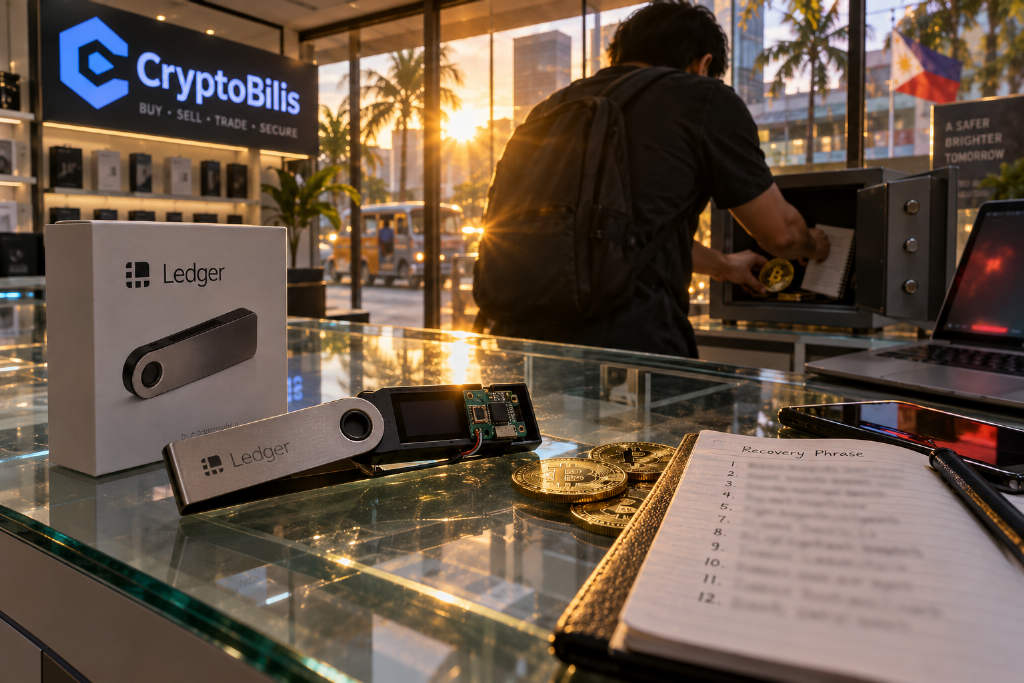
Users who bought Ledger hardware wallets through Southeast Asian reseller CryptoBilis have reported a string of thefts in which funds were drained even though the devices passed authenticity checks and the seed phrases were written down by hand and stored in safes.
One case involved 80 BTC sent to a newly purchased Ledger. The coins arrived on Sept. 29, with a cost basis of about $5.2 million and unrealized profit that at one point reached $1.38 million. At 05:54 UTC on Oct. 9, all 80 BTC were moved out in a single transaction. According to the source report, the owner had bought the wallet from an officially authorized reseller and stored the handwritten seed phrase in a safe.
Similar accounts began appearing the same morning on X and Reddit. One user said nearly 100,000 USDT was taken from a Ledger Stax, with the seed phrase also handwritten and locked away. The common factor in the reported cases was the purchase channel: CryptoBilis.
At 13:32 UTC on Oct. 9, Ledger said it was investigating and instructed CryptoBilis to pause all Ledger sales and shipments. The company also told users who bought devices from that channel within the past 90 days not to initialize units that were still unopened, and to move funds immediately to a new wallet generated from a fresh seed phrase if the device had already been set up.
On-chain estimates put losses above $86 million, with some nearing $93 million
The total damage is still being estimated on-chain.
Investigator Specter first published 10 collection addresses at 12:24 UTC across Bitcoin, Ethereum and Tron, putting losses at more than $86 million. Another investigator, tanuki42, listed eight of those addresses and estimated more than $72 million.
SlowMist’s MistTrack said the figure was “approaching $90 million.” Bitquery, which tracked 311 wallets, estimated about $92.9 million in losses, including about $42 million on Ethereum, $17.6 million in Bitcoin and $16.5 million in USDT.
Arkham has labeled the addresses as “Ledger Theft.” As of Friday afternoon, addresses carrying that label still held about $71.5 million, including roughly $29.4 million in ETH, $17.5 million in BTC, $13.6 million in USDD and $10.8 million in USDT.
The victim profile may be more revealing than the headline total. Lookonchain tracked one address that bought a device three weeks earlier, then deposited 7 million USDT and lost the entire amount around 10 hours before the report. It may be the largest single theft in the incident. Three other labeled Bitcoin addresses held about 211 BTC combined at 13:44 UTC and had not moved funds at that point.
Chain INK estimated that the incident involved about 98 wallets, with average losses of about $890,000 per wallet.
The report compared the event with a Coldcard incident in July, when a firmware random-number flaw made seed phrases guessable. That case caused about $111 million in losses spread across more than 5,200 wallets, averaging about $21,000 each. By contrast, the CryptoBilis-linked event ranked second within less than a day at about $87 million, but involved only about 98 wallets, with an average close to $890,000.
That distribution looks less like a broad sweep and more like selective targeting. In the 80 BTC case flagged by Lookonchain, the coins sat in the device for 10 days before being removed all at once.
Teardown points to a hidden module near the screen assembly
Ledger has not detailed the attack method, but some devices have already been opened.
The most specific public description came from former Mt. Gox CEO Mark Karpelès. He said a device he received came from Malaysia, was listed on Amazon at half price, and shipped from Malaysia rather than Japan, where he had placed the order. He described that shipping origin mismatch as the first warning sign.
After opening the unit, he said he found a concealed module where screen padding would normally sit: a single wire strand used as an antenna, extra space created by a shortened battery or removed screen padding, an LTE module with eSIM capability, and a microcontroller attached to the device’s SPI bus.
Karpelès said the microcontroller appeared capable of recognizing the font Ledger uses on its 128×64 display, identifying the seed-phrase setup screen, reading the words as they appeared for the user to copy, and transmitting the captured text over LTE.
SlowMist Chief Information Security Officer 23pds described a matching path. In his explanation, an attacker adds a microcontroller inside the wallet and taps the screen’s SPI data line. The seed phrase is still generated inside the secure element, but it must be shown on the display so the user can write it down. A malicious module can record every character shown on the screen and send that data out through built-in LTE or eSIM hardware. As 23pds put it, the secure element is meant to prevent direct extraction or export of private keys; it does not control what appears on the screen. The attack window is the few seconds when the seed phrase is visible.
That would also explain why the devices could still pass Ledger’s authenticity checks. Under this theory, the secure element is genuine, generates the seed phrase correctly, and signs transactions normally. The compromise comes from an external observer inside the case. Firmware checks may also miss it if the implant only listens during screen refresh events. In that scenario, the only reliable way to detect tampering may be to physically open the device.
The report also noted two other possibilities. One is a preloaded seed phrase: an attacker powers on the wallet in advance, sets it up, records the words, repackages it, and the user believes they are initializing a new device when they are not. The other is phishing. Developer 0xQuit said some victims may have fallen to phishing and argued that saying flatly that “Ledger was hacked” is irresponsible.
“Officially authorized” covers reseller status, not the whole supply chain
CryptoBilis is not described as a fringe seller.
According to the report, the Kuala Lumpur-based company was founded in 2020 and appears on Ledger’s website as an officially authorized reseller serving Malaysia, Indonesia and the Philippines. It also sells hardware wallets from Trezor, OneKey, Tangem and SafePal.
That is exactly what makes the episode harder for users to process. The security rule many people followed was simple: if direct shipping from the manufacturer is unavailable, buy from an officially authorized reseller. But that label covers sales authorization. It does not guarantee the physical integrity of every box in storage, or every handoff in the route from manufacturer to customer.
Once a device leaves Ledger’s custody, it still has to move through logistics providers, warehouses, sorting operations, resellers and last-mile delivery. The report argues that any point along that chain can become an interception point for opening, modifying and resealing a device. Karpelès said the heat-shrink wrap on the unit he examined was intact.
The timeline around CryptoBilis has drawn additional scrutiny. Newly disclosed corporate records cited in the report show the company was acquired in March this year, and that an individual named “Jiaming,” with a registered address in Heilongjiang, China, has held 100% of the company’s equity since Aug. 3. A former co-founder confirmed the March acquisition and said the original shareholders had exited all operational, management and administrative roles afterward, leaving them unable to see how the company was actually being run. He urged the current management to handle the situation transparently.
According to TechFlow, a non-disclosure agreement signed between the acquirer and former executives restricted disclosure of transaction details until Oct. 19. That meant the former management could not freely discuss the acquisition terms when the incident broke on Oct. 9.
The source report also stressed that there is no conclusive evidence linking the ownership change to the thefts, and Ledger has made no accusation beyond ordering a sales halt.
On Oct. 10, CryptoBilis said it was suspending sales and shipments of all hardware-wallet brands across its stores and online channels in Malaysia, the Philippines and Indonesia. It also reminded users that seed phrases must be generated by the device during initialization and written down by the user. If a wallet arrives with a seed card already printed or handwritten, it should be treated as unsafe.
CryptoBilis is not the only channel to face supply-chain or logistics trouble this year. In September, Trezor said its logistics contractor ShipMonk had been compromised, exposing the real names, phone numbers and home addresses of about 81,000 U.S. customers. In January, Ledger disclosed that payment processor Global-e had leaked names and contact details of some buyers on Ledger’s own website. Those incidents did not directly lead to stolen coins, but they repeatedly exposed the same type of information: who received a hardware wallet, and when.
The report’s conclusion is blunt. Over the past three months, the weakest link in cold storage has shifted from code to logistics.
Asset freezes, emergency channels and the case for a waiting period
The window for recovery appears to be narrowing.
MistTrack said Tether has frozen large amounts of USDT at related addresses. The attacker then began swapping USDT into USDD, a Tron-based stablecoin that Tether cannot freeze.
Onchain Lens said 430.2 ETH, worth about $1.07 million, had already moved through four wallets into Tornado Cash. For Bitcoin and Ethereum, which do not have issuer-controlled freeze switches, the report said that once funds leave the identified addresses, exchange cooperation may be the last remaining checkpoint.
SlowMist and Security Alliance have both opened assistance channels. Security Alliance urged users whose funds were sent to the tracked addresses to contact its SEAL 911 emergency response team.
Among the practical suggestions cited in the report, one from CZ stood out. While describing the incident as “a supply chain attack limited to a single reseller,” he also proposed a specific habit: after buying a hardware wallet, or downloading a new software wallet, wait a few weeks before sending in any meaningful amount and keep watching the news during that period.
As quoted in the report, CZ said: “After buying a hardware wallet (or downloading a new software wallet), leave it for a few weeks before transferring any meaningful amount into it. During those weeks, keep following related news… Hardware can be modified, and official software websites can also be attacked. Self-custody means additional responsibility.”
The logic of that waiting period is informational rather than technical. If a batch of devices was altered before or during distribution, on-chain investigators and the community need time to detect early thefts and raise alarms. Those extra weeks can become the user’s margin of safety.
The boundary of self-custody now reaches the front door
The deeper impact of the incident may be how it redraws the boundary of self-custody.
For years, the industry’s security case for self-custody has been built around cryptography and hardware: secure elements, EAL5+, PIN wipes and open-source audits. According to the report, none of those protections were directly broken here. What failed was the stretch between the factory and the customer’s home, a chain made up of logistics firms, warehouses, resellers and couriers that users cannot independently verify.
Hardware wallets promise that the private key never leaves the device. The bitter irony in this case is that, as the report puts it, the private key may indeed never have left. The seed phrase simply may have been observed in the few seconds when it was shown to the owner.
If the security perimeter now extends past the chip and all the way to delivery at the front door, the last step still fully under the user’s control may be a simple one: do not rush to move large sums in immediately.



