
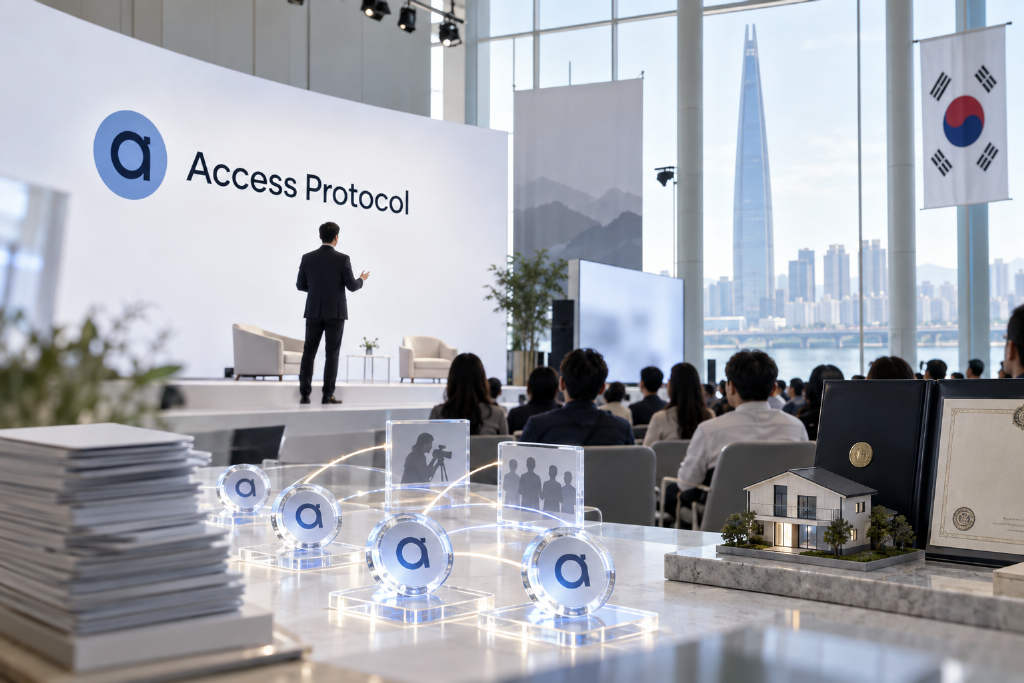
Access Protocol APAC lead Leo Wong said at KBW that tokenization’s next phase is not just about moving stocks, bonds, and real estate on-chain. He argued that the bigger shift is the creation of economic rights around things that traditionally were not treated as assets, including content, data, and community participation.
His core point was that subscription models turn users into customers, while tokenized participation can turn them into stakeholders. In his telling, the real change unlocked by tokenization is not simply putting old assets on new rails, but creating rights around relationships that previously had no economic ownership attached to them.
From asset tokenization to relationship tokenization
Wong said much of the market conversation has focused on bringing traditional assets such as equities and real estate onto blockchain infrastructure. That may be useful, he said, but it still amounts to moving old assets onto a new system rather than creating something new.
What matters more, in his view, is that tokenization can create economic rights around things that never had them before. He used the creator-fan relationship as a concrete example. Today, fans usually pay and that is the end of the transaction. Their support runs in one direction. They do not get equity, ownership, or upside. They are customers, not participants.
Wong asked what happens if participation itself becomes an asset. If loyalty, engagement, and attention, things users already contribute for free, can carry economic rights, then tokenization stops being only about assets and starts being about relationships.
He extended the same logic to data and communities. User data today is typically collected by platforms and sold to advertisers, while the people generating that data receive nothing. Tokenization, he said, could make data a first-class asset owned, licensed, and monetized by the people who produce it. Communities face a similar problem. They usually have no balance sheet and little economic presence. If community participation can be staked, rewarded, and governed, then being an early member could begin to carry financial meaning.
Wong said this is the direction Access Protocol is building toward. The company is not tokenizing stocks, he said. It is tokenizing the relationship between creators and communities, turning payment into subscription and subscription into ownership. He added that he sees this as a market larger than real estate.
Three steps are required for access to become capital
Speaking on the theme of moving “from access to capital,” Wong said access or participation can only become a real economic right, and eventually something that functions as capital, if three things happen in sequence.
Step one: access must become ownable
He said most access today is rented. Users pay for a subscription, receive entry, and lose that access the moment they stop paying. They never actually own anything. They are renting permission.
For access to become capital, it has to exist as an asset in the user’s wallet, something the user holds and something a platform cannot simply take away by changing its mind. Wong described this as the shift from renting to owning.
Step two: access must become productive
In Wong’s view, something that just sits there is not capital. Capital works, generates returns, and compounds.
That is where staking changes the model. If users gain access through staking, their position is not idle. It earns and produces. Wong said that productive layer is what turns a subscription into a yield-bearing asset. Access stops being a cost and becomes a position.
Step three: access must become transferable and liquid
For an asset to function as capital, holders must be able to exit, transfer, and let the market decide what it is worth. That means access has to be transferable and liquid.
Wong said Access Protocol has already built this layer. Subscriptions on the platform are not just records in a database. They are compressed NFTs, fully transferable on-chain assets. Users can hold and transfer them, and those assets live in their wallets rather than on the company’s servers.
On top of that, Access Protocol has built Access Hub, an in-platform marketplace that natively supports Access NFTs, including subscription NFTs and creator-minted NFTs. A fan can discover a creator, subscribe, hold that subscription as an asset, and later trade or transfer it in the same hub where the relationship started.
Wong described the full loop in three parts: ownable, productive, and liquid. He said many projects are still debating whether access should be treated as an asset at all, while Access Protocol has already built all three layers. In that structure, creators are not only selling content, they are issuing economic rights. Fans are not only paying, they are investing.
Clear ownership comes before liquidity, trust, and regulation
Asked what matters most in turning tokenized value into a functioning market, whether clear ownership, liquidity, interoperability, trust, or regulation, Wong said all of them matter. But if he had to choose the one that everything else depends on, it would be clear ownership.
Without ownership, he said, liquidity is just speculation. Without ownership, interoperability is just plumbing. Without ownership, trust and regulation are only fences built around something nobody truly owns. Ownership is the foundation.
His reasoning was straightforward. If a holder cannot clearly prove what they own, or if that ownership can be revoked, altered, or deleted by a platform, then the rest does not matter. No one will provide liquidity for something that does not belong to the holder. No one will build interoperability for an asset that can disappear. Regulation cannot protect an asset that does not really exist on paper.
Wong also pushed back on the idea that ownership is binary. He said ownership exists in layers.
- Weak ownership: a database record showing that a user subscribed. It is revocable and platform-dependent.
- Strong ownership: an on-chain asset in a wallet. It is transferable, verifiable, and belongs to the user.
Once strong ownership exists, he said, liquidity, trust, and regulation become easier to build because real assets can be traded, ownership can be verified, and records of who owns what are clear. His answer, then, was that ownership matters most, but only if it is real ownership rather than rented access.
Four pillars are needed for durable economic rights
Wong said Access Protocol’s model lets users stake tokens to access content and form an economic relationship with creators. But if access or participation is supposed to become a lasting economic right rather than a short-lived token incentive, the model needs stronger support underneath it.
He drew a sharp distinction between token incentives and economic rights. Token incentives are temporary, he said, because they exist only while someone is paying users to show up. The moment emissions slow or yields fall, the incentive disappears and users leave. That is not a relationship. It is a rental arrangement. Economic rights are different because they should still exist after the incentive is gone.
He listed four requirements for that durability:
- Verifiability: the relationship must be provable on-chain. It cannot rest on a promise or a database entry. It has to show that a user was there, participated, and held a position. If it cannot be verified, it cannot be relied on.
- Self-custody: the position must belong to the user, not be granted by a platform and later taken back. Wong said this is why Access Protocol uses compressed NFTs for subscriptions and stores them in users’ wallets rather than on company servers.
- Real utility: if the only reason to stake is yield, then it is not an economic right, in his words, but a farm. Staking has to unlock something real. Yield should be the result of the relationship, not the only reason for it.
- Survival beyond incentives: this is the hardest part. If a position has no second life, cannot be held, transferred, or recognized elsewhere, it dies with the rewards program. Wong said that is why Access Protocol built the Access Hub marketplace, so these positions can actually be traded and priced.
He summarized the framework in four words: verifiable, self-custodied, useful, and durable.
Access Protocol says value should accrue to creators and fans, not platforms
When the discussion turned to platform economics, Wong returned to one question: when a community grows, who is actually accumulating the value?
Under the dominant platform model, he said, the answer is almost always the platform. Creators spend years building an audience. Fans spend thousands of hours supporting, promoting, and believing in that creator. In the end, the platform owns the relationship, the data, and the upside. Creators and fans are renting a connection that should have been theirs.
Wong said Access Protocol exists to replace that model. Instead of asking fans to pay and leave, the system asks them to stake. That stake becomes a position that earns, grows, and remains theirs.
He repeated that subscriptions are issued as compressed NFTs, real on-chain assets that live in users’ wallets rather than in a database. Those assets can be held, transferred, and traded on Access Hub alongside works minted by creators themselves.
In Wong’s framing, that means value compounds back to the people inside the relationship rather than to the platform. Creators own their audience. Fans own their position. That is the shift he wants to make.
Wong pointed to three years of operating data on sustainability
On whether the model is sustainable, Wong said he would answer with evidence rather than promises.
For the past three years, he said, Access Protocol has distributed rewards to creators and subscribers every day. The annualized yield has been about 26%, with no lock-up and daily claiming available. He said the system continued through the deepest part of the latest bear market without a pause and without an emergency shutdown.
He contrasted that with other platforms that tried similar models and, in his words, almost all shut down. They launched rewards, attracted users, then saw emissions outpace revenue until runway ran out and the business closed. Over the last three years, he said, the list of failed creator platforms has grown long.
Against that backdrop, Wong said Access Protocol made its choices and has shown that it can keep operating.
Korea accounts for about 30% of ACS trading volume, Wong says
Wong said Korea is one of the markets he is most optimistic about in the Asia-Pacific region. He pointed to the country’s high density of crypto users and, just as importantly, their speed in adopting new products.
He also said Korean communities have a distinct culture. They do not only speculate. They use products, participate, and help build. In his view, that fits closely with the logic of the creator economy.
One figure stood out in his remarks: about 30% of ACS trading volume currently comes from Korean exchanges. Wong said that shows demand is already real.
Still, he said the next goal is not simply to have Korean users trade ACS. Access Protocol wants to bring those users into Access Hub and the broader ecosystem so they are not only buying and selling tokens, but actually subscribing, staking, supporting creators, and owning their own positions.
He said the team is already in talks with several Korean creators and communities. More localization efforts are coming, including a Korean-language interface, onboarding local creators, and events built with Korean communities. Access Hub will also receive experience optimizations tailored to Korean users.
Wong said he sees Korea as a proving ground for whether a Web3 product can truly gain traction. If Korean users are willing to use it and stay, that is a sign the product has real value. He said Access Protocol is working toward that standard.
His closing message to Korean creators and fans
Asked to leave Korean creators and fans with one sentence, Wong said: “You deserve to own the value you create. Creators deserve to own their audience, and fans deserve to own their position. Not rented, but truly yours. Come to Access Protocol and let’s make that real together.”
The original article also carried a disclaimer that markets involve risk and the piece does not constitute investment advice. Readers should consider whether any opinion, view, or conclusion fits their own circumstances and bear responsibility for any investment decisions made on that basis.
