

UMX, a trading platform incubated by Avenir Group under Li Lin, opened an invitation-only public beta on Aug. 10, with users now able to apply for early access.

According to official materials cited by Odaily, UMX stands for The Unified Market Exchange. It is positioned as a crypto-friendly securities platform for professional investors globally, built around the idea that users should be able to trade crypto assets and real stocks on one venue while moving capital across markets inside the same system.
Odaily frames the launch against Li Lin’s earlier role in crypto trading infrastructure. Thirteen years ago, he founded Huobi at a time when the central question for many users was where to buy and sell Bitcoin. Now, with Bitcoin more deeply integrated into the global financial system and the line between crypto finance and traditional finance less rigid, UMX is aimed at a different problem: capital efficiency across markets and across asset classes.
UMX is pitching a unified market for crypto and stocks
Trading global equities through centralized crypto exchanges or on-chain venues is no longer unusual. Odaily notes that current products span U.S. stocks, South Korean stocks, single-stock perpetuals that only offer price exposure, and even Pre-IPO markets on-chain whose price discovery is becoming more prominent.
Still, the report argues that the market remains split between crypto assets and traditional equities. In that view, there is still no single venue that gives professional investors direct access to both crypto trading and spot stock trading in one integrated framework. UMX is presenting that gap as its main distinction from both crypto exchanges and stock brokerages.
On the platform, users are meant to trade crypto assets and U.S. listed shares under one account structure, with funds able to move between the crypto side and the securities side.
Two-way transfers between crypto and securities accounts
On most crypto centralized exchanges, transfer functions usually move funds only between products such as spot and futures accounts. UMX extends that mechanism to transfers between a crypto trading account and a securities account.
As described in the article, stablecoins moved from the crypto account into the securities account are converted into U.S. dollars and credited instantly. The process also works in reverse.
Once funds are in the securities account, users can trade U.S. stocks, ETFs and U.S. equity options. Odaily says UMX offers actual stock holdings rather than only price exposure, and that users who buy stocks on the platform receive full shareholder rights.
For professional traders active in both crypto and equity markets, that transfer model is presented as an additional instant funding rail that avoids repeated losses tied to moving money in and out of separate systems. The idea is to let capital circulate across crypto and stock markets on one venue.
Using lending and transfers to raise cross-market capital efficiency
Another part of the UMX design is the way it combines transfers with borrowing. Odaily notes that crypto traders are already familiar with pledging BTC or ETH to borrow stablecoins for use in crypto trading. UMX extends that logic into stock and options trading.
Because the crypto trading account and the securities account can transfer funds both ways, users can use what the article calls a borrowing transfer. They can pledge BTC, ETH or other crypto assets, borrow stablecoins, then move those stablecoins into the securities account where they are exchanged into U.S. dollars for stock or options trading.
That means a user does not have to sell crypto holdings to gain buying power in the stock market. Odaily says this improves the capital efficiency of crypto assets.
The flow also works in the other direction. Under a traditional brokerage model, stock holdings generally cannot become margin for crypto trading unless the shares are sold first. UMX says it can bring securities exposure into the crypto margin system as well.
The mechanism is a stock-to-token feature. Users can convert U.S. stock holdings into stock tokens backed by real U.S. equities, and the platform then assigns margin that can be used for crypto trading based on a preset haircut rate. Similar to the two-way transfer function, users can convert those stock tokens back into spot U.S. shares at any time.
Under that structure, users can keep long-term exposure to U.S. stocks while also obtaining capital for crypto futures and leveraged trading.
Wealth management and treasury services form a third business line
Beyond crypto trading and securities trading, Odaily says UMX has a third business segment: wealth management and capital management.
The platform’s fixed-term wealth management and cash management products allow deposited funds to remain eligible for use as trading margin. The article describes this as another attempt to improve the use of idle capital.
Fee schedule published by the platform
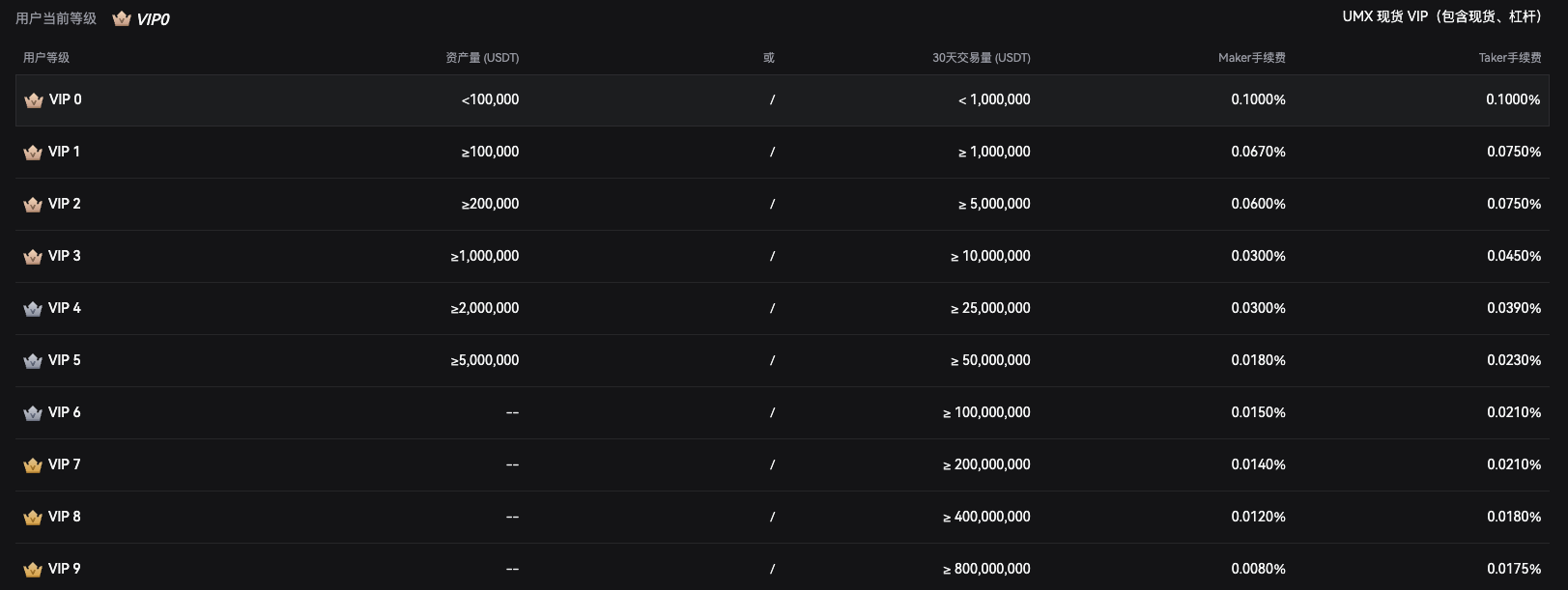
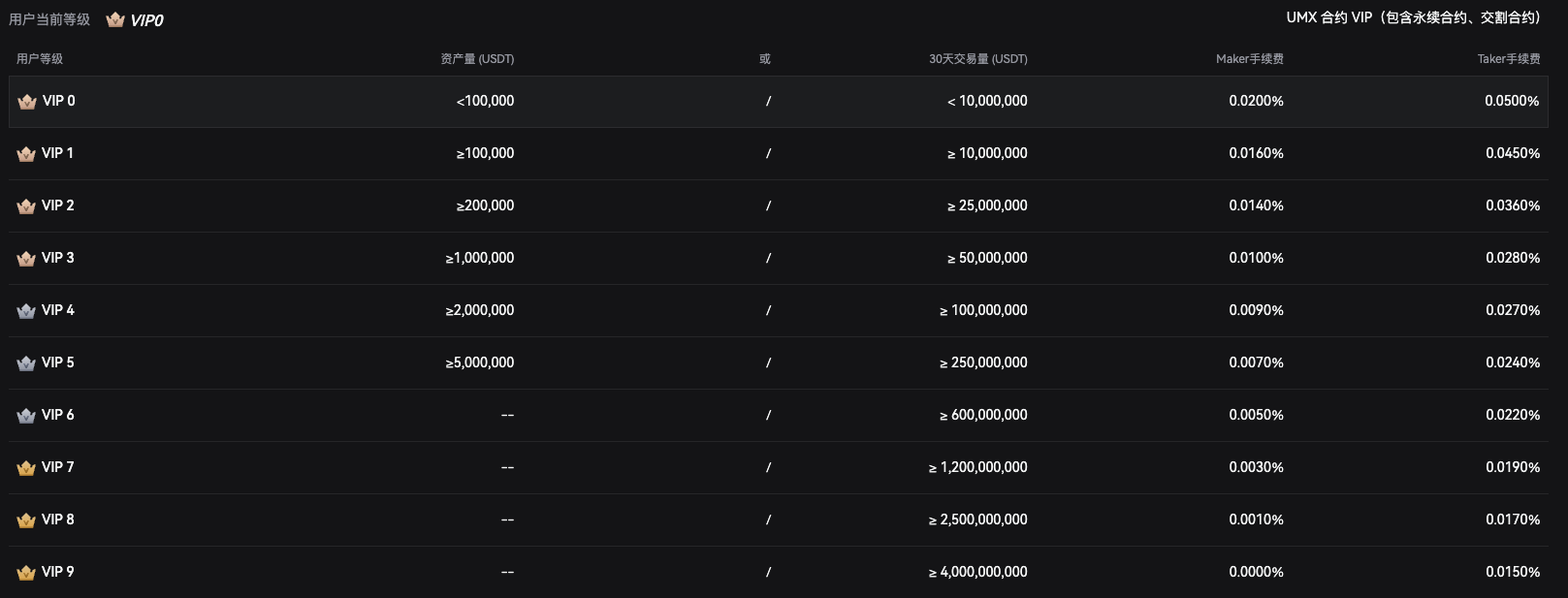
According to UMX’s website, standard users at VIP0 pay 0.1% maker and 0.1% taker fees for spot crypto trading. Fees decline as assets held on the platform and 30-day trading volume increase.
For crypto futures, VIP0 users pay 0.02% maker fees and 0.05% taker fees. The article notes that the maker fee is set 0.03% below the taker fee to encourage liquidity provision.
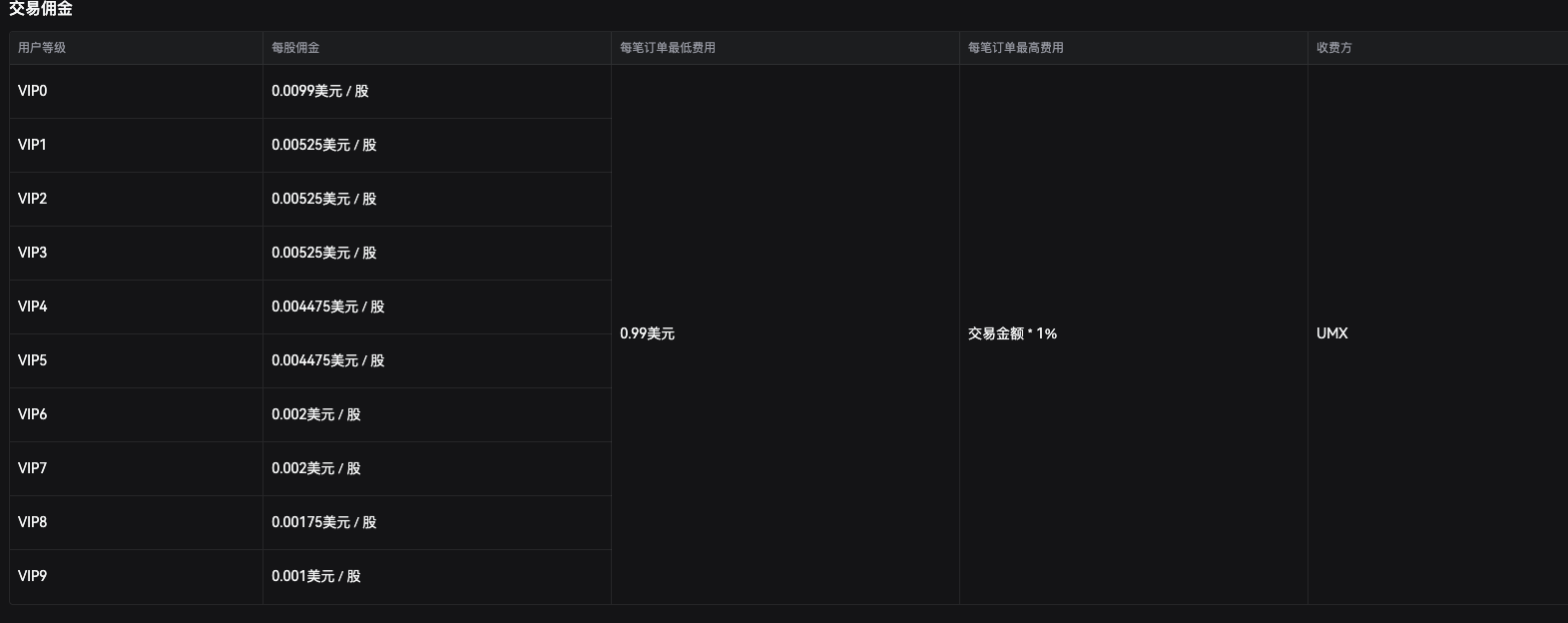
Stock trading uses a different pricing model. For VIP0 users, UMX charges a commission of $0.0099 per share, with a minimum fee of $0.99 per order. Odaily adds that this is roughly the cost of trading 100 shares, while the platform says some U.S. stocks and ETFs support fractional trades from as little as $1. Per-share commissions fall at higher VIP tiers, but the minimum order fee does not change.
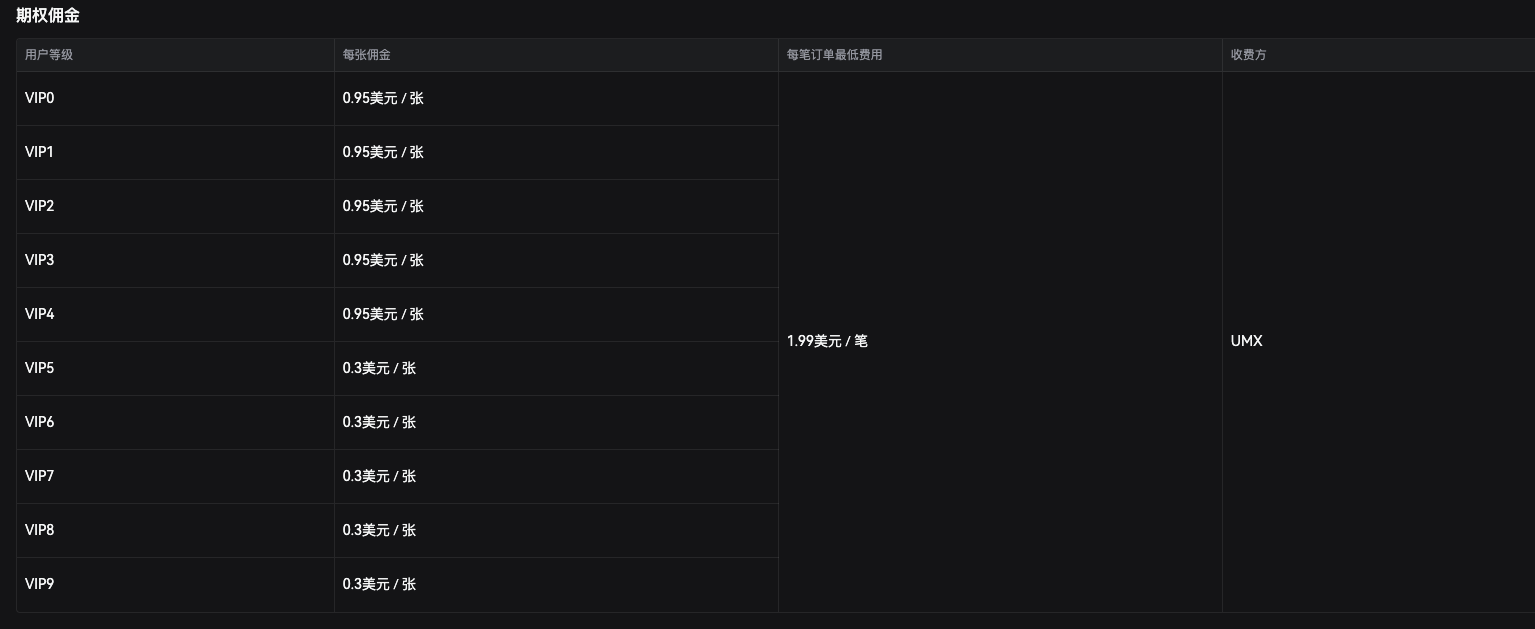
For options, UMX charges standard users $0.95 per contract, with a minimum fee of $1.99 per order and no maximum fee cap. Odaily says that pricing is broadly in line with traditional brokerages.
The target user is the professional, multi-asset investor
Odaily says a growing number of professional investors hold BTC, stablecoins, U.S. equities and options at the same time. Even so, many still trade BTC and ETH on crypto platforms such as Binance and OKX, while allocating U.S. stocks, ETFs and options through traditional brokerage apps such as Futu and Interactive Brokers.
That leaves the portfolio in one place conceptually, but not operationally. Account structures, capital pools and margin systems remain separate, and moving resources across markets still involves friction. The report identifies that split as the more serious pain point for professional investors.
On that basis, Li Lin did not choose a strategy centered on lowering the entry barrier for U.S. stock trading or promoting the idea that all users should be able to join an AI stock bull market. Instead, Odaily says UMX has from the outset been aimed more at high-net-worth clients and professional investors. For that audience, opening a U.S. brokerage account and placing trades is not the primary problem. The more important issue is whether a platform can house crypto assets, stocks and other assets together while allowing crypto and traditional assets to sit inside the same capital and margin framework.
The article closes by saying that competition around RWA, tokenized stocks and crypto-stock trading venues has already entered a later stage, with names such as Hyperliquid, Binance and Ondo already occupying leading positions in the sector. In that reading, the market is not short of generic stock trading access points. What is missing is a platform that addresses a specific user pain point in practice.
Odaily’s conclusion is that UMX reflects Li Lin’s renewed look at current infrastructure gaps after years as an asset allocator. Whether the platform can become a unified layer between crypto finance and traditional finance is still a question for the market.