
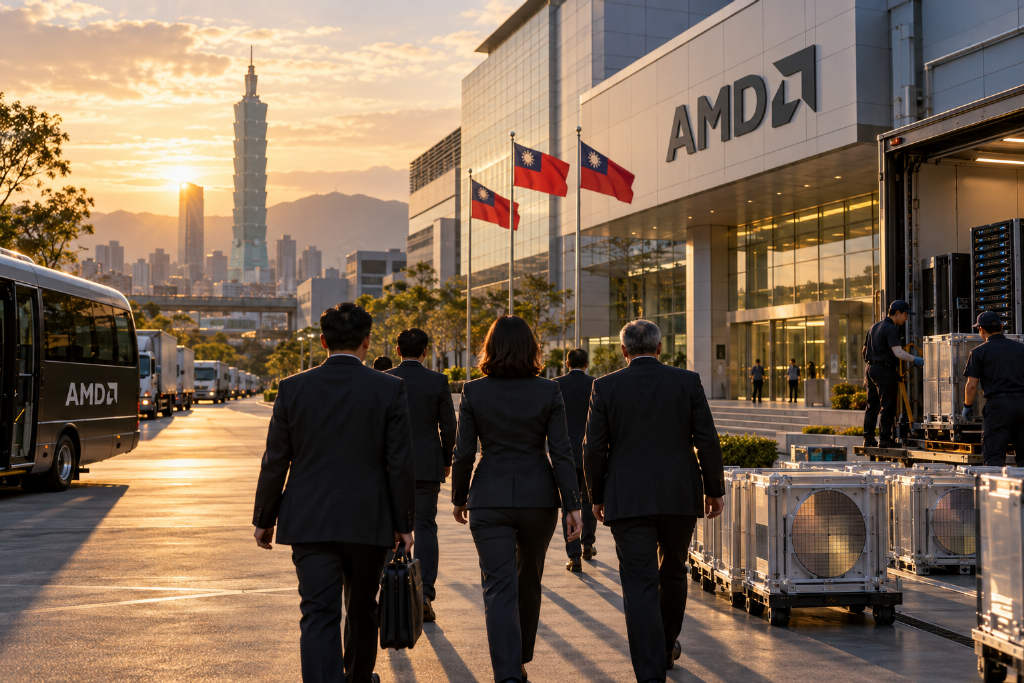
AMD Chair and Chief Executive Officer Lisa Su returned to Taiwan on Oct. 6, less than six months after her last visit in May. This trip was centered on AI and semiconductor supply-chain expansion. Su said AMD’s $10 billion Taiwan supply-chain investment plan, announced in May, is fully on schedule, and added that the company plans to raise that investment as demand for AI, CPUs and data center products continues to run ahead of supply.
She said Taiwan is absolutely critical to the global semiconductor supply chain and “very, very critical” to AMD.
Meetings with Foxconn, TSMC, Acer, Asus and Quanta
Su’s Taiwan schedule was packed. She met Foxconn Chairman Young Liu in the morning and was set to visit TSMC, Acer, Asus and Quanta later in the day.
Su said CPU demand has risen clearly this year. Even though AMD has kept increasing supply capacity, demand is still above supply. The company is now working with TSMC and Taiwan-based partners in outsourced semiconductor assembly and test, as well as substrate suppliers, to expand output. AMD expects to keep increasing supply this year and to make a much larger jump in capacity by 2027.
Capacity planning now stretches much further out
The surge in AI chip demand has lengthened semiconductor capacity-planning cycles. Su said AMD and its suppliers previously may have needed to plan one to two years in advance. Now the company is discussing demand three, four and even five years ahead with partners, aiming to keep advanced wafer production, advanced packaging, substrates and system capacity expanding in step.
HBM and memory supply are also a focus
Memory has become another major point in AMD’s supply-chain planning. Su said the broader memory market remains tight. AMD needs enough high-bandwidth memory, or HBM, for AI servers, while also covering memory demand tied to CPUs and PCs. She said the company is carrying out more detailed long-term capacity planning with memory suppliers and customers.
After a short stay in Taiwan, Su was expected to head to South Korea on Oct. 8 to discuss AI and HBM cooperation with local memory makers and foundry companies. The trip shows that one of AMD’s main tasks in Asia is to lock in wafer, packaging and memory supply ahead of the next wave of AI infrastructure demand.
Geographic diversification does not reduce Taiwan’s role
Responding to questions about cross-strait risk and the semiconductor industry’s push to spread production across more regions, Su said geographic diversity is a healthy strategy for companies, and AMD encourages supply-chain partners to add capacity in different locations.
She also said that supply-chain diversification does not mean Taiwan has become less important. AMD continues to use output from TSMC’s Arizona fab in the United States, and Su said that facility is performing “very good.” She added that AMD wants more capacity to come online globally. Still, with AI computing demand growing quickly, the company needs more advanced process capacity, advanced packaging, substrates and server-system output, and Taiwan’s complete semiconductor ecosystem remains indispensable to AMD’s expansion.
Su also discussed World Labs and Venice
Su said AMD’s acquisition of World Labs, led by Fei-Fei Li, is intended to strengthen hardware-software integration and extend the company’s reach into the model layer, building a more complete end-to-end AI computing stack. AMD had previously announced an $8.2 billion deal for World Labs, giving it an entry point into spatial intelligence and 3D physical-world computing.
Su also mentioned AMD’s latest-generation Venice server CPU, saying it has already seen strong adoption among hyperscalers and enterprise customers, and that she is optimistic about follow-on demand.