
Unitree Technology’s public listing has put China’s “equity finance” debate back in the spotlight.
In recent days, Unitree, described in the article as the first A-share listed humanoid robotics company, debuted on Shanghai’s STAR Market and at one point reached a market value of more than 440 billion yuan. Its shareholder list includes state-backed capital from first-tier cities such as Beijing, Shanghai and Shenzhen, along with local state capital from Chongqing, Chengdu and Shandong.
For local governments, these stakes are not only about financial return. They are also a way to secure an early position in industries seen as strategic for the future. As land finance keeps fading and pressure on local fiscal resources grows, the equity-finance model associated with Hefei’s venture-style industrial investment has become an increasingly popular option for cities looking to pivot. Hard tech has turned into a favored target.
The article then raises the harder questions: what are the real barriers to equity finance, and can it actually take over the role once played by land finance?
Nie Huihua, a tenured professor at the School of Social Sciences at Tsinghua University, told Time Weekly that the unusually high share once contributed by land-transfer fees was tied to a specific historical period and should not be treated as the normal structure of public revenue. Government revenue, he said, should rely mainly on taxation, and it is unrealistic to look for a replacement source based on the scale of previous non-tax income.
Luo Zhiheng, chief economist at Yuekai Securities, said China’s regions differ sharply in administrative rank, resource endowment and governance capacity. In his view, equity finance cannot be rolled out in a rush everywhere. It has to match local conditions, or the result will be limited at best and wasteful of fiscal resources at worst.
Three venture bets built Hefei’s reputation
Equity finance is not a new idea in China, but Hefei is the city that brought it into the public mainstream.
Injecting capital into troubled companies, positioning early in sectors such as new energy and integrated circuits, and staying with those companies over a time frame measured in years all combined to create what the article calls Hefei’s venture-capital myth.
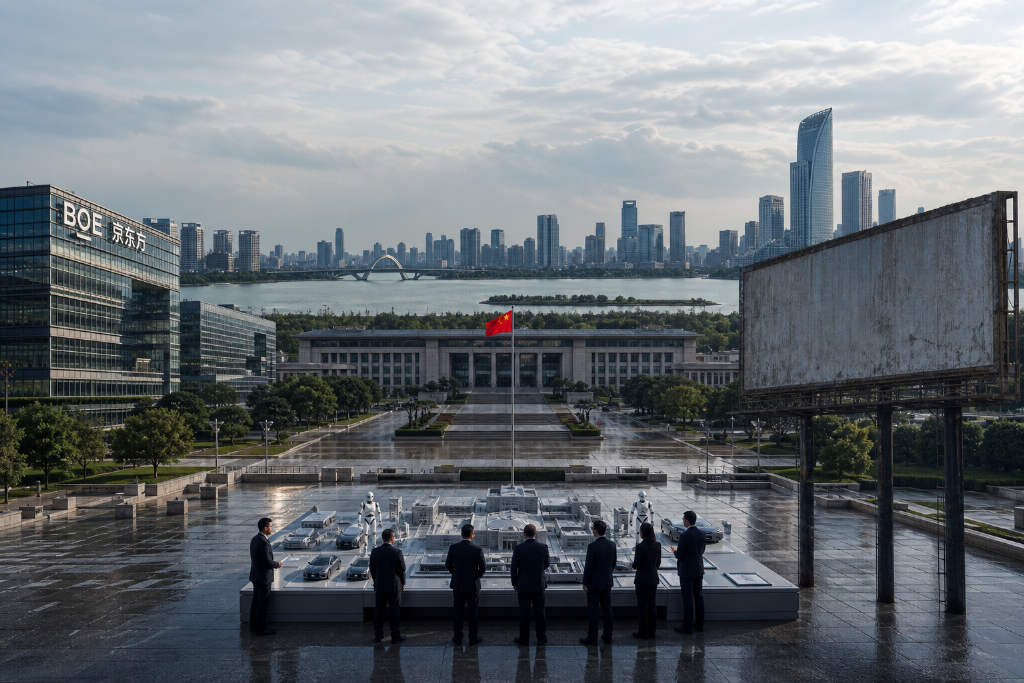
In 2008, BOE posted a 1 billion yuan annual loss, and the first sixth-generation TFT-LCD production line in mainland China had already been rejected by Shanghai and Shenzhen. Hefei took the project, at the cost of delaying subway construction. After the project matured and the city exited, Hefei recorded a net gain of 14 billion yuan. The display supply chain then clustered locally, helping the city become a major global hub for new display manufacturing.
In 2020, NIO was on the verge of delisting as its funding chain broke down. Hefei state capital invested 7 billion yuan for a 24.1% stake. After several rounds of share repurchases by NIO, Hefei booked a net gain of 3.5 billion yuan, while the investment also strengthened the city’s image as an automotive center.
The biggest call, according to the article, was Changxin Technology, also known as CXMT.
DRAM is described as one of the most technically demanding areas in semiconductors, requiring heavy capital expenditure and a long payback cycle. Starting in 2016, Hefei Industry Investment put in about 30 billion yuan over the following decade.
On July 27, 2026, CXMT reached a market value of 3.2772 trillion yuan, topping the A-share market. The book profit of Hefei’s state-capital system exceeded 1 trillion yuan, equivalent to seven times Hefei’s full-year fiscal revenue in 2025.
These three investments were made in different industries, but the operating logic was the same: invest in emerging industries through local state-capital platforms, bring in a leading company, attract a supply chain, build a long-term tax base, and later realize fiscal gains through equity transfers once the company reaches the public market.
It does not match land-finance scale, and execution is difficult
Hefei’s record has encouraged local state capital elsewhere. As land-finance income contracts, more cities are looking at equity investment as a possible way to fill part of the gap.
Data from ZERONE cited in the article show that in 2025, government-guided funds subscribed 398.2 billion yuan, up 73% year on year. A broader category of local state capital subscribed 796.1 billion yuan, up 85.2%. Investment was heavily concentrated in hard-tech areas such as new energy, semiconductors and biopharmaceuticals.
On the regional side, a report from Touzhong Jiachuan said the Beijing-Tianjin-Hebei region ranked first by cumulative size, while the Yangtze River Delta had the largest number of funds. Government investment funds have also spread from the eastern coast into central and western China and down to city, district and county levels. By the end of 2025, county-level funds accounted for 44% of the total number of government funds.
Nie said this marks a shift from a “sell land for cash” model to an “invest to bring industry” model, changing the government’s role from a rent-collecting landlord to a dividend-sharing partner. Even so, he said the actual income generated by equity investment is nowhere near enough to make up for the decline in land-transfer revenue, and the operational threshold is too high for it to become a generally applicable replacement.
The 2025 numbers make the scale gap clear. Local revenue from transfers of state-owned land-use rights stood at 4.1518 trillion yuan, while local state-capital operating-budget revenue at the same government level was 464.421 billion yuan. On that basis, local state-capital operating income was only about 11.2% of land-transfer revenue. Even under a relatively broad definition, the article notes, that is just over one-tenth of the land-finance figure.
And the scale issue is only one part of it.
Nie said land finance can generate cash as long as there is land to sell, but equity investment has to clear at least three hurdles:
- First, there has to be money available to invest. Many local governments, especially in central and western regions, are already fiscally stretched.
- Second, the investment has to be accurate. That demands strong professional judgment from local investment-attraction teams.
- Third, there has to be a workable exit. Equity investments often take five to seven years to unwind. If a company fails to list or no buyer steps in through M&A, the exit channel becomes extremely narrow.
He added that Hefei’s success rests on conditions that are not widely shared: a relatively solid industrial base, a provincial capital’s ability to draw in resources from across the province, stronger fiscal capacity, and forceful decision-making and execution.
Failed bets and audit findings highlight the risks
The article points to Yichun in Jiangxi province and its effort to bring in Neta Auto as a representative failure.
According to CCTV’s Focus Talk, the city had no established automobile industry base, yet still spent nearly 2 billion yuan to acquire about 12.18% of Hozon Auto, paid nearly 300 million yuan to build factory space on the company’s behalf, and offered rent reductions for 10 years. Nanning in Guangxi and Tongxiang in Zhejiang also put money in through similar arrangements. Combined local state-capital investment from the three places exceeded 8 billion yuan.
But Hozon New Energy, Neta Auto’s parent company, posted cumulative losses of 18.3 billion yuan from 2021 to 2023, then entered bankruptcy restructuring in the second half of 2025. Most of the investment is unlikely to be recovered.
The article says this was not an isolated case. Cui Zhu, director of the Fiscal Audit Research Office at the Audit Research Institute of the National Audit Office, previously wrote that some local governments, driven by distorted performance incentives, set up funds blindly or repeatedly without regard for their fiscal capacity. In 2022, the National Audit Office found that six government investment funds and their sub-funds repeatedly invested in 50 companies, with 11 of those companies receiving support from three or more funds. Audit reports from multiple provinces in 2024 also pointed to problems such as unclear positioning and idle capital at some government investment funds.
From that perspective, the article argues, Hefei’s path may look more like survivor bias for most localities than a model that can be copied directly. The very strengths that made it work in Hefei — industrial foundation, fiscal strength and execution capacity — are often what other cities lack.
Where can local fiscal growth come from?
If equity finance is hard to duplicate and land finance is receding, the article asks, what options remain for local public finance?
One immediate reality is that transfer payments remain central to local fiscal operations.
Ministry of Finance data cited in the article show that China’s general public budget expenditure exceeded 30 trillion yuan for the first time in 2026, reaching 30.01 trillion yuan. Of that, central-to-local transfer payments stayed above 10 trillion yuan for a fourth straight year and accounted for more than 40% of local general public budget spending. For central and western regions in particular, the article describes that money as a lifeline for basic operations.
Still, relying on support from the center is not presented as a durable solution. The question is where local governments can find stronger endogenous fiscal momentum.
In the short run, Luo said the most direct lever is to reactivate existing assets. Local governments should step up efforts to revitalize stock assets, while pairing those moves with institutional support such as asset inventories, repairs to title defects, due-diligence exemptions in disposal processes, and incentive mechanisms for assessment. Without those steps, he said, asset revitalization can easily become a one-off deal.
If local governments want equity investment to create new growth, another institutional barrier comes into view.
Luo said the concept of equity finance itself is sound, but the contradiction between the low-risk preference of fiscal funds and the high-risk nature of technology industries has not really been resolved. In his view, making equity finance work requires a systematic framework that includes state-capital performance assessment and due-diligence exemption rules.
One direct problem is the mismatch between official terms and investment cycles. Nie said local officials usually serve three to five years, while a hard-tech project may need at least seven or eight years from investment to exit. That creates an incentive to prefer short-cycle projects. For that reason, he said, the assessment cycle for state-capital investment should be aligned with industrial reality.
Another recurring issue is the lack of a clear fault-tolerance mechanism.
Relevant documents have been issued frequently at both the national and local levels in recent years, but the article says practical implementation still suffers from unclear boundaries and inconsistent standards. Nie said disciplinary inspection and audit bodies need to work together to define the line between normal market risk and misconduct. Without that clarity, the willingness of state capital to invest will be hard to unlock.
The article also notes a common funding problem: some local governments can finance the first round of an investment, but do not know where the next round of follow-on money will come from. Nie said building “patient capital” cannot rely only on annual fiscal appropriations; it also needs a standing mechanism for capital replenishment and circulation.
The experts interviewed in the piece ultimately trace the issue back to the structure of public finance itself. In their view, the long-term way forward for local fiscal systems still depends on a reallocation of fiscal powers and expenditure responsibilities between the central and local governments, along with tax reform.
Luo proposed several directions:
- advance fiscal-system reform by moving powers and spending responsibilities upward and reducing the burden carried by local governments;
- push tax reform by building a tax structure suited to the artificial intelligence era, expanding consumption tax coverage to highly polluting and energy-intensive industries, and raising environmental protection and resource tax rates;
- reform utility pricing so that long-running, large-scale and inefficient fiscal subsidies do not keep weighing on public finances, replacing hidden subsidies with explicit ones.
The article was originally published by the WeChat account Time Weekly (ID: timeweekly) and written by Song Kexin.