
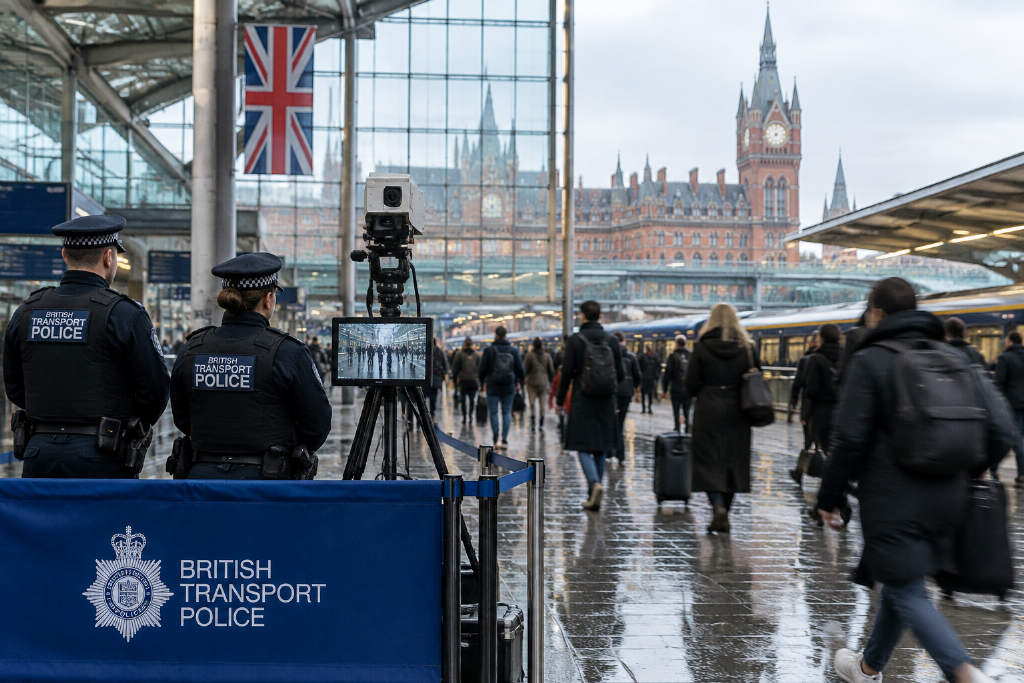
British Transport Police (BTP) deployed live facial recognition (LFR) at London rail stations from February to July, carrying out 18 operations, scanning more than 500,000 faces, and spending £320,786 on equipment rental and police staffing. Over that six-month trial, the system produced just one alert, and that alert was a false positive. No one was arrested as a direct result of an LFR alert.
The figures were obtained by Liberty Investigates through freedom of information requests and published with The Guardian on Sept. 29. The data shows the 18 deployments cost about £17,800 each on average, while the trial used close to 100 hours of police time.
LFR scans faces passing in front of a camera and compares them in real time with a police watchlist. If the system detects a possible match, it issues an alert and officers then make a visual check. In this trial, the only alert was classified as a false positive, meaning the system misidentified a person as someone on the watchlist. On that basis, the technology did not correctly identify any watchlist subject during the initial six-month period.
BTP extended the trial in August and added Tube stations
BTP announced in August that it would extend the trial by four months and expand it to London Underground stations. The first deployment on the Tube took place at Victoria station on Aug. 11. Cameras have since rotated between Underground stations and mainline rail stations, with the trial scheduled to end in November.
Transport for London (TfL) backed the extension. TfL said LFR would be used at "key stations selected for maximum effect" and aimed at people on police watchlists. It also said the technology would be used in particular to address violence against women and girls.
BTP told The Guardian that the extended trial has produced three confirmed correct alerts. Those three people were later found to be complying with Sexual Harm Prevention Orders or other court-imposed conditions. The system identified people on the watchlist correctly, but checks found they were not in breach of court requirements.
A BTP spokesperson also said officers made multiple arrests during deployment periods for offenses including assault, theft, possession of an offensive weapon, breach of a criminal behaviour order, and public order offenses. Officers also located people wanted by courts and other police forces. BTP said those arrests were not directly triggered by LFR alerts, so they were not counted in the system's performance statistics.
BTP also said it kept adjusting deployment locations, operating procedures, equipment, and the way watchlists were built during the trial. According to the force, the watchlist was intentionally kept small at the start to maintain data quality and ensure governance and safeguards were in place. Later expansion of the list was controlled and carried out under BTP policy.
Former commissioner says the results look limited
Fraser Sampson, the former UK Biometrics and Surveillance Camera Commissioner, said police must show that use of the technology is proportionate. He said variables such as location, timing, the composition of the watchlist, and whether listed individuals are likely to appear at the site all need to line up. Sampson is now a non-executive director at Facewatch, a company that runs facial recognition systems in shops.
Sampson said, "In shops, success means these people stop coming in. For police, success means they actually catch people. From that perspective, this trial does not appear to have delivered very much." He also said everything depends on the police watchlist. People not on the list are not "seen" by the system, and the images are not retained in the same way as standard CCTV footage.
Police use of LFR is still expanding in the UK
According to analysis by Liberty Investigates, more than half of police forces in England and Wales have deployed LFR on the street. The Metropolitan Police and the Mayor of London's office said this summer that fixed LFR cameras would be installed in the West End. London Mayor Sadiq Khan later confirmed that Oxford Street, which has recently been converted into a pedestrianized area, would also use the technology.
The Metropolitan Police has cited results from a trial in Croydon, south London, to support wider deployment. According to a June report by The Guardian, fixed cameras were installed at both ends of Croydon High Street for a six-month trial. The Met said 173 people were arrested during that period.
The Joint Committee on Human Rights recently published a report calling on the government to legislate in response to threats AI poses to human rights. The report described the rollout of LFR as a "particularly stark risk case."
Labour MP Bell Ribeiro-Addy said tackling violence against women and girls on public transport is urgent, but money should be spent on measures that work. She said the scheme cost more than £320,000 and produced zero arrests and one false positive during the trial, and argued that the government should pause LFR deployment until stronger safeguards and a clearer legal framework are in place.