
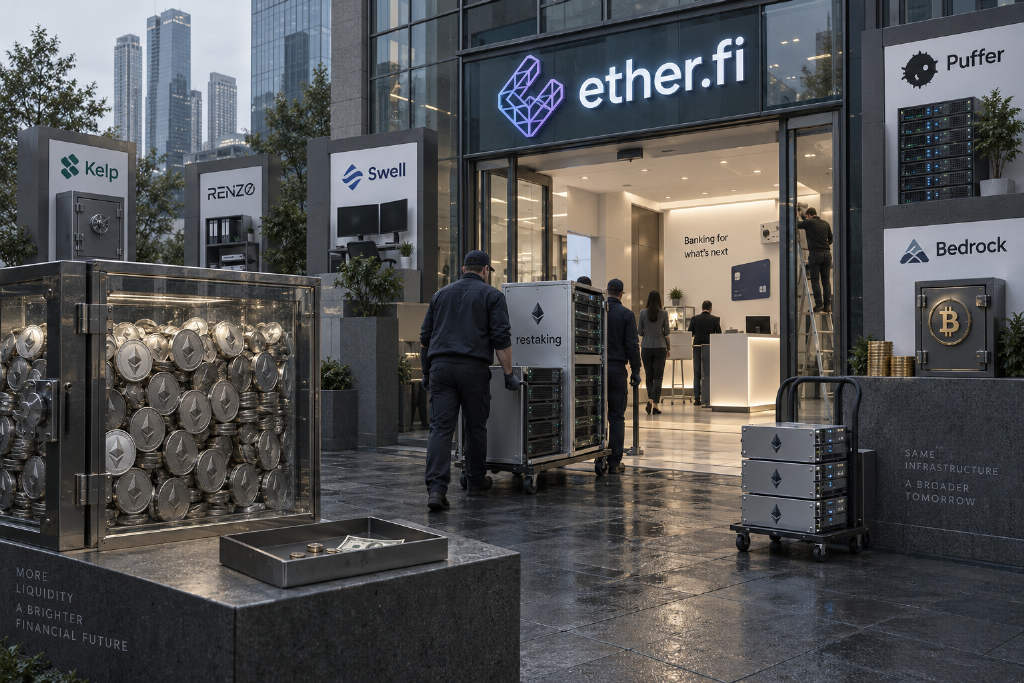
Liquid restaking protocols once sold themselves as Ethereum’s yield engine. That pitch is now breaking down.
On Sept. 29, ether.fi said it will formally separate its restaking business by the end of this quarter and fully pivot to a Neobank, or crypto neobank. CEO Mike Silagadze said restaking no longer offers meaningful yield opportunities and still comes with security risks that cannot be ignored, making an exit the rational choice.
As of Sept. 30, the liquid restaking market had about $1.45 billion in total value locked. Over the course of a week, however, the entire segment generated only about $100,000 in protocol revenue. That mismatch between locked capital and actual earnings is forcing the largest protocols to rethink what they are.
According to the PANews article, ether.fi is neither the first to pivot nor likely the last. Kelp, Renzo, Swell, Puffer, and Bedrock, five of the sector’s leading protocols, are all moving away from a single-purpose LRT identity and into new lines of business. Their routes differ. Their underlying logic does not.
Kelp: from restaking spread income to liquidity sales
Kelp, the largest LRT protocol after ether.fi, is changing course under pressure rather than by choice.
The turning point came on April 18, when a cross-chain bridge attack hit Kelp and became a black swan event for the broader LRT market. By forging cross-chain messages, the attacker minted about 116,500 rsETH out of thin air, worth roughly $293 million. The incident damaged Kelp’s balance sheet and sharpened concerns around the security profile of restaking products.
After that, Kelp began pulling back. In May, it said it would narrow rsETH’s cross-chain footprint, focus on networks with stronger security and ecosystem integration, and gradually shut down rsETH bridges on multiple chains. Earlier still, Kernel, the BNB restaking product in the same KernelDAO ecosystem, had already been wound down, with new deposits fully suspended from March.
Kelp did not leave the yield business altogether. It changed what it wants to sell. Instead of selling restaking yield, it is moving toward short-term credit liquidity. Its new focus is split between two products: the Gain strategy vaults and the KUSD stablecoin.
KUSD has not launched yet. Based on the official description cited in the article, it is designed as a short-term settlement liquidity tool for institutions. Institutions can access short-duration funding for payments, foreign exchange, and cross-border settlement, then repay the funds with interest after the transaction is completed. The yield is meant to come mainly from real settlement activity.
After the exploit, Kelp’s TVL fell from nearly $1.5 billion to a little above $1.1 billion, a drop of about 25%. Even so, it remains the largest LRT protocol by TVL outside ether.fi. Since the start of this year, Kelp has posted $26.52 million in cumulative gross revenue. Most of that, though, has to be passed through to users in the form of ETH staking rewards and EIGEN token incentives. Only 5% is actually retained by the protocol, leaving profit at just $1.41 million.
The contrast with its newer products is sharp. The article says management fee retention for Gain products such as agETH and hgETH is 100%, while their TVL is only about $30 million. In PANews’ framing, strategy vaults account for roughly 2.5% of TVL and 1.3% of revenue, yet generate nearly 25% of profit.
Renzo: from LRT issuer to on-chain structured yield platform
Renzo’s shift looks more deliberate.
On Sept. 9, Renzo Protocol rebranded as Renzo Finance and changed its positioning from an LRT protocol to an on-chain structured yield platform. Its product stack was split into three modules: Staking Suite, Reserve Vaults, and Enterprise Suite.
The name change reflects a deeper business change. ezETH used to be the center of gravity, with the protocol built around issuing LRT. Now LRT is being pushed down the stack into the role of an asset entry layer and legacy base, while growth is expected to come from actively managed structured yield products.
Since the start of the year, Renzo has recorded $5.84 million in cumulative gross revenue and $1.01 million in gross profit. Revenue is meaningful in size, but the conversion into profit remains weak.
The article also notes that the ratio between ezETH market capitalization and Renzo TVL has been trending lower since the fourth quarter of last year. It remains very high, but has now slipped to 94.5%, suggesting ezETH is no longer the sole engine of growth.
Execution has followed the rebrand quickly. On the same day it changed its name, Renzo launched Renzo Basis on Hyperliquid, a delta-neutral basis yield vault designed to capture arbitrage opportunities between funding rates and spot basis. A week later, it said it would expand to Lighter on Robinhood Chain to pursue basis trades tied to on-chain stock perpetuals.
In practical terms, this resembles the structured product model used in traditional asset management. Renzo acts as a strategy manager, selecting and building trading strategies with different risk-return profiles, then packaging them into standardized vault products for users. The protocol earns management fees and performance fees. ezETH no longer has to carry the entire growth story. It becomes one underlying asset among several.
Swell: shutting down an L2 and betting on an AI trading terminal
Swell has taken the most aggressive route.
Since the start of the year, Swell has generated $868,600 in cumulative gross revenue and only $43,400 in gross profit. Costs are eating heavily into revenue, leaving the protocol with weak earnings quality.
Its strategic break came earlier. On April 28, Swell announced it would shut down Swellchain. The Layer 2 network, built on the Optimism Superchain and once positioned as a dedicated chain for restaking, was shelved less than a year after launch. The team said the restaking ecosystem was maturing much more slowly than expected, while Ethereum L1 scaling and lower transaction fees had reduced the need for a separate L2. Rather than keep spending into that setup, Swell chose to redirect engineering and business resources to Faro.
Faro has no direct connection to LRT. It is a non-custodial AI trading application built on Hyperliquid. It aggregates on-chain data, social sentiment, and market indicators, generates trading strategies, and lets users execute trades on Hyperliquid with one click.
That marks a clear business shift. Swell is moving from supplying yield-bearing assets to supplying trading services. Its revenue model is moving away from staking spread income and toward subscription fees, execution fees, and potential ecosystem value capture later on.
The article adds one important caveat: the transition is still early, and it remains unproven whether Faro can turn trading volume on Hyperliquid into protocol cash flow.
Puffer: moving deeper into Ethereum execution infrastructure
While other protocols are looking for growth on the asset side or the user side, Puffer is going down the stack.
Its current product lineup spans four areas: LRT, institutional services through Puffer Institutional, Preconf, and UniFi Based Rollup. LRT is still part of the business, but more as a base allocation for institutional clients. On March 12, Puffer partnered with regulated digital asset platform Anchorage Digital to offer institutions a compliant investment channel into pufETH, pushing further into a business-to-business model.
UniFi Based Rollup stands out most. Instead of using the centralized sequencer model common across the industry, Puffer introduced a rollup architecture in which Ethereum L1 validators directly handle transaction ordering. The article says this removes cross-chain composability barriers and censorship risk tied to centralized sequencers at the architectural level, while enabling native atomic interaction and instant withdrawals between L2 and L1.
On Sept. 23, Puffer said it had entered a strategic partnership with Google Cloud, which will serve as the enterprise gateway operator for its Preconf Gateway system and provide sub-second preconfirmations for transactions. One week later, on Sept. 30, Puffer announced another collaboration with Anchorage Digital to bring institutional-grade custody and settlement infrastructure to Puffer UniFi.
Taken together, those steps show Puffer evolving from a single-purpose LRT protocol into a service provider for Ethereum’s execution layer.
Since the start of the year, Puffer has generated $1.14 million in cumulative gross revenue and $57,200 in gross profit. Staking rewards contribute almost nothing to profit, according to the article, which suggests the protocol’s actual earnings are coming mainly from service fees. If restaking itself produces close to zero profit, then becoming settlement and execution infrastructure for trading platforms, AI agents, and institutional payments opens up other fee streams, including sequencing fees, preconfirmation fees, and infrastructure charges.
Bedrock: rebuilding the yield engine around Bitcoin
Bedrock has chosen a different escape route. It is moving the center of gravity from Ethereum to Bitcoin.
Among the leading LRT protocols, Bedrock has gone furthest in replacing its core asset base. Its official narrative now leans heavily toward BTC, with ETH no longer in the starring role.
DeFiLlama data cited in the article shows that the Restaked BTC segment has already surpassed $1 billion in TVL, while the ETH LRT segment stands at about $1.4 billion. The gap between the two is narrowing.
Within Bedrock itself, the shift is even clearer. Out of $408 million in TVL, uniBTC accounts for $379 million, or nearly 94%, making it the protocol’s main asset gateway. uniETH, once the flagship product, is down to just $27.5 million in TVL and has become a secondary line.
On June 24, Bedrock launched version 2.0 and made the strategy explicit: build a Smart Yield Engine for Bitcoin capital. Through Yield Vaults, it aims to allocate Bitcoin capital across institutional credit, delta-neutral basis trades, DeFi, and RWA strategies, in an attempt to build a profit base less tied to Ethereum’s cycle.
Yet the article points out a tension in the numbers. Bedrock’s current revenue and profit still rely on uniETH staking. Since the start of the year, the protocol has posted $647,800 in cumulative gross revenue and $76,800 in gross profit. uniBTC redemption fees contribute more to profit than they do to revenue, which points to stronger profit conversion elasticity, but the protocol’s overall revenue and profit remain highly dependent on uniETH staking rewards.
That leaves Bedrock with a practical challenge. The product that has become secondary, uniETH, is still generating more revenue and profit with less TVL. The flagship product, uniBTC, has not yet matched that performance. The next question is whether uniBTC can develop the same kind of profit leverage effect that uniETH once had.
A shared conclusion: LRT is becoming a capital entry layer
Five protocols are taking five different paths, but the logic underneath them is closely aligned.
First, the yield equation has changed. LRT used to sell a three-layer return profile: base staking yield, restaking yield, and points or airdrop incentives. As demand for AVS, or actively validated services, has come in below expectations, points incentives have faded, and slashing risk has risen, the extra yield no longer offsets the added risk exposure. A growth model built on yield alone is running out of room.
Second, protocols are moving from asset issuance toward asset management. Renzo’s structured vaults, Kelp’s Gain strategy vaults, and Bedrock’s Bitcoin yield vaults all point to the same goal: earning management fees and performance fees on user capital allocation. Revenue efficiency per unit of capital is starting to matter more than TVL by itself.
Third, infrastructure is emerging as another monetization path. Puffer is betting on Preconf and Based Rollup infrastructure. Swell is moving into an AI trading terminal. In both cases, the business is no longer centered on locking assets. It is centered on processing trades, serving orders, and selling capability. The revenue ceiling is no longer tied only to staking yields, but to transaction scale and product penetration.
PANews sums it up this way: LRT is being reduced to a base-layer capital entry point. Users route funds through restaking to gain base yield and composability, while protocols try to earn from structured products, credit, trading, and infrastructure services built on top. In the next cycle, the story shifts toward cash flow that can be explained in operating terms.




