

Memory has been one of the most talked-about themes in global capital markets this year. As AI infrastructure buildout continues, high-bandwidth memory, or HBM, has remained in short supply, turning SK Hynix, Samsung and Micron into some of the market’s hottest names. Money poured in, share prices surged, and even after a sharp pullback in recent sessions, their gains for the year have still remained striking.
That kind of rally tends to attract investors who want more than the return from the stock itself. In that setting, single-stock leveraged ETFs have moved from a niche product into the mainstream of speculative trading. Unlike a traditional ETF that tracks a basket of stocks or an index, these products follow one stock and use derivatives such as swaps and futures to amplify the stock’s daily move by 2x or even 3x. If the underlying stock rises 10% in a day, a 2x product would theoretically gain about 20%. If the stock falls 10%, the fund would theoretically lose about 20%.
As speculative money chased bigger returns from AI and memory-related trades, assets in single-stock leveraged ETFs linked to popular names such as SK Hynix also kept growing. The attraction is obvious. So is the danger. When the market turns violent, the underlying stock may still get a chance to rebound later, while the leveraged ETF may not survive long enough for holders to see that recovery.
A Lucid selloff shows how fast a 2x product can fail
Odaily pointed to an episode from U.S. trading two nights ago as a clear illustration of the risk.
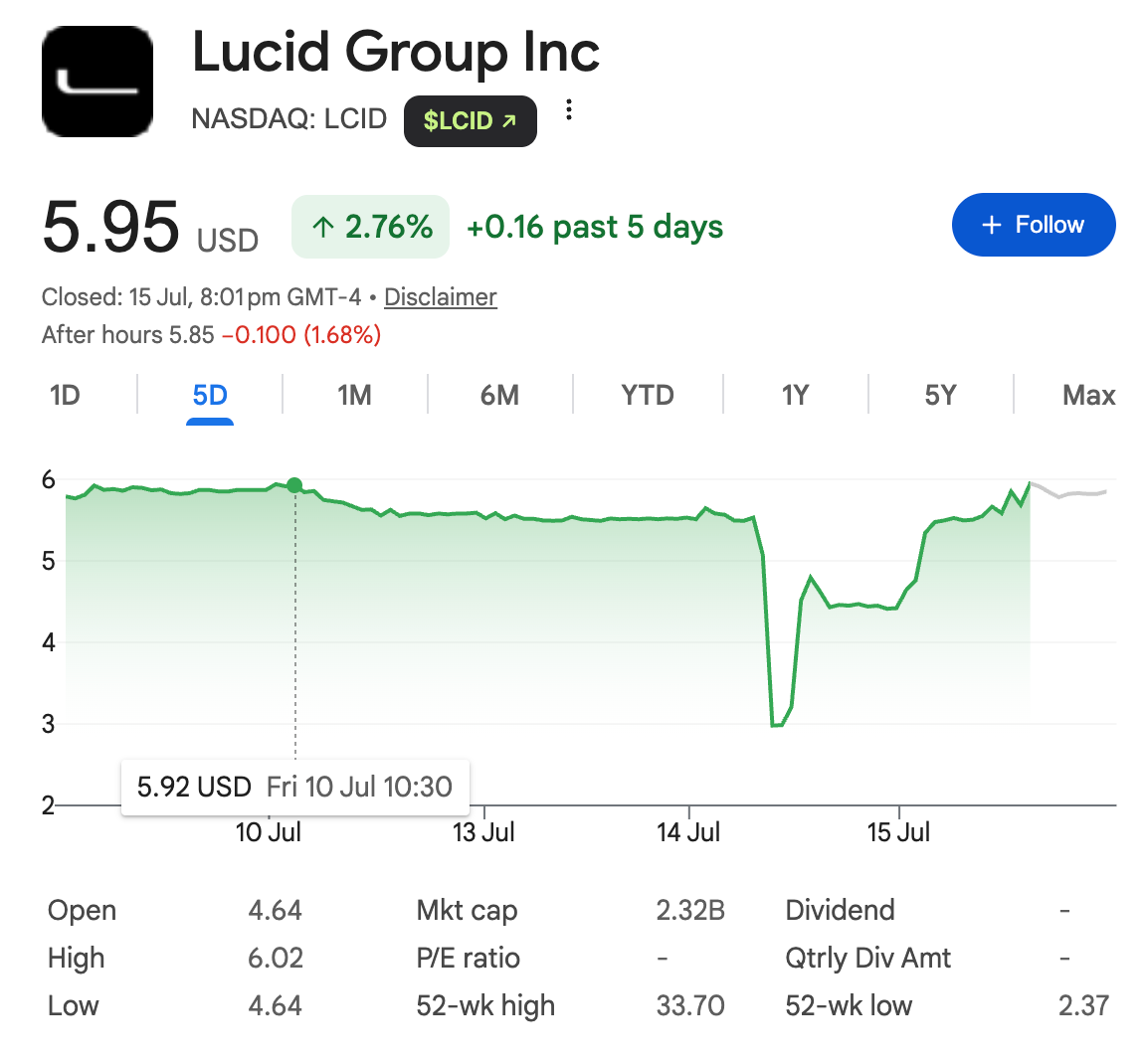
Lucid, the U.S. electric vehicle maker, saw extreme volatility during trading on July 14 local time after a market rumor said the company was considering bankruptcy protection. The stock at one point plunged 57% intraday, triggered multiple volatility halts, and logged its biggest intraday drop since listing.
The move did not last. Lucid later issued a statement saying it had hired consulting firm AlixPartners to conduct a full operational review aimed at improving operations, cutting costs and advancing new vehicle development, but the bankruptcy claim was "entirely false." The company also said it had sufficient liquidity to support operations into next year, and that AlixPartners was working only on operational optimization and had not made any bankruptcy recommendation to management or the board.
After that rebuttal, sentiment improved quickly. Lucid shares rebounded from the session low and eventually closed down about 16%. For holders of the stock, the day became a violent round trip. For another group of investors, the story ended during the plunge itself.
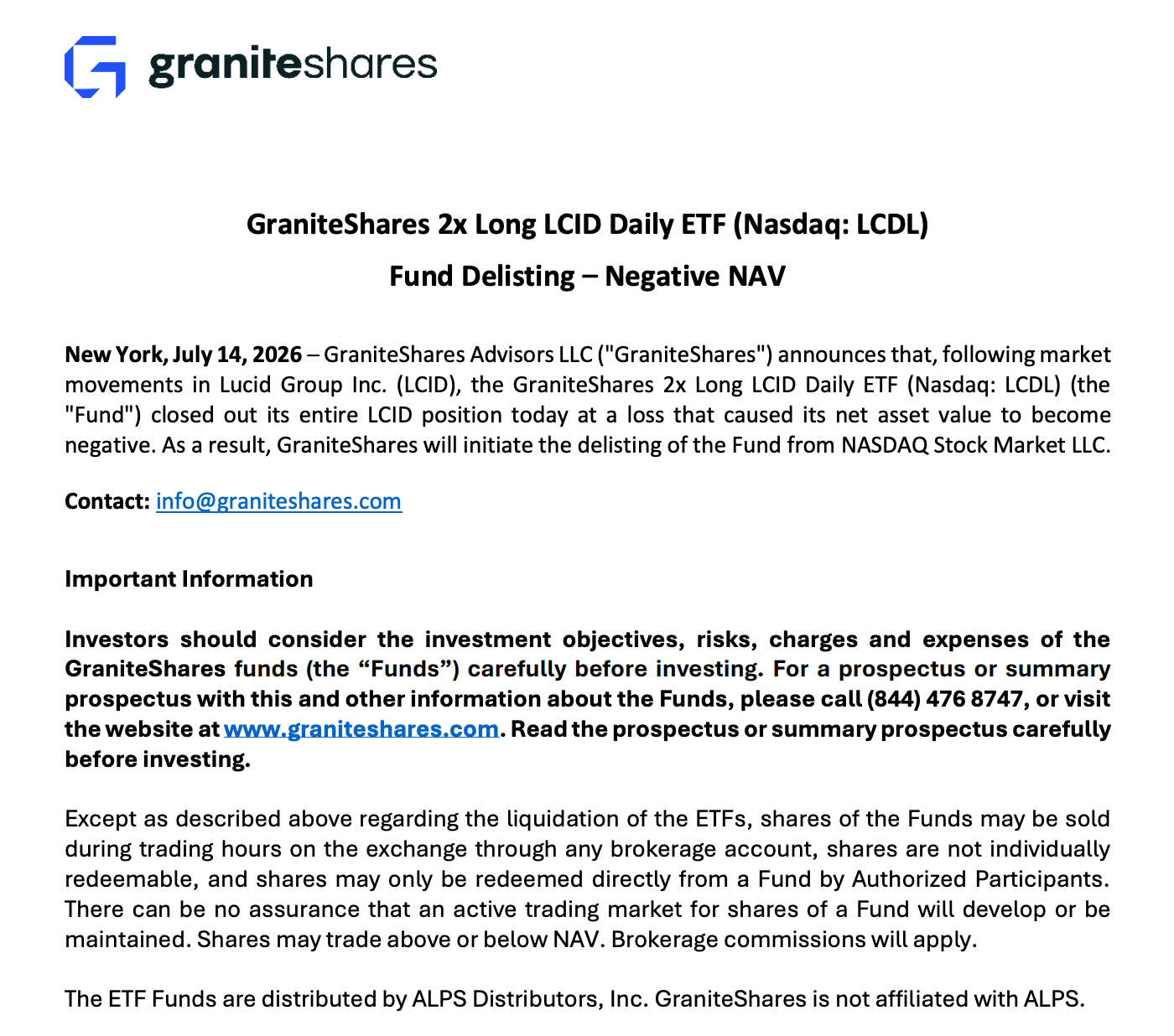
GraniteShares 2x Long LCID Daily ETF, ticker LCDL, which tracks Lucid with 2x long exposure, was effectively wiped out during the selloff. GraniteShares later confirmed that the fund had closed all LCID positions that day and would formally begin delisting procedures because its net asset value had fallen below zero.
That detail matters. By the time Lucid stock bounced, the ETF no longer had any position left to rebuild its NAV. Investors in LCDL therefore had no way to participate in any subsequent recovery in LCID.
This is the key difference between a single-stock leveraged ETF and simply holding the stock. A stock can crash and still leave investors with the option of waiting, as long as the company remains in business. A leveraged ETF can hit a point where liquidation or delisting cuts off that option entirely, even if the underlying later regains part of its losses.
South Korean regulators are weighing tighter rules
The delisting of LCDL is not being treated as a one-off event. As single-stock leveraged ETFs spread across AI-related trades, regulators have started taking a harder look at the risks. South Korea stands out in Odaily’s report.
According to The Korea Times in mid-July, four major financial authorities — the Ministry of Economy and Finance, the Financial Services Commission, the Financial Supervisory Service and the Bank of Korea — plan to hold a dedicated meeting under the government’s F4 macroeconomic and financial coordination framework to discuss the risks of single-stock leveraged ETFs and possible regulatory responses. Options under discussion include raising margin requirements, restricting daily price swings and lowering leverage multiples.
Retail participation in South Korea’s stock market has climbed for years, and the AI trade has become close to a nationwide investing craze. Heavyweights such as Samsung Electronics and SK Hynix have drawn concentrated flows, while leveraged ETFs tied to those stocks have amplified both enthusiasm and volatility. The concern from regulators is that when more investors turn to high-leverage products to chase crowded trades, a single sharp market move may stop being just a portfolio problem.
Concern is shifting from market losses to social fallout
As memory-related shares have come under pressure, the South Korean market has also seen a string of extreme episodes. Odaily noted that social media has circulated claims of suicides tied to stock investment losses. It also cited a report from The Chosun Daily saying a YouTuber in Busan who ran a stock investment channel was repeatedly stabbed by a man in his 20s on the street. Police said in a preliminary investigation that the suspect was a subscriber who had suffered heavy losses after following stock recommendations from the channel and attacked out of resentment.
Odaily said those incidents were not directly caused by single-stock leveraged ETFs. Even so, regulators may read them in the same way: if high-risk investment tools become easier to access and are combined with social media distribution and livestream stock-picking, financial risk can spill beyond the market itself and turn into a broader social issue.
That is the outcome South Korean authorities appear most concerned about.