
Lumentum reported fiscal 2026 fourth-quarter and full-year results for the period ended June 27, with quarterly revenue rising above $1 billion for the first time. In the same earnings release, the optical and photonics company posted a GAAP net loss of $7.162 billion.
According to the company, AI data centers are pushing demand for higher-speed, higher-bandwidth connectivity into optical links. It also said the large GAAP loss was mainly tied to a one-time, non-cash loss on debt extinguishment recognized after settling part of its convertible notes in common stock.
Revenue kept rising as the growth streak extended
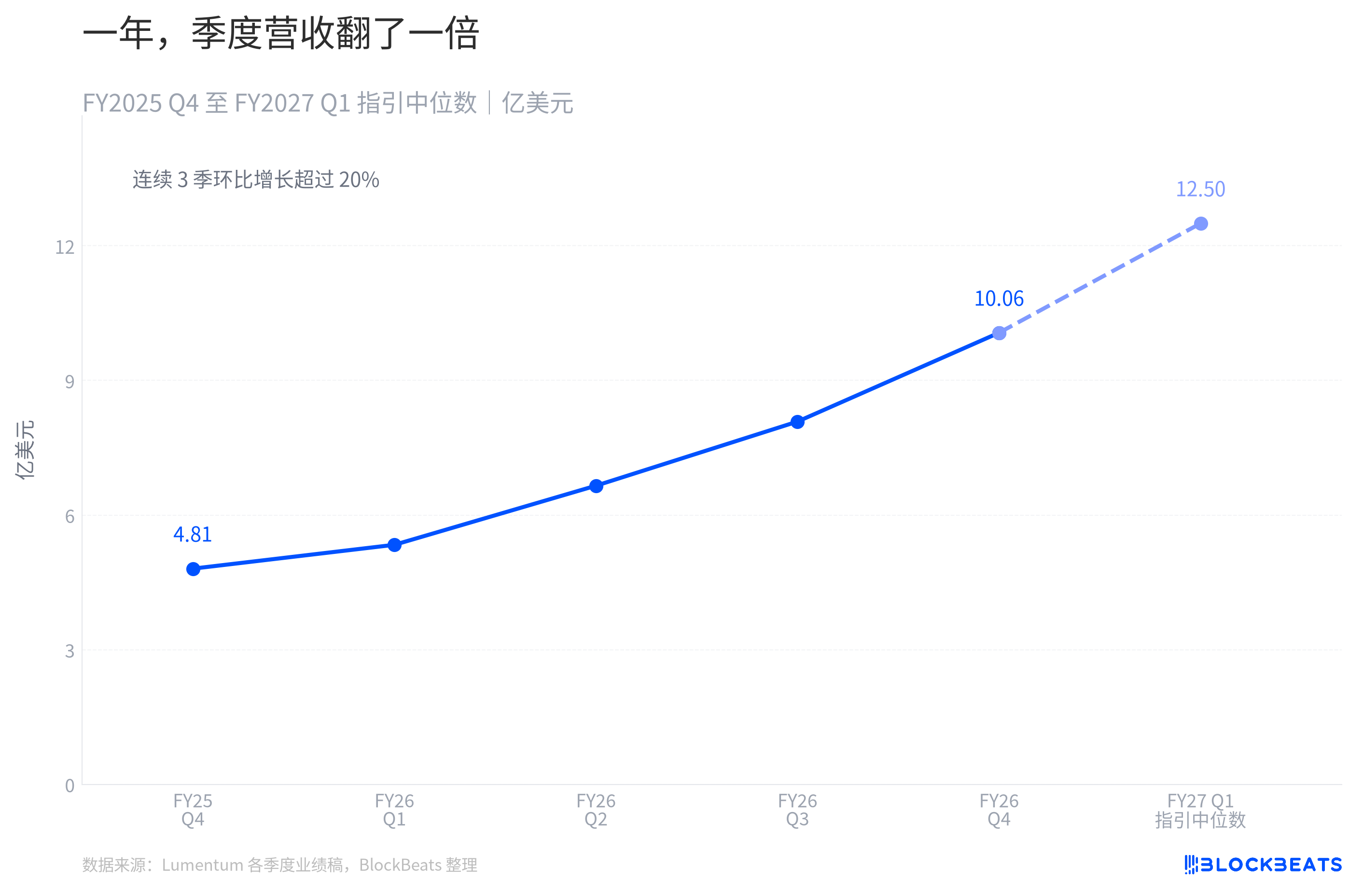
The key point in Lumentum’s recent revenue chart is not a single peak quarter but the fact that the slope has stayed intact. In its earnings presentation, the company said the fourth quarter marked its eighth consecutive quarter of revenue growth, and sequential increases in the last three quarters of fiscal 2026 each exceeded 20%.
Based on the company’s quarterly earnings releases, revenue in the latest quarter increased 109.3% from a year earlier.
Lumentum gave revenue guidance for the next fiscal quarter with a midpoint of $1.25 billion. That figure remains management’s forward-looking view, not booked revenue, and it should not be treated as a direct stand-in for orders. Looking across the company’s recent run of quarter-by-quarter gains, the $1 billion mark appears as one point on a continuing climb rather than a standalone break.
There is also an important limit in the filing. Management listed optical circuit switching, cloud modules and co-packaged optics as future growth drivers, but the company did not break those items out into quarterly revenue figures that can be added up directly. What the filings confirm is revenue growth at the aggregate level. They do not support a reverse calculation of how much any one new product has already contributed.

Both Systems and Components expanded
Lumentum groups its products into Components and Systems. Under the company’s definitions, Components include laser chips, subassemblies and wavelength management systems that customers integrate into larger platforms. Systems include cloud transceiver modules, optical circuit switching systems and industrial lasers that can be delivered as finished products.
Both segments grew in the fourth quarter. According to the earnings release, Systems revenue rose 122.6% year over year, while Components revenue increased 102.7%. Systems grew faster, but Components still accounted for nearly two-thirds of total revenue.
That helps explain the shift in mix. The company’s legacy device base was not replaced by newer businesses. Instead, new delivery formats were added on top of an expanding core, lifting total revenue higher.
Management tied the drivers on the Components side to scale-out and scale-across optical devices, and on the Systems side to record cloud transceiver module shipments. In fourth-quarter presentation materials, Lumentum said 1.6T transceiver modules have started shipping, while the ramp in optical circuit switching systems, or OCS, remains on plan. It linked that trend to strengthening demand under a multi-year procurement agreement worth tens of billions of dollars.
The operative word there is demand, not itemized recognized revenue. The charts do not show that any single cloud customer or one new technology alone carried the growth. What they do show is that Lumentum sits across both device supply and system delivery, with the latter scaling faster.
Margin expansion says more than revenue alone
Revenue growth is the easiest metric to spot, but margin movement often says more about manufacturing efficiency and product mix. Based on the company’s quarterly disclosures, Lumentum’s non-GAAP gross margin improved from 37.8% to 50.4%. That means the amount left after direct costs on each dollar of revenue widened materially.
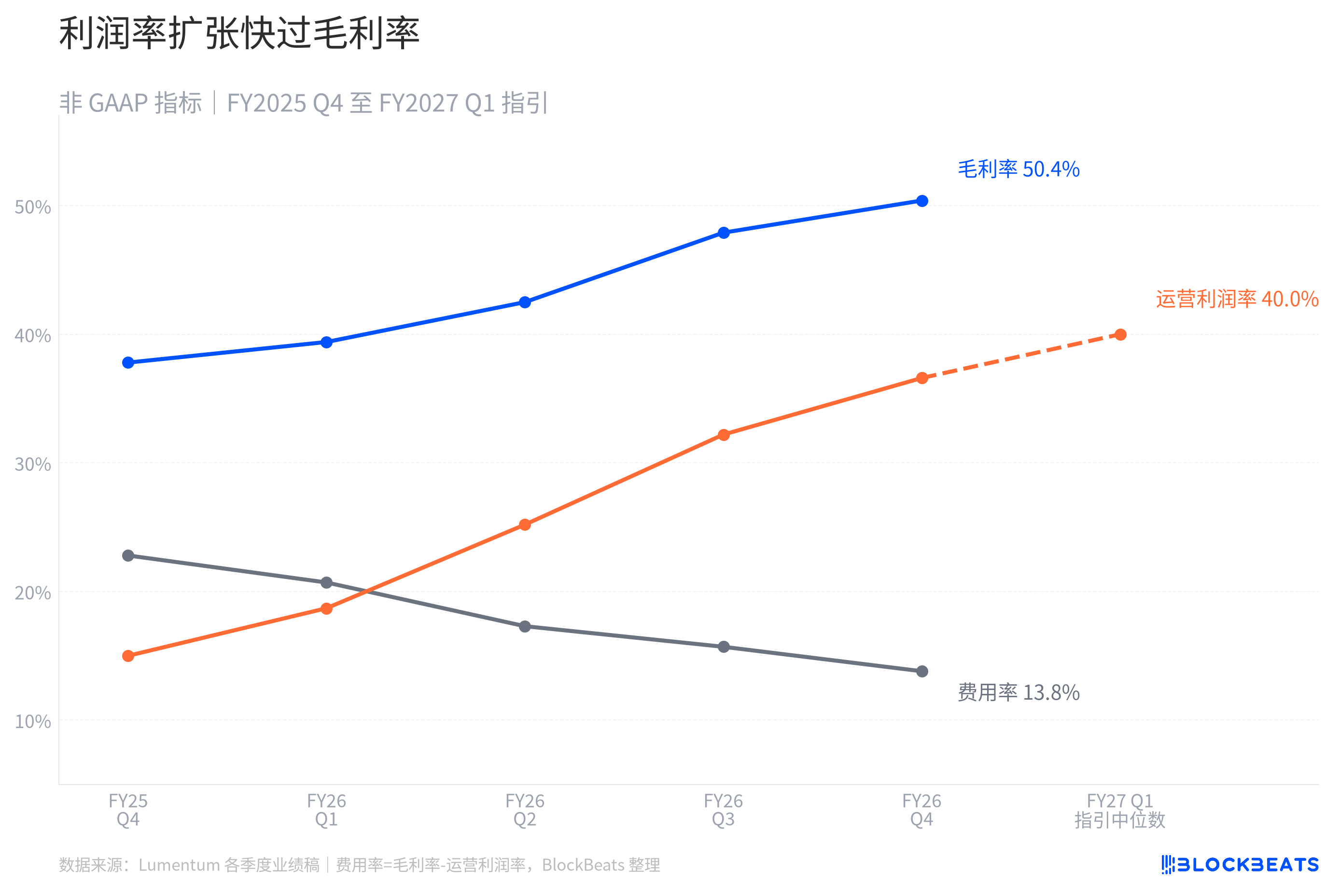
The move in operating margin was even steeper. Non-GAAP operating margin climbed from 15.0% to 36.6%. Using the company’s disclosed non-GAAP gross margin and operating margin, the operating expense ratio moved lower through the period. Better gross margin, paired with a declining share of expenses relative to revenue, allowed operating profit to rise faster than sales.
That chart is not the same thing as the GAAP income statement. The company said its non-GAAP figures exclude stock-based compensation, acquisition-related costs, amortization of intangible assets, restructuring charges and losses on debt extinguishment. The measure is useful for tracking what Lumentum defines as ongoing operating performance, but it does not replace GAAP results.
Lumentum also guided to non-GAAP operating margin of 39.5% to 40.5% in the next fiscal quarter. That number is forward-looking as well.
Put more plainly, the story is not just that revenue is getting bigger. The share of research, selling and administrative costs spread across each dollar of revenue is coming down. For a company selling high-end optical components and systems, that shift can reveal more about whether growth is reaching operating results than a single quarter of higher sales on its own.
The $7.162 billion net loss came largely from accounting for convertible note settlement
The most counterintuitive part of the report sits below operating profit. Lumentum posted GAAP operating profit of $279 million in the quarter, but then recorded a $7.757 billion loss on debt extinguishment that pulled the final result sharply lower.

According to the company’s 8-K exhibit and earnings release, the charge was a one-time, non-cash item tied to settling part of its convertible notes in common stock. Most of it came from an accounting loss created when the conversion value exceeded the principal amount of the notes.
Regular other income and tax benefits were still present in the quarter, but they were not enough to change the outcome. Lumentum’s final GAAP net loss was $7.162 billion. In the same release, the company reported non-GAAP net income of $326 million. The two measures cannot be added together mechanically because the non-GAAP adjustments also include stock-based compensation, amortization and tax items.
The company also made clear that non-cash does not mean irrelevant to shareholders or to the balance sheet. The reported loss reflects the accounting treatment applied when the convertible notes were settled. It should not be translated directly into an equal amount of cash leaving the company during the quarter, and it also does not support the conclusion that every related settlement had no cash component.
A closer reading is that the company booked a capital structure change through the income statement in one step, rather than losing more than $7 billion from core operations in a single quarter.
That leaves this earnings report to be read in two parts: one operating statement shaped by AI-driven optical interconnect demand, and one accounting statement shaped by the equity settlement of convertible debt.