
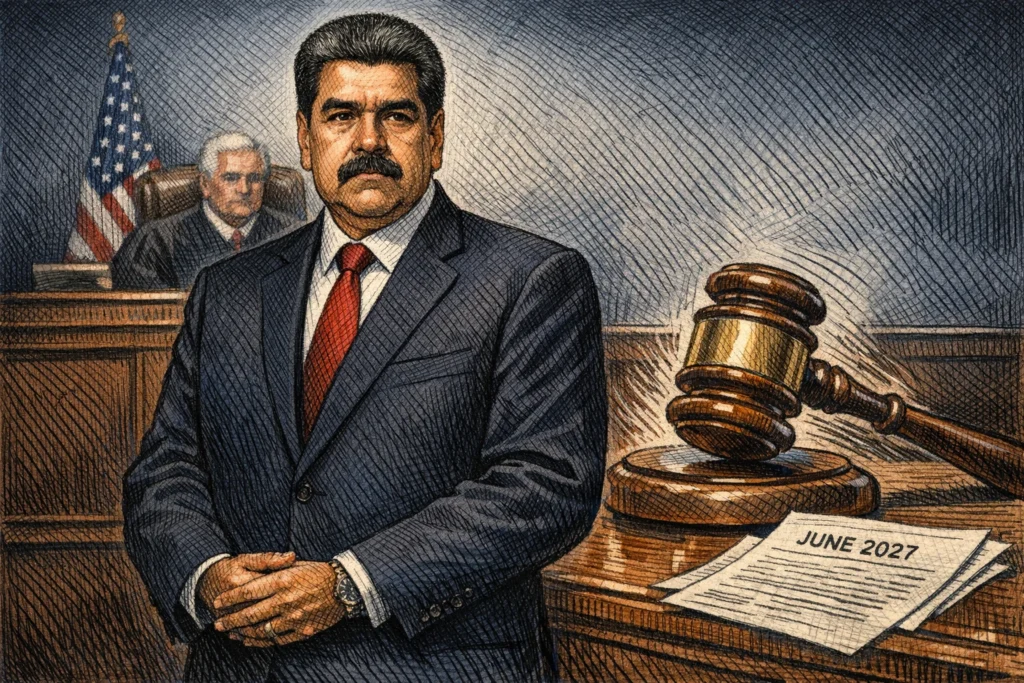
Six months after U.S. forces raided Caracas on Jan. 3 and took Venezuelan President Nicolás Maduro and his wife, Cilia Flores, to New York, their criminal case is only now getting a trial date. The U.S. District Court for the Southern District of New York has scheduled the trial for June 1, 2027, which would leave the couple in U.S. detention for more than 500 days by the time proceedings start.
Judge Alvin Hellerstein set the date on July 22. The Trump administration had described the capture as a “surgical law-enforcement operation,” but the courtroom fight has barely moved beyond threshold questions of procedure and jurisdiction.
Four felony charges filed in Manhattan
Federal prosecutors in Manhattan have charged Maduro with four felonies. The core counts are narco-terrorism conspiracy and conspiracy to import cocaine, with prosecutors alleging that he worked with drug trafficking groups to move thousands of tons of cocaine into the United States. If convicted on all counts, he could face life in prison.
Flores is charged in the same case. In addition to drug importation-related accusations, she also faces charges tied to possession of a machine gun and destructive devices. Both defendants have pleaded not guilty.
Defense to focus on immunity and the arrest itself
Maduro’s lawyer Barry Pollack has made clear that the first major fight will not be over the factual allegations. It will be over whether the case can proceed at all.
Pollack plans to move for dismissal on head-of-state immunity grounds, arguing that Maduro, as the leader of a sovereign state, is entitled to judicial immunity. If that argument succeeds, the case would not move into a full merits stage.
The defense is also expected to challenge the legality of the capture. The question of whether U.S. forces can seize a sitting head of state through a military operation on foreign soil and then present him in a U.S. criminal court is set to become part of the litigation.
Under the schedule submitted by the parties, the first motion to dismiss is due on Sept. 2, and oral argument is set for November. That puts the central issue for the second half of 2026 in plain view: whether a U.S. court has the authority to try this defendant at all.
One defense argument has already fallen away. Lawyers had previously said U.S. Treasury sanctions prevented the Venezuelan government from paying legal fees and interfered with the defendants’ right to counsel. That claim was withdrawn after sanctions relief in April.
Political and economic changes continued in Venezuela
While the case has moved slowly in New York, developments inside Venezuela have come faster. After Maduro was detained, Venezuela’s Supreme Court appointed Vice President Delcy Rodríguez as acting president. On April 1, the U.S. Treasury removed Rodríguez from the SDN sanctions list.
Since January, the Office of Foreign Assets Control, or OFAC, has issued multiple general licenses easing restrictions on energy and mining. Venezuela’s National Assembly also gave initial approval on Jan. 23 to a bill that would allow private companies to explore for and produce oil on their own, a step that had been barred during the Chávez and Maduro eras.
The export figures also shifted. Venezuela’s crude exports rose from 489,000 barrels a day in December 2025 to about 800,000 barrels a day in February 2026. Trump said the United States would “manage this country, until there can be a safe, proper and prudent transition.”
The indictment does not mention crypto
Blockchain intelligence firm TRM Labs said its review of the superseding indictment found no references to cryptocurrency, stablecoins, wallets, exchanges, or on-chain transfers. The prosecution’s theory follows a conventional criminal route: diplomatic cover, institutional protection, bribery, and the recycling of drug proceeds back into power structures and weapons.
That matters for two reasons presented in the report. First, when the U.S. government prosecutes a head of state, it appears to use the charges it sees as the strongest, not the newest. Second, market expectations that Maduro’s alleged crypto empire would be laid out in court are not supported, at least not in the charging documents now on file.
The report also addressed online claims that Venezuela holds a shadow reserve of hundreds of thousands of bitcoin. It said those claims largely trace back to second-tier crypto media repeating one another, without on-chain proof or support from official records.
Stablecoins remain part of Venezuela’s financial infrastructure
The absence of crypto from the indictment does not mean digital assets are irrelevant to the broader story. In the report’s framing, crypto is not in the dock; it sits in the country’s financial plumbing.
Chainalysis estimated that Venezuela recorded $44.6 billion in crypto transaction volume between July 2024 and June 2025. A separate estimate cited by The Wall Street Journal, from economist Asdrúbal Oliveros, said that by late 2025 to early 2026 roughly 80% of the country’s oil revenue, about $12 billion a year, was being settled in USDT to bypass the U.S.-controlled banking system.
That flow has already drawn enforcement attention. On Jan. 11, Tether froze $182 million in USDT across five Tron wallets, one of its largest single-day actions. Tether said it follows OFAC sanctions rules and works with law enforcement, adding that the number of frozen Venezuela-linked wallets had reached 41.
The report said Venezuelans first turned to USDT because sanctions and hyperinflation left them with few alternatives. Banks were difficult to use, and the bolívar was hard to hold as a store of value, making stablecoins a substitute for dollars. Once that tool becomes everyday infrastructure, however, sanctions relief alone does not make it disappear. Payment rails are already in place, merchants are used to them, and public distrust in the domestic currency does not reverse simply because Washington changes policy.
Three dates to watch
- Sept. 2: Deadline for the defense’s first motion to dismiss, putting the head-of-state immunity argument into formal written briefing.
- November: Oral arguments on the dismissal motion, the clearest point for a major turn before the 2027 trial.
- June 1, 2027: Trial begins.