
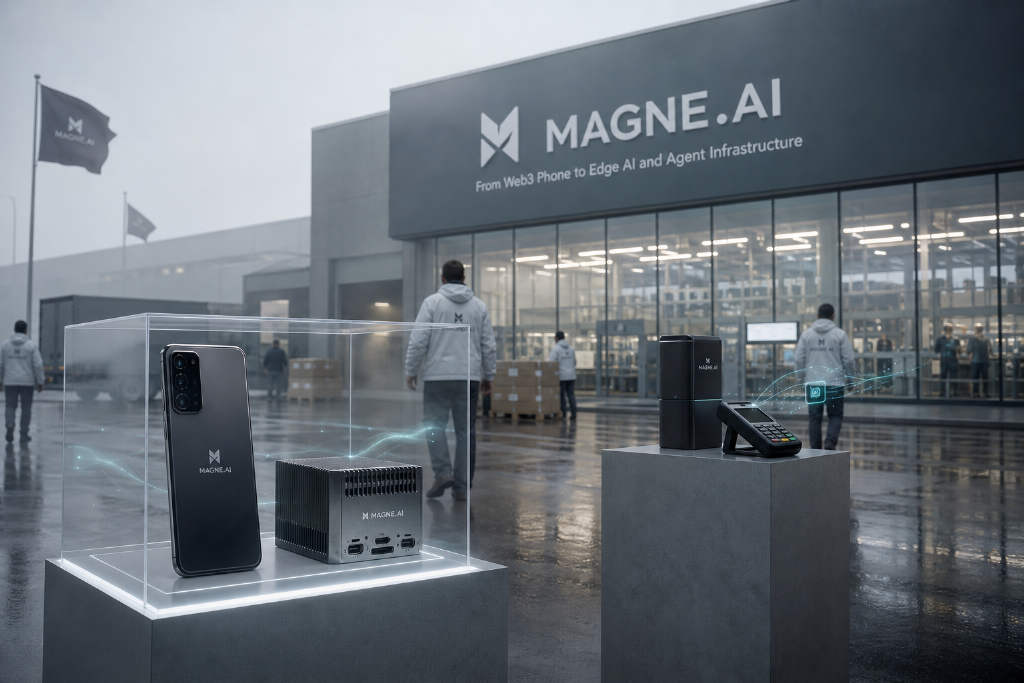
MAGNE.AI is moving beyond its original identity as a Web3 phone project and into a broader stack that spans edge AI, device identity, onchain settlement and agent payments. Based on RootData entries, public regulatory materials and the company’s own disclosures, a growing set of verifiable signals has emerged as of Aug. 23, 2026. What has not yet been proven at the same level is mass production, customer validation and live production payments.
Looking at MAGNE.AI only through the lens of a Web3 smartphone misses how much the project has stretched over the past six months. Financing updates, team records and event history remain trackable through its RootData page, while product, certification and engineering milestones are being published through MAGNE.AI’s official sites. The recent markers are concrete: a disclosed $2.64 million strategic follow-on round, Phone Gen1 reaching PVT P2, public FCC, GMS and GSMA TAC-related compliance materials, a public 3D engineering structure viewer for the handset, and testnet-facing evidence tied to MAGNE AI BOX and Agent Pay. Taken together, the company is extending its early “phone as the Web3 entry point” pitch into a route that covers hardware, edge computing, identity and machine payments.
That route is still in an engineering delivery phase. The most useful things to watch now are not the size of the vision, but whether the phone reaches production, whether AI BOX clears prototype validation, whether Agent Pay progresses on testnet, and whether community activity turns into actual device users. In that sense, MAGNE.AI is better judged on systems integration, delivery pace, public verification and operating continuity than on any one specification sheet or category label.
RootData and financing: a public trail is in place, but not every implication is proven
There has been market chatter around labels such as “Tier 1.5” or “Tier 2,” but RootData has not assigned MAGNE.AI a public unified tier rating. What can be checked is that the project has a RootData profile and appeared in RootData’s 2025 Web3 annual report, in the AI track funding Top 30 chart, based on a then-publicly disclosed $10 million financing figure.
On Aug. 5, 2026, MAGNE.AI announced an additional $2.64 million strategic round. The disclosed participants were GAEA Ventures, Titans Ventures and Go2Mars Labs. By the company’s own account, that brought cumulative public financing to $12.64 million. The stated use of proceeds covers engineering verification and commercial delivery for MAGNE AI BOX, integration between AI BOX and MAGNE L1/MHash L2, and research and development for MAGNE Agent Pay and x402-compatible payments.
$12.64 million does not, by itself, establish market standing. What it does provide is a continuing financing signal. After an initial strategic round in 2025, the company disclosed additional capital in 2026. The structure of the new round, funding status and rights arrangements, however, still come mainly from the company’s press release and would need more independent documentation to be confirmed in fuller detail.
From a third-party perspective, public materials now show fairly clear pre-TGE preparation signals, but they do not prove that a token generation event or an exchange listing is imminent. MAGNE.AI’s official milestone page lists exchange due diligence, token disclosure, protocol audits, exchange coordination and market-making or liquidity arrangements as ongoing items. It also labels the TGE preparation checklist and listing window as planned items, explicitly subject to legal, audit, exchange, liquidity and operational conditions. Season 2 materials also link later MHA distribution and future TGE arrangements.
When combined with the follow-on financing, those updates make “TGE is being prepared” a reasonable market reading. A stricter formulation is still needed, though. Until full audits, final token contract or mainnet information, a fixed date, or exchange announcements are public, the available record supports “preparing for TGE,” not “TGE is about to happen.”
Phone Gen1: the handset is not obsolete in this model, it is the first trusted endpoint
MAGNE Phone Gen1 is not being sold on flagship consumer-electronics specs alone. The current official specification page lists a UNISOC T9100 5G SoC, an IMG AX3596 10 TOPS INT8 NPU, up to 12GB RAM and 512GB UFS 3.1 storage, Android 15, a 5000mAh battery and a 6.78-inch 120Hz display.
The sharper point of differentiation sits in a three-layer security structure built around key custody, recovery and isolation. Trusted execution is handled through TEE isolation. A separate secure element is used for private-key storage and signing. An NFC recovery card moves offline backup outside the device itself. In practical terms, that makes the MAGNE phone look less like a standard Android device with a wallet app added on top and more like a daily-use hardware wallet plus an agent control terminal.
Inside the broader MAGNE stack, the handset is not just an end-consumer product. As personal agents begin calling external services, requesting permissions and initiating payments, the phone can function at once as an identity carrier, a human authorization interface and a secure signing terminal. Its role in the stack shifts from consumer device to network entry point.
Engineering progress is better reflected in production and compliance traces than in raw specs. The official progress page says Phone Gen1 has completed Pre-EVT and EVT P1 and is now at the PVT P2 production validation stage. Design freeze, component procurement and manufacturing partner alignment are marked complete, with first-batch manufacturing targeted for the third quarter of 2026.
Public FCC records add another checkpoint. The filing tied to FCC ID 2BVCPGC603606 covers test materials for cellular communications, Wi-Fi, Bluetooth, NFC, EMC and SAR. The project has also launched a 3D engineering structure viewer for the phone. That page lists 31 visible components, including 6 STEP precision parts, 13 V51 appearance parts and 12 modeling supplement parts, allowing users to inspect the enclosure, camera sections and core structure layer by layer.
A web viewer is not a substitute for production acceptance. It does show that the team is willing to make industrial design, internal stacking and product structure part of its public communication. In a DePIN sector that has often faced “PPT hardware” skepticism, that kind of engineering transparency has value on its own.
AI BOX: the route expands from personal hardware to enterprise edge AI
If Phone Gen1 is aimed at individual users, MAGNE AI BOX opens a larger commercial path in private AI and edge computing for enterprises. Its specifications, validation boundaries and Release Gate status are being published through W3.MAGNE.AI.
The product logic is straightforward. Models, knowledge bases and agents are meant to run locally as much as possible. Raw enterprise files are not directly put onchain. The chain keeps device identity, task summaries, authorization status and settlement receipts. High-risk tool calls or payment requests still require human confirmation through a bound phone or wallet, while private keys stay out of the model. By that design, the box is not just a smaller cloud server. It is presented as a controllable physical boundary for enterprise AI.
The public specification control page lists a 56 TOPS INT8 NPU, bandwidth above 600GB/s, AI power consumption of 8–15W, and a 34GB/38GB capacity list composed of main system memory, NPU-adjacent memory and expandable memory. At the same time, the page clearly marks some items as “vendor declared” or “requires testing,” and says that the summed capacity figures do not equal one unified pool of available memory.
That separation matters. The page distinguishes among PDF configuration, vendor declarations, verified items and pending tests. It states that a Q4_K_M artifact of Qwen3.6-35B-A3B has completed its first local runtime validation. The project is currently at Gate 0, the specification freeze stage. Gate 1 is set to build three prototypes for performance, power, thermal, offline, security, upgrade and recovery testing, followed by design-partner validation and then a small-batch stage.
This suggests the technical team is not treating hardware industrialization as simply “build a demo box.” It is already using a Release Gate structure to manage risk from specifications to prototype work, customer validation and small-batch preparation. For outside observers, AI BOX also expands MAGNE.AI’s commercial reach from crypto-native users toward fintech firms, digital asset institutions, Web3 teams and enterprise buyers that want local knowledge boundaries.
Agent Pay: where hardware signing, identity and onchain payment are meant to meet
One of MAGNE.AI’s more notable technical developments is Agent Pay. x402 uses the HTTP 402 status code to let a server return pricing and payment requirements. After authorization, an agent can make the payment and request the resource again. That creates a machine-payment route for APIs, data, inference and digital services without relying on a traditional account stack. Cloudflare has already introduced x402 payment capability in its Agents SDK, which shows agent-native payments moving into the developer tooling layer.
MAGNE Agent Pay is meant to place x402-related payment flows inside a device identity and hardware-signing environment. According to the current official status page, the project has shown a local contract demo and testnet evidence. End-to-end HTTP 402 flow remains under development. MHash L2 receipts are on a testnet path. Production payments are not open.
The intended control chain is explicit. An agent initiates a request. Policy checks permissions and budget. High-risk actions move to human confirmation. The phone or wallet signs the payment. The system then generates a task receipt. In this design, computation is handled by AI BOX, identity by MAGNE L1, and authorization and settlement records through MHash L2 and Agent Pay. The cross-module loop still needs public testnet transactions and third-party service integrations before it can be treated as validated.
This also explains why MAGNE.AI is building a phone, AI BOX, L1, L2 and payments at the same time. Each layer on its own is not rare. In combination, the stack is trying to answer four practical questions in the agent economy: where the model runs, how a device proves identity, who authorizes machine spending and how transactions leave an accountability trail.
Operating model: turning engineering progress into trackable public information
Over the past year, one of MAGNE.AI’s clearer strengths has been steady disclosure and structured milestone presentation.
First, the project leans heavily into what could be called transparency-driven marketing. Many teams try to win attention with large narratives. MAGNE.AI has instead made FCC lookup pages, GMS support materials, GSMA TAC data, PVT progress, 3D engineering structure files, AI BOX gates and Agent Pay status pages publicly browsable. Not every user will understand each engineering artifact, but the cumulative effect is simple: the team appears to be dealing with certifications, supply-chain work and testing issues that real hardware projects run into.
Second, the milestones have been staged in sequence. After the phone produced a set of security and compliance disclosures, AI BOX was introduced to extend the direction toward enterprise edge AI. Agent Pay then connected AI BOX, the dual-chain structure and x402 research. Financing updates and Season 2 picked up institutional and community attention on separate fronts. The narrative is continuous, but each capability still needs to be described according to its real validation stage.
Third, the project presents different entry points for different audiences. Consumers see the phone, wallet and NFC recovery flow. Institutions see certifications, data-room style disclosure and manufacturing stage signals. Developers see L1, L2, x402 and Agent Pay. Community users engage through Season 1 and Season 2 device distribution and points mechanics. That mix suggests the team is building more than social-media visibility. It is building a market-facing structure aimed at product users, capital, developers and community participants.
For hardware projects, that operating layer is not separate from execution. Hardware cycles are long and expensive to explain. Teams need a way to keep turning intermediate progress into verifiable information if they want supply chains, investors, developers and communities to understand what stage the product is really in. MAGNE.AI has already established a fairly complete public-information path. The next test is whether those disclosures stay aligned with actual delivery.
Technical posture: not a base-model inventor, but a systems engineering team
MAGNE.AI’s technical team is not best evaluated by asking whether it built a proprietary foundation model. Phone Gen1 uses mature mobile SoCs, NPUs, secure elements and the Android ecosystem. AI BOX is adapting the open-source Qwen3.6-35B-A3B model. Agent Pay is built on open standards including x402 and ERC-20.
That means the team’s edge, if any, lies elsewhere. It is not trying to replace chip vendors, Google, Qwen or protocol ecosystems. It is trying to fit mature capabilities into one product architecture and bridge edge optimization, security isolation, authorization state machines, device identity and onchain settlement. That is closer to a strong systems engineering and productization profile than to frontier model research.
It also suggests discipline around what to build in-house and what to borrow from supply chains and open ecosystems. The phone, the box, the chains and the payment layer all need interfaces that work together. Consumer hardware must also survive EVT, PVT, certification, recovery, upgrades and after-sales realities. Public materials indicate the team understands that distinction.
Another notable point is the restraint in how the engineering claims are expressed. The AI BOX page marks vendor declarations, pending tests and gate conditions. The security page says EAL levels correspond to specific components or evaluation ranges and should not be generalized to the whole device. The Agent Pay page separates testnet evidence, features under development and production payments that are not yet available.
That kind of boundary-setting helps outside readers understand the product by engineering status rather than marketing finish. Based on the public record, MAGNE.AI’s technical approach can be summed up as borrowing strength without losing control: use mature supply chains to avoid the cost of building hardware from scratch, use open-source models to shorten edge-AI development time, and keep control over the more distinctive parts, namely security architecture, device identity and the payment-control layer for agents.
In the current Web3 environment, the combination of steady operations and pragmatic engineering may support a transition from prototype to delivery. The final proof still has to come from production, customer use and public network data.
Season 1 and Season 2: more than giveaways if devices become network endpoints
Community operations are also tied to the product route. MAGNE.AI’s progress page says Season 1 drew 76,650 unique onchain addresses. That number represents participating addresses, not final device users or delivered units.
Season 2 published a more explicit set of rules: 1,600 campaign devices, 17 USDT per participation, one phone draw triggered for every 100 valid participations, and the use of MS2 as an event record and later qualification credential.
If the phone is treated as a standard consumer device, this is a user-acquisition campaign. If the phone is treated as an endpoint with hardware signing, onchain identity and future agent capabilities, then the Season mechanism also serves device distribution, address accumulation, onchain behavior education and network cold start.
That is where MAGNE.AI’s operating and technical routes align most clearly. Operations create participation through campaigns. The technical stack then links participation records, devices, identity and future network rights. If shipping, activation and persistent online data emerge on schedule later, those campaigns may become an early base layer for network scale rather than just attention.
What the market still needs to see
Projects that try to build hardware, chains and payments at once are often criticized for overextending. That concern still applies here. Recent disclosures also offer another reading: a full stack is not only a larger product count, it can also be a test of organizational coordination.
In MAGNE.AI’s current design, the phone provides the user entry point and secure signing, AI BOX handles local models and enterprise knowledge boundaries, L1 carries device identity and ownership logic, L2 provides lower-cost execution, Agent Pay manages service calls and settlement, and Season campaigns handle community cold start. The modules now show clearer causal connections to one another rather than reading like unrelated products assembled side by side.
That is why the central question is not whether every piece has already succeeded. The better question is whether MAGNE.AI can organize capital, supply chain work, hardware, AI, blockchain and community into a delivery path the market can verify. Certifications, PVT stages, model adaptation, payment controls and community campaigns have all left public traces. The outcome still depends on the next set of data.
The harder milestones ahead are straightforward. Phone Gen1 needs to complete first-batch production and delivery. AI BOX prototypes need to pass performance, power, thermal and offline security tests. Design partners need to validate the product through real contracts or knowledge-base tasks. Agent Pay needs publicly reviewable third-party service payments on testnet. Season participation addresses need to convert into real device users and active network nodes.
Those checks are not side challenges. They are the path from an engineering signal story to a scaled delivery story. MAGNE.AI has not completed that transition yet, but it has published enough material for the market to keep tracking it. Financing, team and event updates remain visible through MAGNE.AI’s RootData project page. Phone, certification and production progress are on the company’s official website. Technical status for Agent Pay and AI BOX is being published through W3.MAGNE.AI.