
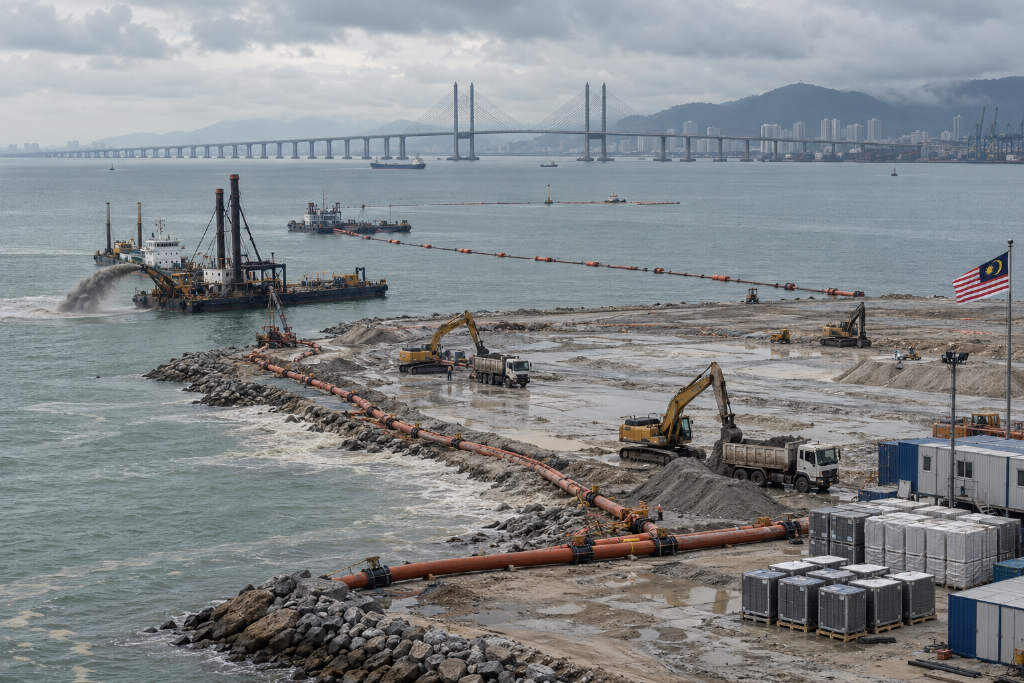
Malaysia is reclaiming land off the southern coast of Penang to build Silicon Island, a 2,300-acre artificial island meant to draw AI chip and semiconductor investment. In an on-site report published by Bloomberg on Oct. 8, excavators, dump trucks and orange pipelines carrying fill material were described as slowly turning a stretch of blue-green sea into new land.
The island is expected to be completed at some point in the next decade. Bloomberg said its area would be close to three times the size of New York’s Central Park. The project is being cast as a way to reinforce Malaysia’s position in the global semiconductor industry, with expectations that it could add hundreds of billions of dollars to the economy and create about 220,000 jobs by 2050.
Penang Chief Minister Chow Kon Yeow told the state assembly in November last year that Silicon Island is expected to attract RM74.7 billion, or about $18.3 billion, in investment. He also said it could contribute as much as RM1.1 trillion, or about $269 billion, to Malaysia’s GDP by 2050.
Those figures are projections rather than current results. The gap between the site activity and the official targets comes down to three issues raised in the report: why Penang was chosen, whether the construction pace is sufficient, and whether the project’s planning foundation is secure.
Penang is pitching scarce industrial land to a chip supply chain
In an August report, Bloomberg cited the International Monetary Fund as saying Malaysia is already one of the world’s four largest net exporters of AI-related hardware, alongside South Korea, Taiwan and Thailand. HSBC analysts estimated that data center investment in Malaysia has reached nearly 18% of GDP, the highest level in the world.
Penang’s shortage is land. In a July article on the developer’s website, the company said Silicon Island sits next to the Bayan Lepas Free Industrial Zone, a manufacturing base that dates back to the 1970s and has seen industrial land become increasingly scarce. Intel, AMD and Infineon already operate facilities in Bayan Lepas. Silicon Island is being positioned as new expansion space for that cluster and as a way for Penang to move from back-end assembly and testing toward IC design and advanced packaging.
That was not the project’s original purpose. According to a summary by Malaysian media outlet Citizens Journal, the starting point was transport funding. The state government wanted to push ahead with the Penang Transport Master Plan, but the federal government would not fund it, so the state turned to land reclamation and land sales as a financing method. Chow told the state assembly that revenue sharing from land sales with the developer is expected to bring the state government RM14.2 billion.
Three years in, reclaimed area stands at roughly 21%
The schedule remains a central question.
In September 2024, state executive councillor Zairil Khir Johari said the government hoped to reclaim 1,000 acres by the end of 2025, with the first factory starting construction in 2026 and operations beginning in 2027. At that point, 40 acres had already been reclaimed.
By September 2026, state assembly member Joshua Woo Sze Zeng said the project had entered its fourth year. More than 480 acres had been reclaimed, equal to 21% of the 2,300-acre target. Total spending had reached RM1.9 billion, or about $465 million, and the project had created jobs for more than 900 Malaysians.
For the roughly 700-acre Green Tech Park, the developer’s earlier article listed the operating timeline as "as early as 2028."
The official goal is to complete the full reclamation by 2032. Based on the 480 acres already finished, about 1,820 acres remain. That would require an average pace of about 300 acres a year over the next six years. From the September 2023 start of construction to now, the average has been about 160 acres a year, so the pace ahead would need to be close to double what has been achieved so far.
Court ruling leaves a licensing dispute unresolved
The project is also facing questions over its legal footing.
On June 30, 2026, the Court of Appeal unanimously dismissed an appeal from seven fishermen and two environmental groups, including Sahabat Alam Malaysia (SAM), on the grounds that it was filed out of time. At the same time, the court found that the director of the Penang State Planning Department and/or the State Planning Committee had no power to issue the planning permission for the reclamation project.
SAM honorary secretary S. Mageswari Sangaralingam said, on that basis, that the Penang government "is currently constructing an island without valid planning approval."
Broader supply-chain scrutiny has also reached Penang
Questions around Penang’s role in the chip supply chain have surfaced outside Silicon Island itself. A Sept. 6 report by The New York Times alleged that Penang-based electronics contractor Innospec received chips and parts from Aivres, a U.S. subsidiary of blacklisted Chinese company Inspur, and then passed them to Chinese IT companies.
Innospec denied the allegation in comments to Free Malaysia Today on Oct. 3. The company said, "We assemble components for customers. No parts involved any sensitive technology transferred from the United States to China," and added that all materials were supplied on consignment by clients and could only be returned to the original consignor.
The allegations concern a Penang contractor rather than Silicon Island itself. Even so, they show that the chip supply chain Penang wants to attract is operating at the edge of U.S.-China controls.
Land reclamation is an engineering challenge. Whether chipmakers will eventually move onto the island, the report said, will depend on the courts, the White House and the next election.