
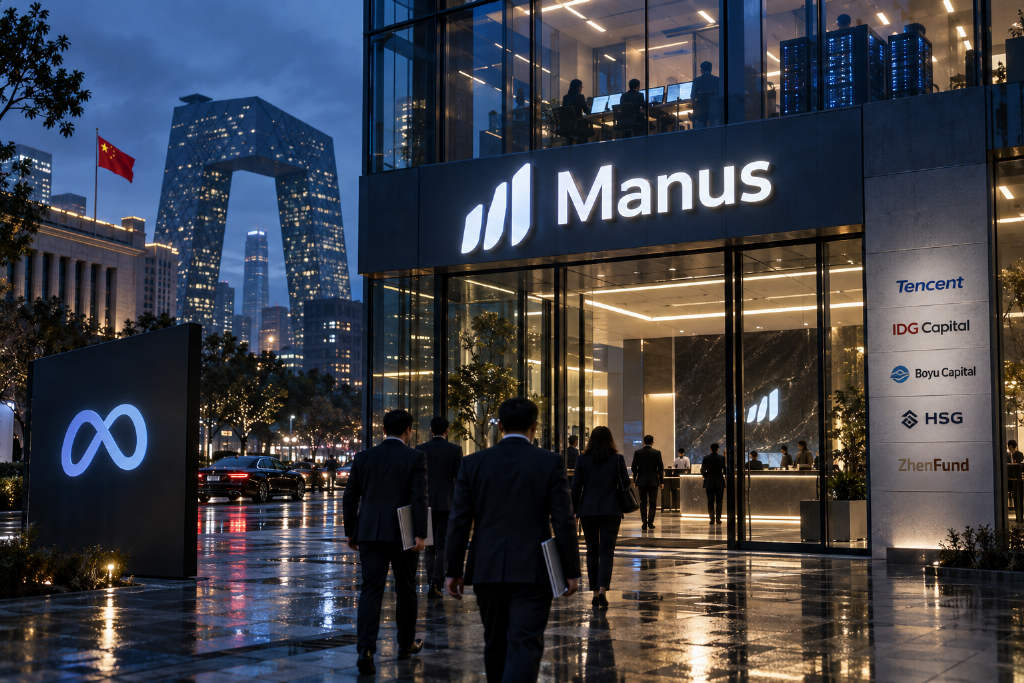
Manus, the AI agent startup that Meta had agreed to acquire for about $2 billion before Chinese authorities forced the deal to be withdrawn, has raised more than $500 million in fresh funding.
Its parent company, Butterfly Effect, confirmed the round in a WeChat post. Boyu Capital and IDG Capital led the financing, while existing investors Tencent, HSG, the firm formerly known as Sequoia China, and ZhenFund also joined.
Funding confirmed, valuation not disclosed
Butterfly Effect did not say how it plans to spend the new capital. It only said the company will continue hiring in China and overseas.
The company also did not disclose a valuation. Bloomberg had previously reported that Manus was seeking to raise $500 million at a $4 billion valuation, roughly double the price Meta had agreed to pay.
What Manus builds
Manus develops AI agents, software that goes beyond answering prompts like a chatbot and instead takes a goal and carries it out on its own. The examples cited in the report ranged from booking trips to analyzing stocks.
When the product launched in March 2025, it was pitched as a Chinese rival to OpenAI’s invitation-only agent product priced at $200 a month.
Demand quickly surged. Invite codes were reportedly listed on a Chinese resale marketplace for as much as 10 million yuan, or more than $1.3 million.
On the model side, the company said it used Anthropic’s Claude and fine-tuned versions of Alibaba’s Qwen models alongside its own technology.
The report said Manus was experimenting with agentic AI before the biggest AI companies had fully turned their attention to that use case.
Shift to Singapore and layoffs
Around the middle of 2025, Manus moved its team to Singapore, shut most of its China operations, and laid off dozens of employees in July.
Revenue growth and Meta’s acquisition plan
By December 2025, about eight months after launch, Manus had reached $100 million in annual recurring revenue, the yearly total of its subscription business.
That same month, Meta announced that it would acquire Manus for roughly $2 billion.
OpenClaw drew attention as OpenAI hired its creator
Attention later shifted to OpenClaw, an open-source agent that runs on a user’s own machine and takes instructions through apps such as WhatsApp and Telegram.
Within weeks of going viral, OpenClaw collected well over 100,000 GitHub stars, a developer bookmarking metric.
OpenAI then hired OpenClaw creator Peter Steinberger to lead its push into personal agents.
Chinese regulators stepped in and the deal was withdrawn
China’s commerce ministry said in January that it would assess the Manus transaction. Reuters later reported that by March, co-founders Xiao Hong and Ji Yichao had been summoned to Beijing and barred from leaving the country.
On April 27, the National Development and Reform Commission, China’s top economic planning agency, ordered the deal withdrawn and said it would 「prohibit foreign investment in Manus in accordance with laws and regulations.」
Meta cut ties in June. In August, Manus said it would operate independently again and deleted some user data created on or after December 29, 2025, to separate its systems from Meta’s.
Back on its own, Manus is now selling Cue
Also in August, Meta launched its own coding agent, Muse Code, into a market where it appeared late against Codex and Claude Code.
Manus, for its part, now sells Cue, an app that gives agents their own phone numbers and digital wallets, with payments capped by a budget set by the user.
A broader tightening in Beijing
The Manus case sits within a wider tightening in Beijing. In May, China required some senior AI workers at private companies, including Alibaba and DeepSeek, to obtain approval before traveling abroad, as Chinese AI approached a level of quality and relevance that could compete directly with U.S. companies.