
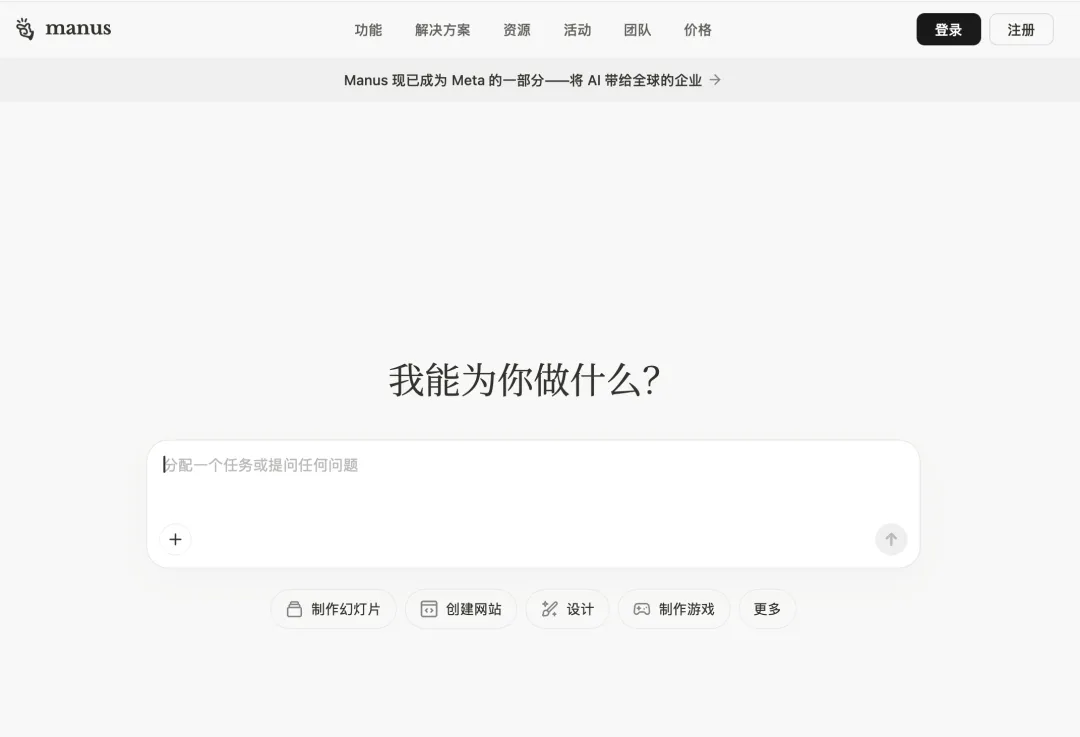
Manus said late on Aug. 11 that it will return to independent operations, changing the wording on its website from 「Manus is now part of Meta」 to 「Manus will soon resume independent operations.」 The shift came less than eight months after the company agreed to be acquired.

According to LatePost, founder Xiao Hong moved from Wuhan to Singapore with the team in July 2025. On Dec. 29 that year, he decided to sell Manus to Meta for more than $2 billion and took the role of Meta vice president.
The deal was described as the largest acquisition in the large-model application sector at the time. It took about 10 days from first contact to signing. It was also Meta’s third-largest acquisition, behind WhatsApp and ScaleAI.
Regulatory review changed the course of the acquisition
One week after the transaction was announced, a spokesperson for China’s Ministry of Commerce said at a regular press briefing that the government would work with relevant departments to assess and investigate whether the acquisition was consistent with laws and regulations related to export controls, technology import and export, and outbound investment.
On April 27, China’s National Development and Reform Commission issued a decision stating that it had prohibited the foreign investment acquisition of Manus and required the parties to revoke the deal. Meta later said in a statement sent to the media that the transaction fully complied with applicable laws and that it expected the review to be properly resolved.
LatePost noted that a deal unwind usually means reversing a completed transaction and restoring the parties as closely as possible to their pre-deal state. A few days later, the actual separation between Meta and Manus began. Media reports said the two sides stopped sharing data, and Manus staff could no longer access Meta’s internal systems.
The reversal drew outsized public attention. On social platforms, discussion came mostly from people following the drama rather than from Manus users. Phrases such as 「the champagne was opened too early」 and 「$2 billion disappeared overnight」 were repeated widely. Some also treated the episode as a turning point for the idea that Chinese founders could build companies at home and exit through U.S. capital.
During that period, venture firms that would once have pushed in from any opening to win a stake kept their distance. Xiao Hong, Ji Yichao and Zhang Tao stayed in daily video calls with the team in Singapore to share updates and assign work.
Product development continued and revenue kept rising
Manus continued to release one to two feature updates a week through the upheaval, matching the pace seen in late 2025 and running faster than a year earlier. The product did not move to a new major version and remained on 1.6, but the team kept filling out features, adding connectors for global products including GMail, Shopify and Slack, and launching a client app.
A Manus source said version 2.0 had already been completed and would be released after the transaction is fully over.
Revenue grew sharply during the three months of uncertainty. According to the report, Manus increased revenue by about five times, from $300,000 a day to nearly $1.5 million a day, at one point surpassing DeepSeek. During the investigation period, Manus also pushed annual recurring revenue above $300 million for the first time.
By June and July, investors that had stayed on the sidelines started to see an opening. One investor told the publication that if there was still a funding gap, they would be keen to participate. Some venture capital firms and entrepreneurs moved faster and prepared capital in hopes of joining the first financing round after Manus returns.
Team stayed intact as rumors spread
Rumors followed the company throughout the turmoil. In July, one report claimed that Tencent would take a controlling stake in Manus. The Beijing and Singapore teams stayed in close contact every day to steady morale and keep the organization together. Over those months, not a single employee left the roughly 150-person company, according to the report.
Life also changed for the people who remained in Beijing. Xiao Hong went back to studying mathematics and researching large models. Zhang Tao took up climbing and practiced solving Rubik’s cubes. Over half a year, he cut his weight from 150 jin to 120 jin, slept seven hours a day and even lowered his blood pressure.

From selling the company to starting over
Back in December 2025, Manus was in the middle of fundraising when Meta said it wanted to meet the core team to explore potential business cooperation. After several rounds of discussion, Meta unexpectedly stated its interest in an acquisition in a meeting attended by the full core team. For Xiao Hong and the group around him, several partners and key technical staff had followed him for years and had already gone through two startups together. Selling the company was seen as a way to deliver both recognition and returns to the people who had stayed with him.
After the acquisition closed, Xiao Hong walked along the Singapore waterfront on New Year’s Day in 2026 and felt that a winding 10-year journey had reached its endpoint. He thought the next step would be life inside a large corporation. But when he finally arrived at what looked like a neat ending, he felt a sense of loss instead.
Once it became clear that the acquisition would be unwound, what looked from the outside like a major reversal and setback gave this group of repeat founders a new reason to look ahead. Citing a person close to Manus, the report said Xiao Hong told the team on a call that he did not want to stand outside this era or merely look back on it later. He wanted to remain inside the wave and take part. Otherwise, he said, he would become someone writing memoirs about the past.
How Monica led to Manus
LatePost framed Manus as a classic technology startup story. Before ChatGPT, Xiao Hong had already seen the potential in GPT-3 and brought in Ji Yichao and Zhang Tao to build Monica, a browser shell for GPT.
A browser product did not make it easy for outsiders to picture the next breakout platform. The report said that a year before Manus launched, one founder met one of Xiao Hong’s partners and came away feeling that the person was not especially confident when talking about the already released Monica.
While building Monica, and as large models improved, the team found a more forward-looking product form through repeated trial and error: agents that could work like humans with full automation. In 2024, Cursor, Copilot and even ChatGPT still largely assumed a user would sit in front of the screen and keep prompting the AI. In that period, inference costs were an order of magnitude higher than they are now, but Manus was already doing Wide Research, a token-intensive process built on the bet that token costs would fall sharply. It was also one of the earlier AI application companies to build its own Evaluation team and create a closed-loop development cycle.
Those calls and investments helped Manus stay ahead and keep growing for a long stretch. Not long after Manus launched in 2025, one large technology company internally approved at least seven similar projects, but none of them took away Manus users.
Independent again, but facing a harder competitive field
Xiao Hong has used the phrase 「trade, product, technology」 to describe his view of the startup path: first find the market, then build the product and the business, and only after that go deeper into technology. By that measure, Manus has already completed the first two steps. It has built a product wanted by a large user base and turned it into a real business.
Its competitive pressure has not eased. The report said the company now faces rivals that control more of the core technology stack. Over the past six months, Claude and Codex have been competing aggressively, improving from model to application in the ability to let agents control computers and complete tasks. Manus’s desktop app and its Plan Mode, which plans first and executes later, were described as efforts to catch up with those Silicon Valley pioneers. More recently, a group of large Chinese companies have also started to treat computer-based work as the next battleground.
After the transaction is fully resolved, Manus will face another choice: keep trying to stay ahead through product insight, or invest in deeper technology such as model training and take on the harshest part of competition in large-model applications.
Website wording changed, but buyback details remain undisclosed
As of the evening of Aug. 11, the Meta acquisition had entered a substantive unwind stage and Manus was preparing to stand alone again. The final amount to be paid in any buyback, and whether the company will return to a China-based capital structure, have not been formally disclosed.
That night, Xiao Hong wrote to employees and investors: 「This is my third trip.」 Internally, the new Manus is being viewed as a startup setting out again, with a team of more than 150 people, a partner group that stayed together through months of disruption, and a product with annual recurring revenue above $300 million. Its story, the report said, is not over.