
By Alea Research
Compiled by DeepTechFlow
Maple Finance raised the management fee on syrupUSDC during the third quarter of 2026, pushing September protocol revenue to $1.57 million and moving SYRUP buybacks into the mid-tier range set by MIP-021. Total deposits fell after redemptions by two Sky allocators and the departure of leveraged capital from Plasma. syrupUSDG, Maple’s product aimed at fintech applications, continued to grow quickly.
This report draws on on-chain lending data and protocol financial disclosures. It examines how the fee adjustment changed revenue generated per dollar of deposits, tracks three new growth channels and redemption-queue volatility, and compares SYRUP’s valuation with those of similar protocols.
Fee changes drive third-quarter revenue
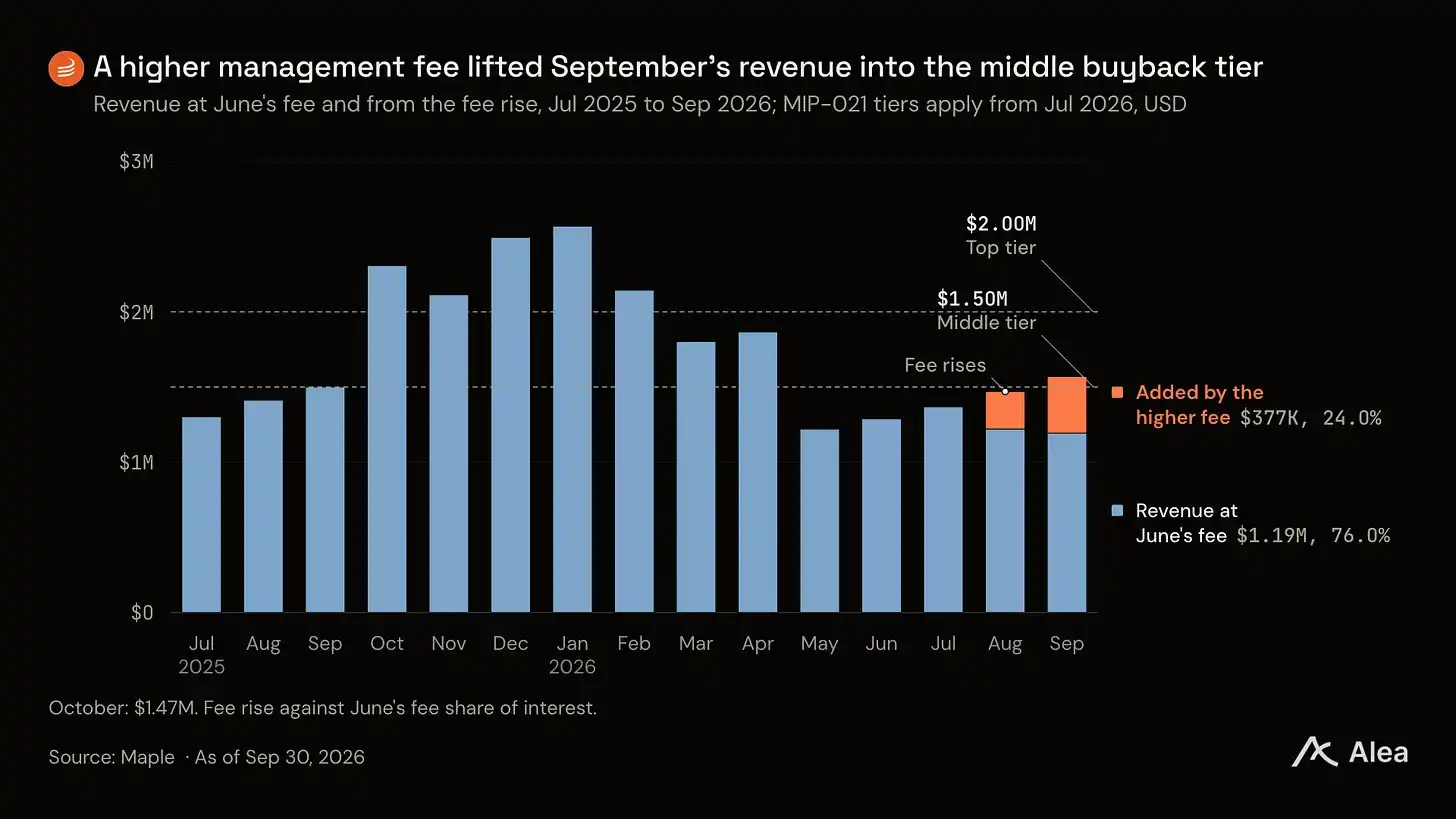
Maple positions itself as a credit and yield layer for stablecoins. During the third quarter, syrupUSDG extended the protocol’s credit engine into fintech applications. A higher average loan balance lifted July revenue. The revised management fee drove the increase in August and September.
September revenue reached $1.57 million, moving SYRUP buybacks into the middle band under MIP-021. Two Sky allocators withdrew about $422 million during the quarter.
At the June fee rate, September revenue would have been about $1.19 million, below the $1.5 million threshold for the mid-tier buyback band. Borrower loan fees represented 82% of Maple’s third-quarter revenue, up from 33% in the first quarter of 2026.
October revenue slipped to $1.47 million, just $35,000 below the mid-tier threshold. The buyback rate therefore fell to 10%, equal to about $147,000 for the month.
Quarterly revenue and buyback figures
- After the management fee increase in August, monthly revenue rose throughout the third quarter and reached $1.57 million in September.
- Third-quarter revenue totaled $4.41 million, compared with $4.38 million in the second quarter.
- syrupUSDG attracted $176 million in deposits during its first quarter and added another $142 million in October.
- Under MIP-021, buybacks represented 13.6% of third-quarter revenue, compared with 3.4% in the first half of 2026 and 25% in the third quarter of 2025.
- Maple bought back 2.9 million SYRUP for the Syrup Strategic Fund during the quarter.
As of Sept. 30, Maple was the fourth-largest on-chain lending protocol, with $1.67 billion in outstanding loans. Its loan balance had grown 2.7% since Dec. 31, 2025, while the top 10 protocols had declined 15% over the same period. During the third quarter, however, the top 10 protocols grew 32% and Maple contracted.
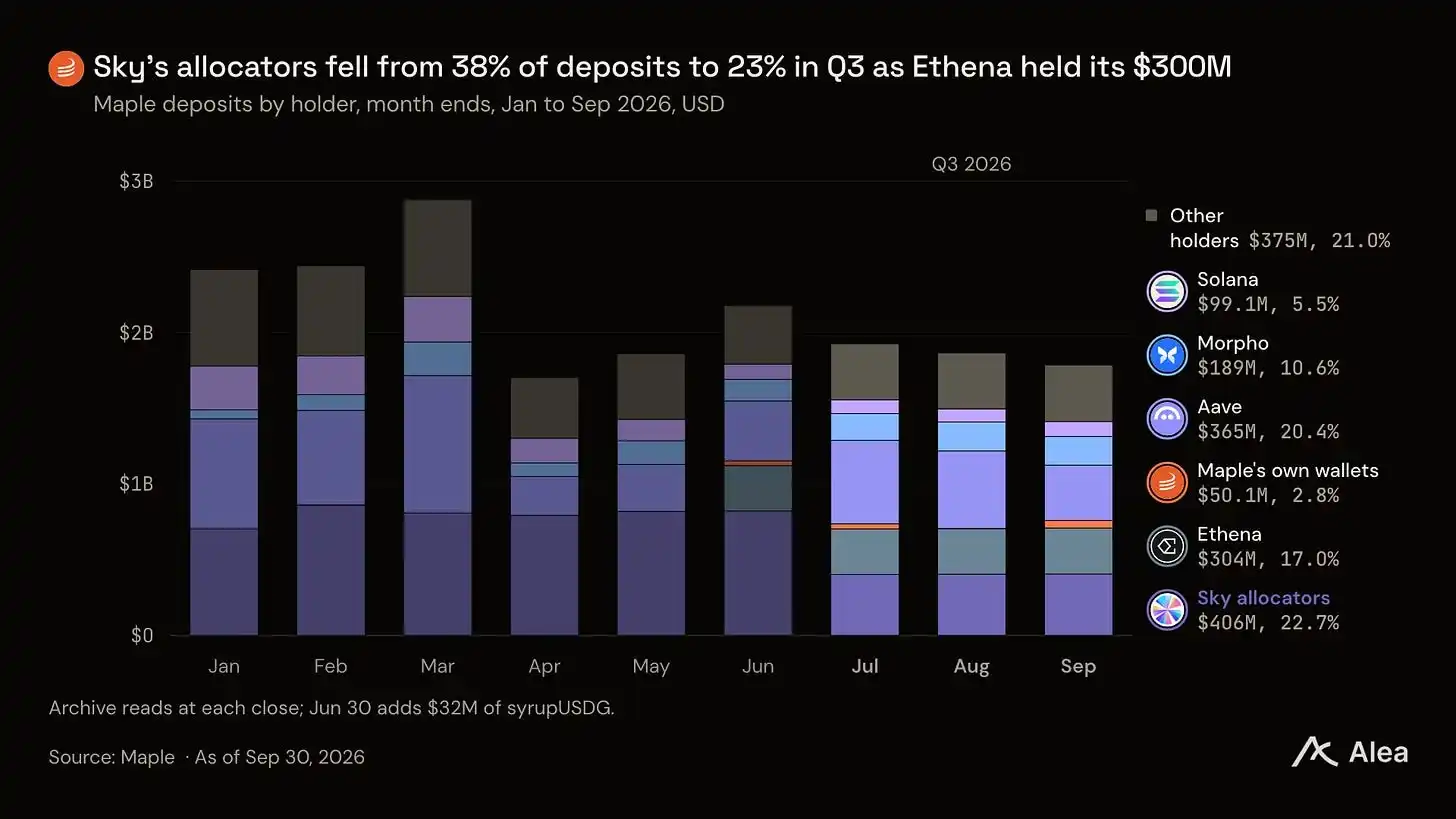
Total deposits declined 17% as two Sky allocators redeemed funds and leveraged syrupUSDT capital left Plasma. Excluding Sky, Ethena and Maple’s own wallets, other holders collectively had $1.03 billion as of Sept. 30, unchanged from June 30.
Three growth channels emerge as Sky funds leave
Maple lends stablecoins to institutions against crypto collateral, mainly BTC. Like Aave, it requires collateral to exceed the borrowed amount. Maple also conducts its own underwriting assessment for each borrower.
From August, as loans moved into their next interest period, the syrupUSDC management fee rose from about 8 cents per dollar of interest to 15 cents. Depositors bear the difference.
Three channels grew during the quarter. syrupUSDG reached $176 million after launching on July 1. A large portion entered the Morpho market supporting Robinhood Earn, where it was used as collateral.
At the same time, Aave’s Monad market absorbed $140 million of syrupUSDC, while the Aave market on Ethereum added $106 million of syrupUSDT.
Maple Institutional held $350 million in deposits as of Sept. 30. Ethena’s wallet accounted for $304 million. In late October, Ethena withdrew $56 million and on Nov. 10 requested redemption of the remaining roughly $250 million.
Maple connected to Zodia Custody’s Interchange on Sept. 14 and launched syrupUSDC on Circle’s Arc on Sept. 16.
Sky allocator holdings fell from $822 million on June 30 to $406 million on Sept. 30. As leveraged positions left Plasma, syrupUSDT on other chains fell by $330 million. One wallet bridged about $102 million to Aave on Ethereum.
Between July 15 and July 24, the syrupUSDC pool settled every Sky redemption request with USDC within three hours. During that period, total loans fell by $220 million and internal allocations declined by $139 million. Maple’s loans across all platforms reached $1.75 billion on Aug. 31.
Redemption queues become volatile
syrupUSDC withdrawals slowed from Oct. 30. Requests submitted on Oct. 31 had a median wait of 44 hours, compared with about three minutes between July 1 and Oct. 27.
The queue then paused settlements for 25 hours before Nov. 7 and paused again for 48 hours before Nov. 9. From Nov. 10, redemption requests returned to settlement within minutes.
Fee income outpaces the effect of lending growth
Monthly revenue equals the average deposit balance multiplied by revenue generated per dollar of deposits. Between June and September, deposits declined, while revenue per dollar supported all of the growth.
On March 21, loans represented 27% of deposits: $807 million out of $2.98 billion. The remaining funds were held in internal allocations, cash, Aave strategies and Sky strategies.
Deposits fell by $1.41 billion between April 16 and April 25. Internal allocation funds handled most of the redemptions. From May, Maple directed more retained capital into lending.
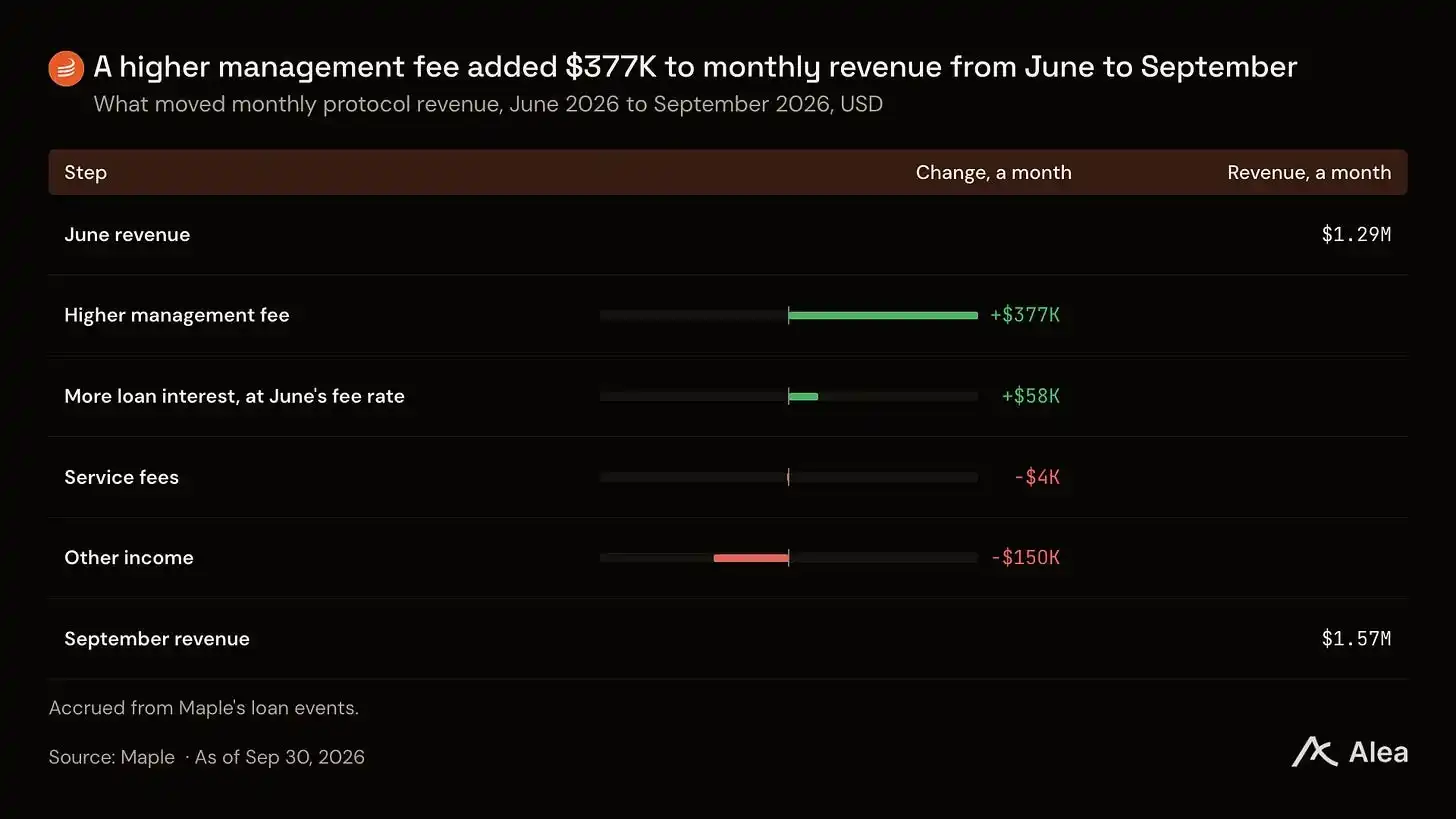
The August fee increase had the stronger effect. If the June rate had remained in place, September revenue per dollar of deposits would have been below the June level. Loans represented 93% of average deposits in September. After the fee change, annualized revenue per dollar of deposits rose to 1.04%, the highest level since February, before easing to 0.92% in October.
Since Maple issued its first open-term loan in June 2023, neither its syrup pools nor its secured institutional pools have recorded a loan impairment or collateral seizure.
Maple’s proof of reserves dated Oct. 30 showed collateral coverage between 1.4 times and 1.7 times syrup loans. No assets were held on Binance.
SYRUP’s implied revenue trails Maple’s actual run rate
SYRUP rose 65% in the third quarter, close to ETH’s 71% gain, then gave back 29% in October. Based on the Sept. 30 closing price, its price-to-sales multiple against annualized third-quarter revenue was 15.1 times. The median for Aave, Sky and Spark was 8.5 times.
By Oct. 31, the multiple against third-quarter revenue had fallen to 10.7 times. SYRUP dropped another 17% by the Nov. 11 close, compressing the multiple to 8.8 times.
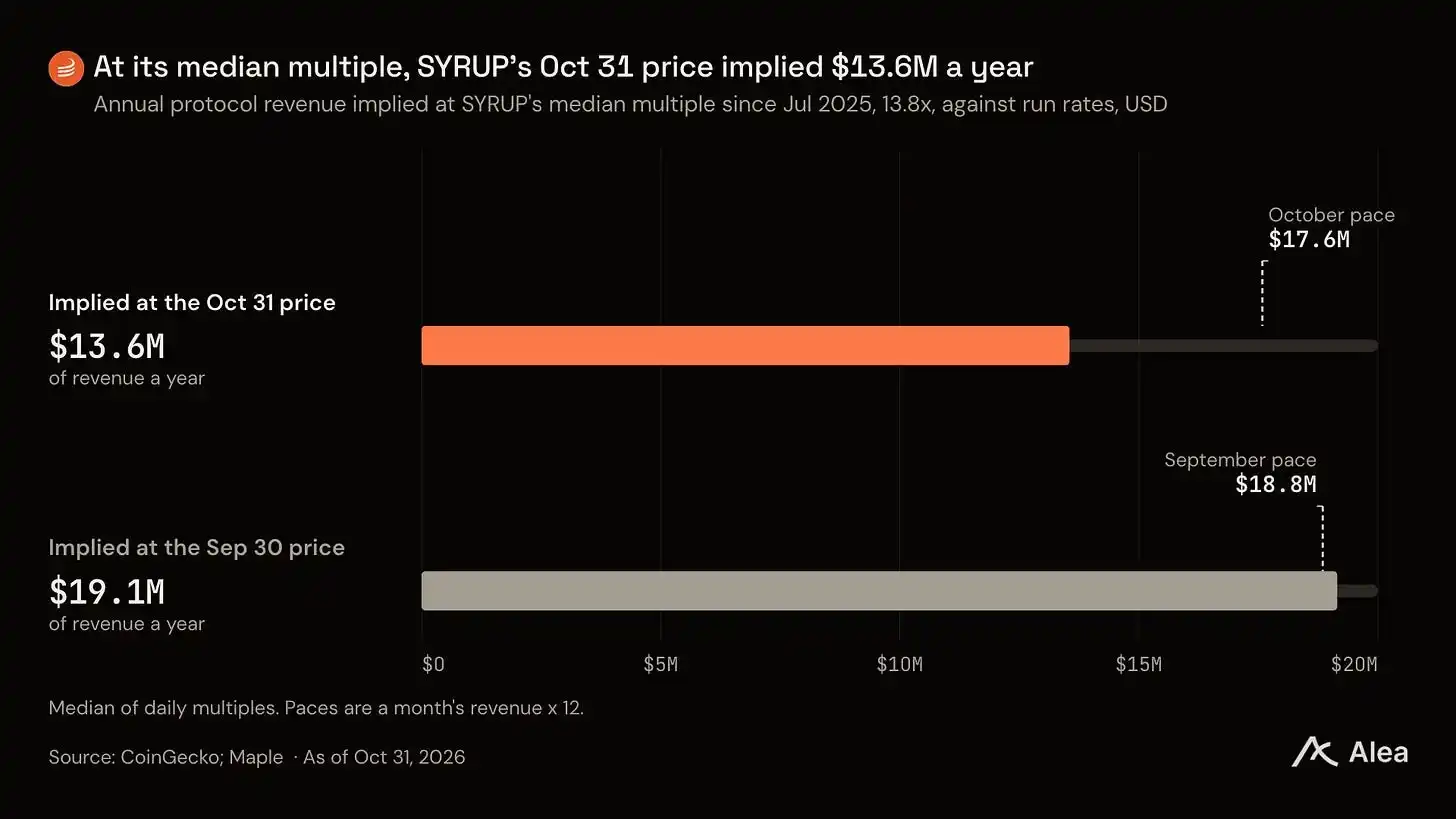
Using Maple’s own median multiple of 13.8 times since July 2025, SYRUP’s price on Oct. 31 implied annual revenue of $13.6 million.
Annualizing third-quarter revenue by multiplying it by four gives Maple an actual annualized run rate of $17.6 million. October’s revenue pace was comparable, while September’s annualized revenue reached $18.8 million.
Total deposits rose by $80 million in October to $1.87 billion on Oct. 31. The main support came from a $142 million monthly net inflow into syrupUSDG. Deposits eased to $1.81 billion on Nov. 7.
Most of the new capital entered Morpho’s Arbitrum market as collateral. Borrowers in that market had taken out about $115 million in USDG as of Oct. 31.
At September’s revenue-per-dollar level, Maple would need $2.31 billion in deposits to trigger the highest buyback tier, or another $438 million. At October’s level, the required deposit base would be $2.6 billion, leaving a gap of $735 million.
Asset-allocation contract launches as leadership changes
Maple launched an asset-allocation strategy contract in November. The protocol had planned to activate it first for syrupUSDT, but the initial $5,000 allocation came from syrupUSDC on Nov. 10. The cap was $10,000.
On Nov. 11, co-founder Joe Flanagan stepped down as chairman and left Maple. November revenue will determine whether buybacks return to the mid-tier range under the first version of MIP-021, which covers revenue through December. Net deposit growth and revenue per dollar of deposits will determine how quickly Maple can reach the highest buyback tier.
Maple’s Q3 2026 Benchmark report breaks down the data by pool and includes the distribution of SYRUP holders, comparisons with similar protocols and 63 charts. Its investor-relations presentation sets out the same arguments in slide form.
Source: MarsBit. The report is based on work by Alea Research and was compiled by DeepTechFlow.



