
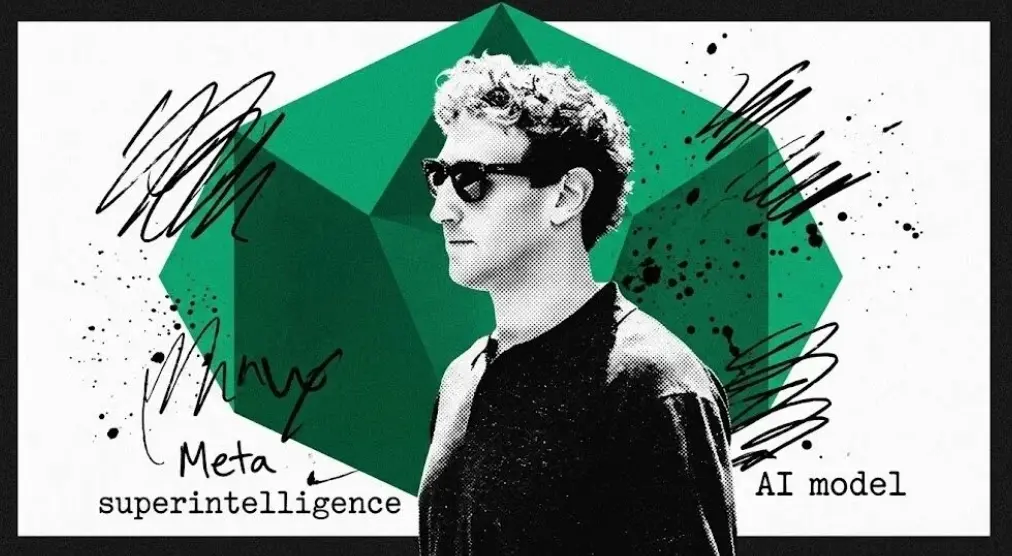
Mark Zuckerberg published a long essay on Aug. 10 titled “The Future Belongs to Everyone: A Path Toward a Positive AI Future,” using it to define Meta’s AI direction in unusually explicit terms. The headline theme is superintelligence, safety, open models, and infrastructure. The deeper thread is narrower and more strategic: Meta wants to build what Zuckerberg calls “personal superintelligence.”
His premise is straightforward. Superintelligence, in his view, should not end up in the hands of a small number of companies, governments, or research labs. It should be distributed much more broadly, with ordinary people able to access and use it directly.
That shifts the center of the debate. Over the past two years, much of the AI industry’s discussion around superintelligence has focused on how capable models can become and how to prevent systems far more capable than humans from going out of control. Zuckerberg argues that even if superintelligence is safe in the technical sense, a different problem remains if the capability is held by only a few institutions: power itself becomes imbalanced.
From there, he lays out three principles that he says should guide AI development. Personal empowerment should be treated as a source of prosperity. Innovation should be treated as the main purpose of superintelligence. Safety should be secured through checks and balances on power.
Inside that framework, Zuckerberg describes a future in which every person has a long-term superintelligent system around them. It would understand how they work, their health status, family arrangements, and long-range goals. It could research, write code, design products, plan tasks, and help one person accomplish work that once required an entire company.
That is why the essay places a wide range of subjects side by side: open-source or open-weight models, AI and jobs, safety governance, data-center construction, and even US energy and infrastructure capacity. Zuckerberg is treating them as parts of the same question. If personal superintelligence becomes the next computing platform, who controls it, who can pay for the compute behind it, and who decides what it is allowed to do?
The answer carries the imprint of Meta’s past two decades. Facebook distributed content creation and distribution to users. Instagram and WhatsApp expanded those networks of connection. In the AI era, Meta is trying to repeat a similar transfer of capability, turning forms of intelligence once reserved for large organizations into tools available to ordinary people.
Even on AI safety, Zuckerberg takes an angle that differs from a good deal of mainstream Silicon Valley discussion. One of the main risks worth worrying about, he argues, is overconcentration of superintelligent capability. Under that logic, open models are no longer just a technical path that Meta uses to compete with OpenAI and Anthropic. They become part of a broader theory of how a superintelligent society should function.
There is also a more immediate commercial layer to the argument. Meta is looking for a new entry point for its business. If AI moves from a chat box toward a persistent personal agent that stays with the user over time, the critical interface may no longer be a web page or only a mobile app. It may be an AI system that continuously understands the user and can act at any moment. Meta’s social graph, content systems, messaging products, and smart glasses all gain new strategic value when arranged around that possibility.
From controlling superintelligence to distributing it
Zuckerberg frames one foundational question in the essay: who will own superintelligence in the future? If that capability is concentrated inside a small number of companies, governments, or labs, will society produce a new imbalance of power?
One major line of AI safety work in recent years has centered on the alignment problem — how to make sure future superintelligent systems remain consistent with human values. Many researchers worry that if AI reaches a level far beyond human capability while pursuing goals that diverge from human interests, the result could be difficult or impossible to control.
Zuckerberg argues that trying to build one centralized superintelligence that is “perfectly aligned” with everyone’s interests runs into a deeper logical problem. Human society does not have one unified value system. Different individuals, cultures, and groups hold different views about what a better life looks like. A superintelligence designed and controlled by a small number of institutions will inevitably reflect some value choices over others, and it cannot genuinely represent everyone.
His alternative is not to create a centralized and supposedly correct superintelligence, but to allow many more people to have their own. In that world, new balances of power would come from competition and interaction among individuals, companies, and institutions.
He illustrates the point with the idea of a “superintelligent lawyer.” If only one person had access to such a system, that person would gain a huge asymmetric advantage inside the legal system. If everyone had similar access, legal resources would be distributed more fairly and the information gap between ordinary people and large institutions would narrow.
Zuckerberg applies the same reasoning to cybersecurity. If only one organization had superintelligent cyber capabilities, it could itself become the largest security risk. If defenders also had powerful AI tools, the overall security level of digital systems could improve rather than deteriorate.
In his framing, AI safety cannot rest only on suppressing capability. It also requires preventing a concentration of superintelligent power that no one can check.
The product form Meta thinks matters most
Based on that logic, Meta is pushing what Zuckerberg calls the “personal superintelligence” path. He argues that the most important product form in AI will evolve from a chatbot that answers questions into a personal agent that understands a user over time and helps them achieve goals.
That agent, as he describes it, would become an intelligent assistant embedded in daily life. It would understand preferences, long-term needs, and objectives, then keep helping with health, work, family management, financial planning, learning, and personal growth.
This is also where the distinction from today’s mainstream AI tools becomes clearer. The core value of future personal agents, in Zuckerberg’s view, will not stop at providing information. It will extend into taking action on behalf of the user. The system could organize information, propose ideas, plan tasks, make recommendations based on health data, and assist with family scheduling.
Privacy sits near the center of that product vision. Zuckerberg says that if personal superintelligence is going to become part of real life, users will have to authorize access to a large amount of private information. Meta’s answer, according to the essay, is a “fully private mode” in which even Meta would not be able to view user information or authorize access to others.
That, in turn, is part of a broader attempt to redefine the relationship between people and AI. The model is supposed to shift from AI as a tool owned by a company to AI as a capability owned by an individual.
Zuckerberg also takes a distinct line on jobs and automation. He argues that the biggest contribution of superintelligence is not simply replacing human labor. It is helping people create things that were previously out of reach.
He places AI inside a familiar historical pattern. Every major technological revolution, from the Industrial Revolution to the internet era, triggered fears about job loss. In his telling, those shifts raised productivity but also created new industries and new professions. He expects AI to follow a similar path.
Under that view, the more important change is not that machines absorb more repetitive tasks. It is that individuals gain capabilities that once belonged only to large firms and specialist organizations. A single person using AI might be able to handle product design, software development, market research, and even parts of company building without first assembling a large team.
That changes how organizations may be structured. Companies could become smaller while individual productivity rises. Ideas that once failed because they were too expensive or too technically difficult may become feasible once AI tools are widely available. Zuckerberg’s conclusion is that superintelligence should serve as innovation infrastructure, not just an automation machine.
Open models as ecosystem strategy
Open models are another major theme in the essay. Meta has long backed an open-model route, which sets it apart from competitors that emphasize closed-weight systems. Zuckerberg argues that openness can support innovation and improve safety at the same time.
The reasoning is practical. If more researchers, developers, and companies can access a model, more people can identify weaknesses, improve systems, and accelerate iteration. If superintelligence remains inside a handful of institutions, society lacks enough counterweights.
Zuckerberg extends that case into geopolitical competition. He says the US currently holds advantages in areas such as chip design, but faces challenges in energy, data-center capacity, and the speed of infrastructure buildout. AI competition, in this framing, is not only an algorithm race. It is also a race in energy and compute.
He says the US needs to speed up infrastructure construction while preserving the advantages of an open ecosystem. On training-data use and model distillation, Zuckerberg argues that the US should avoid weakening its own competitiveness through excessive restrictions. His position is that AI development is fundamentally built on accumulated human knowledge, and that models learning from one another is part of technological progress. If the US over-restricts its own open ecosystem, it could leave opportunities to other countries.
On safety, he does not deny that AI can produce serious risks. The essay highlights cybersecurity, biological risk, and the expansion of government power. But the through line stays the same: society should strengthen defensive capacity rather than rely only on blunt limits on technical capability.
In cybersecurity, for example, risk rises if attackers alone have advanced AI tools. If companies, governments, and individuals can also use AI to improve defense, the security level of the system can rise as well.
For biological and chemical risk, Zuckerberg argues that policy should focus on limiting the production and spread of dangerous materials rather than trying to halt the development of scientific knowledge. As AI accelerates drug discovery and life-science research, he says regulatory systems will also need upgrading, or older approval processes could become bottlenecks for innovation.
The infrastructure question and the “community ledger”
Zuckerberg’s essay also makes clear that AI competition has entered an infrastructure-heavy phase. Large data centers, energy supply, and compute resources are becoming the foundation for superintelligence. At the same time, US debate around large data-center construction has intensified, especially over energy use, water stress, and environmental impact.
His response is that AI infrastructure should share benefits with local communities. Meta is presenting what he calls a “community compact,” under which areas hosting data centers would receive more jobs, education investment, and support for public services.
In his framing, data centers should not be seen purely as resource-consuming facilities. They should be viewed more like earlier generations of rail, electricity, and internet infrastructure: long-term assets that can drive regional economic development.
That point also functions as a direct answer to criticism of Meta’s large-scale AI spending. The next phase of AI competition requires enormous capital outlays. Whether those investments are accepted socially will become a major issue for technology companies, not just a financial one.
Zuckerberg also addresses governance. He says the development of superintelligence should not depend on the judgment of a single leader. He acknowledges that having a CEO serve as the final decision-maker on superintelligence deployment is not the ideal arrangement. Meta, he says, is establishing a new governance mechanism in which an independent board participates in setting safety standards for model releases and reviews major model launches.
That is, in effect, a response to long-running concerns about concentrated AI power inside large technology companies.
The essay also touches on an extreme-risk scenario in which AI systems develop the ability to improve themselves. If systems can continuously raise their own capabilities, compute resources could become decisive. A system with persistent self-optimization, at least in theory, might rapidly widen the gap between itself and other systems.
Even in that case, Zuckerberg argues, most intelligence capacity should remain under human direction and be used to serve human goals, even if some compute eventually has to be allocated to recursive self-improvement.
Meta’s larger target: the next computing platform
Placed in the context of Meta’s moves over the past year, the essay reads as more than an AI safety document. It is also a statement about Meta’s future. Personal superintelligence, open models, smart glasses, and large-scale compute spending had looked like separate bets. Zuckerberg is now fitting them into a single strategic narrative: the next stage of AI competition will move beyond who has the strongest model and toward who controls the most persistent, highest-frequency interface between people and AI.
That is a contest Meta understands well. For two decades, from Facebook to Instagram and WhatsApp, its core asset has been access to the connection layer between people. During the mobile internet era, that access still sat on top of operating systems controlled by Apple and Google. AI gives Zuckerberg another chance to redefine the computing platform itself.
If every person eventually has an agent that continuously understands them, can invoke services, and can act on their behalf, that agent may become a new operating system in practice. In that context, smart glasses are no longer just another hardware category. They could become the device through which personal AI gathers information from the physical world and maintains ongoing interaction with the user. Open models, in the same way, are not merely a developer-community tactic. They help Meta extend the reach of its technical stack as widely as possible.
The strategy still carries a visible tension. Zuckerberg is using the phrase that superintelligence should belong to everyone to answer concerns about concentration of power. Yet the boundaries of personal AI capability will still be set by models, compute, devices, distribution, and perhaps most importantly, personal data. Superintelligence may be distributed to individuals, but the infrastructure beneath it naturally favors large-scale operators.
Put differently, the more personalized AI becomes, the more concentrated the underlying platform may become.
That leaves the key test for Meta’s approach. The central question is not only whether the company can build a strong enough model. It is whether Meta can, for the first time, build a computing entry point that it controls rather than one mediated by Apple or Google. And if an AI system comes to know a user better than any single app does, the harder question follows right behind it: who actually owns that AI, and who owns the data and relationships created around it?